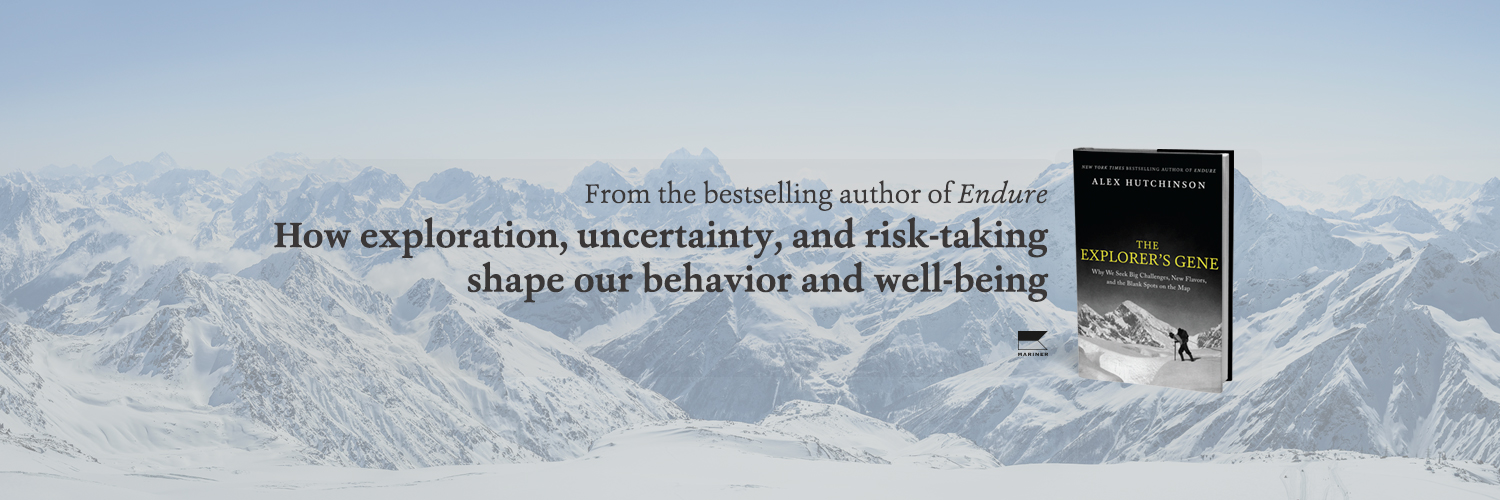
The Explorer's Gene is out TODAY! Try before you buy:
-excerpt in @TheAtlantic: https://t.co/7VFTt4pnUi
-excerpt in @outsidemagazine: https://t.co/k6vGMvN8ZK
-newsletter interview with @DavidEpstein: https://t.co/65GQQt0e35
-podcast with @richroll: https://t.co/7o0g3NSrF0
Baking soda to counter the effects of altitude? A new study finds a 1.2% gain for 40K cycling at 1,800m. But that's actually no better than the same group found at sea level - so more evidence that it works, but nothing special about altitude.
https://t.co/ejLD7MDBzb
I have just finished "The explorer's gene" by @sweatscience and I loved it. I see some answers to my questions and I love the 5 rules that close the book:
1. Explore then exploit
2. Seek the uncertainty sweet spot
3. Play more
4. Minimize regret
5. Embrace the struggle
@HermanPontzer@cremieuxrecueil I meant a regression of Fig 3A (with resistance excluded). I'm not trying to argue that there's no compensation, just that the number in the abstract (represented by the blue line below) is inconsistent with the data it claims to represent.
@cremieuxrecueil FWIW, my take is that the high-leverage point exposes an inappropriate method of analysis (a weighted average of a bad secondary variable). Take it out and the number jumps from 31% to 55%, which is closer... but we should just be looking at the slope of the regression line.
Our 2nd monthly issue, "Biology's New Era," is live now on https://t.co/kgPGFGgPR5.
In this issue, we explore the bleeding edge of biotech, as well as the scientists, writers, and philosophers whose efforts helped get us here.
Some of what's inside:
⬤ Scientist-turned-writer Alex Hutchinson @sweatscience uses the legend of Secretariat to probe the limits of human athletic performance.
⬤ Futurist Peter Leyden examines how synthetic biology could help save Earth.
⬤ Astrophysicist Ethan Siegel @startswithabang challenges the leading theory of how life began.
All that and much, much more. We hope you enjoy.
“But it’s enough, for now, to know that when the moment of truth comes, science has confirmed what athletes have always intuited.
There’s more in there, if you’re willing to believe it.”
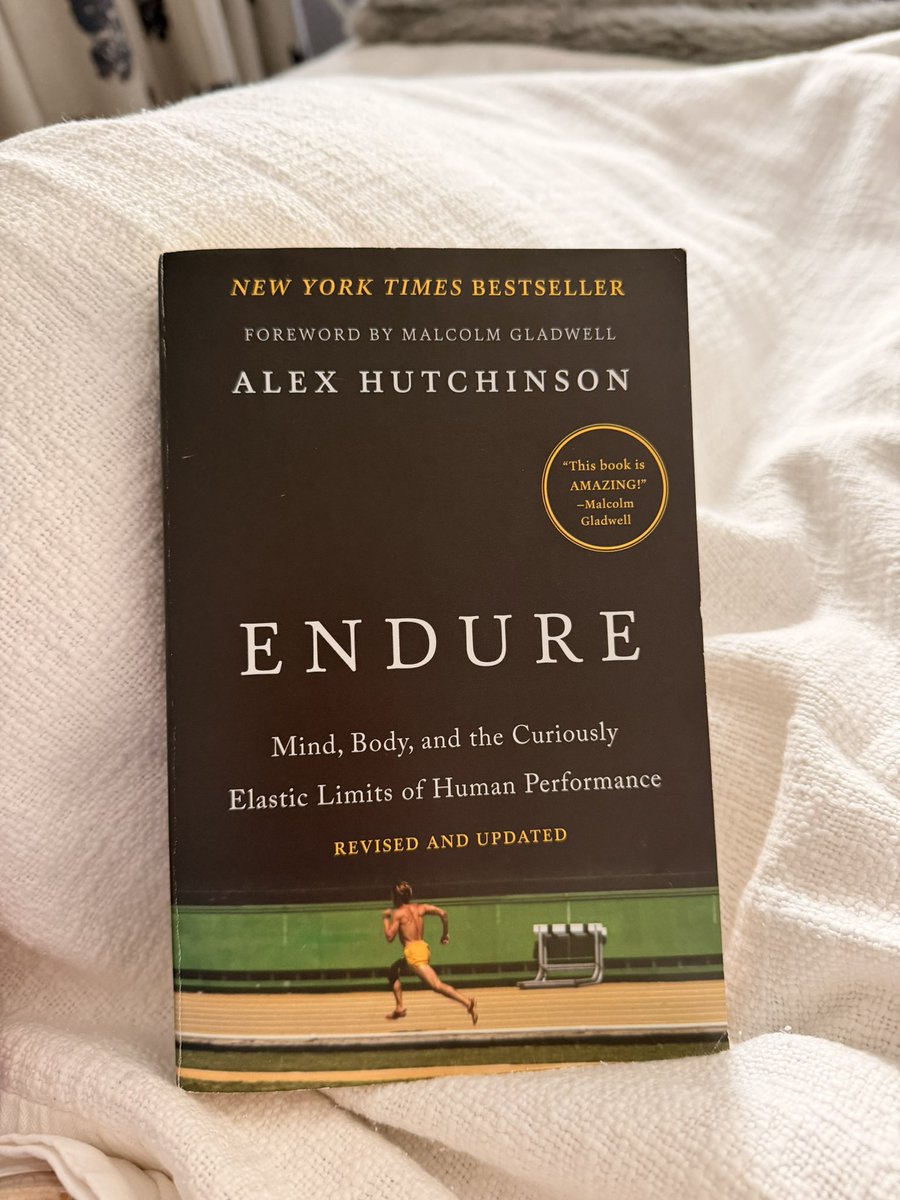
First book of the year down.
Highly recommend the work from @sweatscience!
A new study on an old question: does exercise actually burn (net) calories?
Or do our bodies respond to exercise by cutting back on, e.g., immune function and cell repair, with potentially negative consequences at high levels?
The evidence is... mixed.
https://t.co/8TxAxTq85i
“But it’s enough, for now, to know that when the moment of truth comes, science has confirmed what athletes have always intuited.
There’s more in there, if you’re willing to believe it.”
First book of the year down.
Highly recommend the work from @sweatscience!
@dhammonia That's weird - I only skimmed the paper, but didn't see that message. I'll have to take another look. And no apologies needed, interesting to see that paper!
@dhammonia [...] (NCP is "non carbon plate" and CP is "carbon plate." The two bars are unfatigued and fatigued.)
The main point seems to be that the shoes shift load from the foot to the ankle, knee and hip. You could argue this isn't worse, just different: the body needs to adapt.
@dhammonia That said, they try: "The reduction in knee flexion moment is clinically relevant, reflecting a quadriceps-avoidance gait that redistributes loads and increases patellofemoral joint stress..."
Here (below) is the key graph. I can't say it fills me with fear. [2/...]
Kristian Blummenfelt's apparent VO2max record of 101 (and why scientists are skeptical of his respiratory exchange ratio), bone health for cyclists, freediving physiology, and the trouble with a recent exercise/longevity study. My latest Substack:
https://t.co/K34H5q3UKL
@benjtannen @BMJMedicine The data is straight from their supplementary data (first supplementary file, Table 5), which gives adjusted and unadjusted (except for age) all-cause mortality. Link to supp data is here: https://t.co/L4Q4WA79e1
There's been a ton of discussion about the recent @BMJMedicine paper on exercise variety and longevity. I have some thoughts, including on why statistically adjusting for BMI, blood pressure, cholesterol, etc. creates the illusion of a plateau:
https://t.co/SjPsUDE17P











![sweatscience's tweet photo. @dhammonia That said, they try: "The reduction in knee flexion moment is clinically relevant, reflecting a quadriceps-avoidance gait that redistributes loads and increases patellofemoral joint stress..."
Here (below) is the key graph. I can't say it fills me with fear. [2/...] https://t.co/pe17OCKnlE](https://pbs.twimg.com/media/HAZ1txlWIAAxOgi.png)