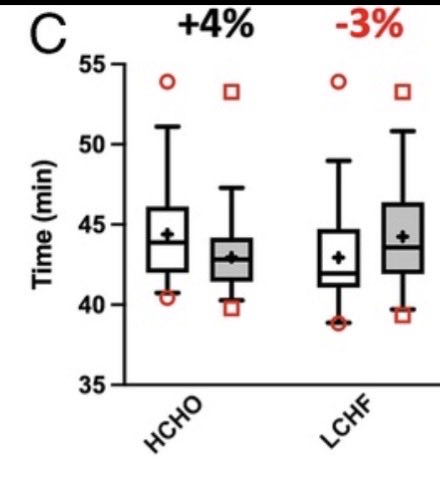
LCHF diet decreases GLUT4 protein expression and inhibits PDH activity -
this means you get less glucose into muscle, and create a bottle neck for using it. Decreased glycolytic flux in sport is like putting a limiter on your engine.
The CHO debate does not die in journals. It dies every day in real competition.
One thing that is often forgotten is that sports science frequently validates what practitioners have already been doing successfully in the field for years. The laboratory is essential, but it is not always where innovation begins.
~20 years ago, when I was recommending and using 80-100 g/h of carbohydrate with elite athletes, many in the Carb camp, considered it crazy, unrealistic and impossible... Yet it worked remarkably well in practice. The athletes did not care about the debate. They cared about performance.
~10years ago, I began using protocols approaching 125 g/h. This time I kept quiet. I knew it provided a significant competitive advantage and I had no interest in debating it publicly. In 2021, UAE and Tadej Pogačar helped demonstrate to the world what many of us had already seen firsthand: higher carbohydrate intakes could transform performance when implemented correctly.
Now, after more than a decade of practical application, these strategies are being presented as a major scientific breakthrough because they have finally appeared in the literature.
This is not an argument against science. Quite the opposite. Science is a process. It evolves. Even within the carbohydrate camp, recommendations have changed dramatically over the last two decades because the original understanding was incomplete.
The lesson is simple: evidence comes from both the laboratory and the battlefield. The best advances in sport happen when science and practice inform each other, not when one dismisses the other.
Sometimes the peloton is already living in the future while the journals are still trying to describe the past.
The whole "most elite athletes are on drugs anyway" narrative is such a lazy take on human performance.
And it's mostly being spewed by people who have never worked with truly elite athletes or been an elite athlete.
The cognitive dissonance is real.
What can elite ultrarunners, rowers, and race walkers reveal about the limits of human performance?
At #ACSM2026, Wu Tsai Human Performance Alliance members share what years of research with world-class athletes has uncovered.
https://t.co/G6BLlR7yCS
For years, my colleague, Prof. Martin Gibala, and I have appeared on literally hundreds of podcasts. Today, we dropped our own podcast! As lifetime faculty members of the McMaster Department of Kinesiology, we thought it was time for our take on reality in the world of exercise, nutrition, health, and more.
The Podcast is Real Exercise Science, and you can pick it up on all your favourite platforms.
The goal? Real science, not hype. Not fluff, not the latest paper, but evidence, with scientific humility. But reality means disappointment sometimes. That stuff you heard about protein, lifting, Zone 2, peptides, GLP-1... It's often more than the data shows, extrapolation, overstatement, or downright wrong.
Hard facts, no hype!
Episode 1 dropped today https://t.co/ekPprWMkYn and featured a chat about the updated American College of Sports Medicine position stand in honour of day 1 of the ACSM annual meeting in Salt Lake City!
I'm in Salt Lake City with Marty, and you can hear an amazing update on the position stand https://t.co/uG9pWYdQf9
Wednesday, May 27, 3:15-4:45 MDT - see you there.
How bad were the enhanced games at enhancing?
They somehow took near world-class sprinters, doped them, and made them slower...
Not just from their PRs, but from last season...and in most cases, slower than a good HS runner...
Here's the details:
This will be my only post on the #EnhancedGames.
The Enhanced Games are an abomination. I will not watch them, cover them, or even do any social media posts about them. They fly in the face of everything I have worked for in sports.
The results are meaningless.
These aren’t the highest rates of fat oxidation ever measured in a human - elite racewalkers who adapted to a keto diet for 6 days or 3.5 weeks showed higher rates - some at 2 g/min. But they raced at a slower speed when asked to perform in a real life race. You can’t outrun the stoichiometry of fuel production. Carbs produce more ATP per litre of oxygen than fat.
I was part of this study (low carb arm). It was interesting. We did learn the potency at which you can alter your fat ox rates through dietary intervention. The study at times gets used as a carb fueling defeater. It didn't show that. A higher fat ox doesn't automatically translate to better performance. It could given the right constraints, but those constraints aren't present in events like professional marathon running or competitive cycling stage races. The more interesting area of application for this information would be very long races performed below aerobic threshold out of necessity due to duration, events that require self support or sub optimal access to refueling, and the like.
1/6 The last paper from my PhD is out, looking at what endurance athletes eat! 🧵
We tracked training & dietary intake of 46 endurance athletes over 12 weeks (~4,000 days of diet tracking) to see how athletes actually practice carbohydrate periodization in real-world training.
The GOAT of Sports Nutrition @LouiseMaryBurke is back to share all her favourite things - cutting edge research, applied sport science, chocolate, and occasionally the St Kilda Saints.
Give her new account a follow
Maurten has issued a release outlining the 12 months of testing done with Sawe to run sub 2. This included stable isotope analysis for exogenous CHO oxidation, and doubly water to assess energy expenditure.
The resultant 115 g/h strategy wasn't guess work - it was precision.
What it takes to fuel a sub2h marathon record?
115 CHO g/h!!! Wow!!
This is insane. Congratulations to all Maurten team (specially Tobias & Olof)!
Great job, this is real history made!
@ProfTimNoakes@FlashGordy all the modern products are ~15 to 20% (or more) CHO solutions.....Sawe even took bottle at the 40km table (slightly off tangent), as apparently it was that important to him. Literally no elite athlete (and i work with a lot of them) fuels with 10g/hr.....