Bulgaria a depășit România la putere de cumpărare și nu numai.
Și iată cum ajunge ajungem încet codașii Europei peste tot.
Inflația în Bulgaria e și ea mai mică. 6.3% în Bulgaria versus 9.7% în România.
Deficitul bugetar e sub jumătate din al nostru. Iar dobânzile cu care se îndatorează statul la fel.
Creșterea economică a fost de 4 ori mai mare la ei decât la noi. Și anul ăsta ei sunt pe creștere, în timp ce la noi suntem în scădere. Pentru că „trebuia” să crească din nou taxele.
Cum au reușit bulgarii și noi nu?
Pe scurt, unii au ales creșteri de taxe și cultul personalității, iar alții au ales taxele mai mici și cheltuieli mai mici. Vă las să ghiciți ce țară a ales ce.
Statul bulgar e departe de a fi un stat minimal. Dar nici nu e nevoie să fie minimal ca să reușească mai bine decât noi. E nevoie doar să fie mai mic decât statul român.
Unul dintre cei mai importanți factori este taxarea muncii.
La ei e mult mai mică decât la noi. 35% versus 43%. O diferență colosală.
Și să nu credeți că compensează prin alte taxe. Deloc.
Cotele de TVA sunt mai mici decât la noi (20% și 9% versus 21% și 11%).
Impozitul pe profit e 10% și pe dividende 5% la ei. La noi e 16% pe profit, 16% pe dividende și apoi încă 10% CASS.
Accizele la carburanți sunt la minim european, pe când noi suntem în top. De aceea benzina și motorina la ei e cu până la 2 lei pe litru mai ieftină decât la noi.
La noi încă funcționează propaganda socialistă că suntem paradis fiscal, că taxele sunt mici, și, deci, implicit, hai să mai crească. Așa că evident clasa politică tot crește taxele. „Trebuie”. „Suntem responsabili”, „maturi”, și tot crește taxele pentru a reduce deficitul.
În același timp tot crește și cheltuielile. Acum o săptămână guvernul a găsit încă 5 miliarde de lei de dat noii bănci de stat din România (a treia bancă de stat). Iar anul acesta și-a planificat creșteri de cheltuieli de încă 55 de miliarde de lei față de anul trecut.
Acum câteva luni au naționalizat un combinat de îngrășăminte chimice, făcându-ne singura țară UE unde statul deține combinate de îngrășăminte chimice. „Îl salvăm” cu banii dumneavoastră și gaz subvenționat.
Soluția nu e să copiem Bulgaria orbește, ci să înțelegem lecția: stat mic, taxe mici, cheltuieli controlate, libertate economică. Altfel, vom continua să ne comparăm cu cine era cândva în urma noastră și să ne întrebăm retoric „de ce pleacă tinerii și capitalul?”
România poate să se însănătoșească. Dar nu tot crescând taxe și cheltuieli cum s-a făcut până acum.
@cosminsroman Cine sa raspunda? Nimeni.
Doar tu/eu ca am bagat banii in....iluzii
Nu m-a fortat nimeni.
Au mai fost "țepe" si cu alte alts si...o sa mai fie, din pacate 🫣
YESTERDAY's $2.2 TRILLION MARKET CRASH MAY HAVE BEEN JUST THE BEGINNING.
The US is now entering another midterm election cycle, and history shows these periods are usually some of the most dangerous times for markets.
Since 1926, the S&P 500 has suffered an average drawdown of nearly -18% BEFORE US midterm elections.
Some of the biggest crashes in modern history happened during these cycles:
• 1930: -34.8%
• 1974: -41.8%
• 2002: -33.8%
• 2022: -25.4%
Yesterday’s selloff already became the biggest percentage crash and the largest dollar wipeout since April 2025.
The scary part is that today’s market looks even more fragile than previous midterm cycles.
Stocks are near record valuations.
The top 10 companies now control 40% of the S&P 500.
AI stocks became the most crowded trade on Wall Street.
And markets are still heavily dependent on rate cuts that may never come.
At the same time:
• Oil is back above $90
• Inflation remains sticky.
• The Fed is still hawkish.
• bond yields are rising
• and liquidity conditions are tightening globally
History shows markets usually panic into midterms because investors hate uncertainty.
That panic often creates violent crashes before the election actually happens.
🚨 SOMETHING VERY ALARMING IS HAPPENING IN THE JAPAN BOND MARKET RIGHT NOW.
And it could become a problem for every stock market in the world.
The Bank of Japan spent the last two years trying to unwind one of the biggest money printing programs in history through Quantitative Tightening.
The goal was simple: reduce its massive bond holdings, normalize policy, and slowly return the bond market to private investors after years of central bank intervention.
Now that plan may be falling apart.
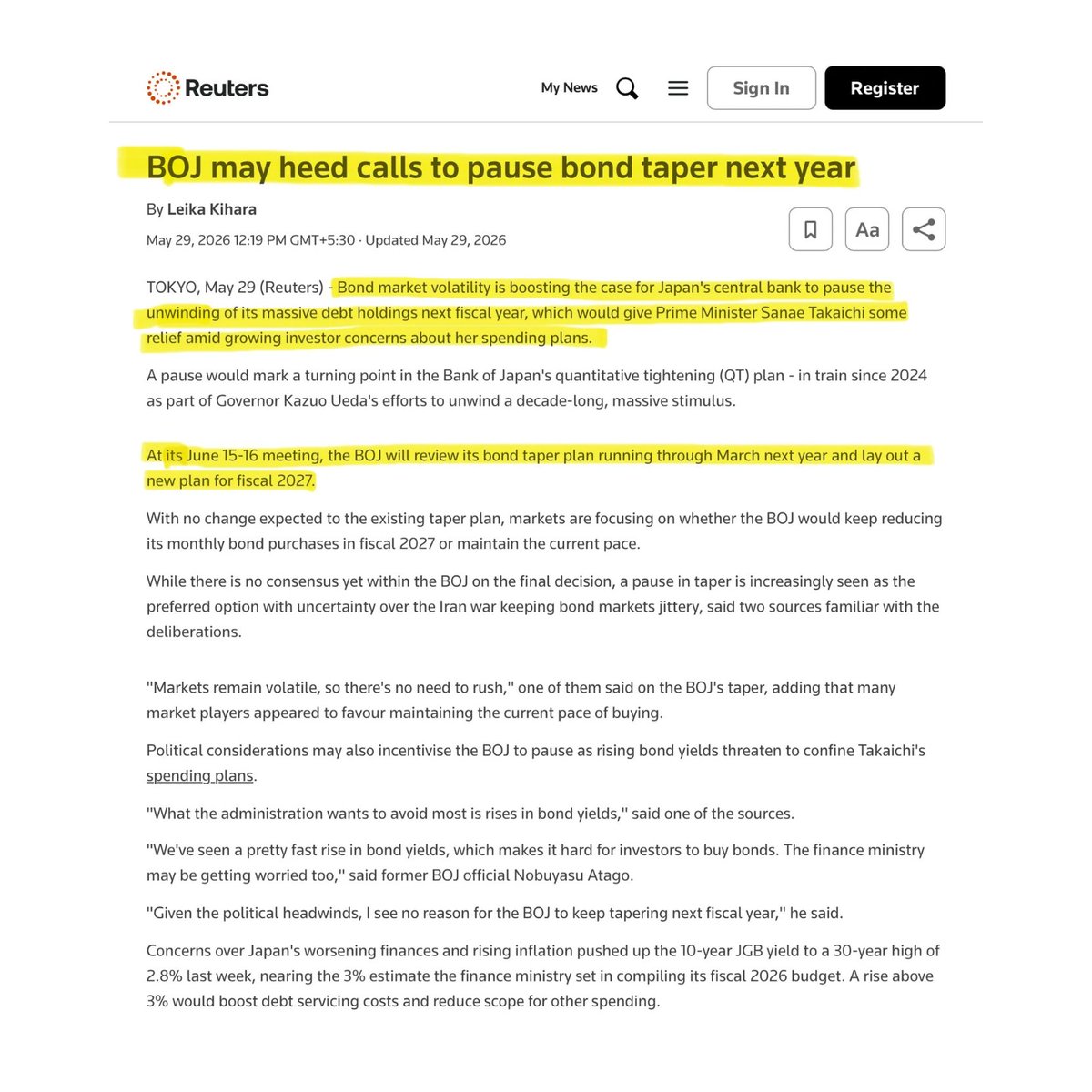
According to Reuters, BOJ officials are increasingly considering a pause to QT in 2027 as bond market volatility continues to rise.
This would be a major reversal for a central bank that has spent years trying to exit emergency-era policies.
The reason is the bond market itself.
Japan's 10-year government bond yield recently hit 2.8%, the highest level in nearly 30 years.
Long-dated bond yields have reached record highs, and investors are becoming increasingly concerned about Japan's debt burden and rising inflation.
This is becoming a serious problem because Japan has more than $8 trillion of government debt. The finance ministry built its entire 122.3 trillion yen budget assuming yields would not exceed 3%. Japan's debt servicing costs have already risen 10.8% this year to 31.3 trillion yen. Every move above 3% automatically wipes out spending room the government does not have.
At the same time, inflation is rising again.
For years Japan wanted inflation because the country was stuck in a low growth, low wage environment.
Now inflation is being driven by higher energy costs and imported inflation from the Iran conflict, which is a very different type of inflation and much harder to control. Japan has recorded above-target inflation for 45 consecutive months.
This leaves the BOJ trapped.
If it continues QT, bond yields could move even higher and put more pressure on government finances.
If it pauses QT, it risks showing that the bond market still depends on central bank support after more than a decade of intervention.
And this is where global markets come in.
Japan is the third largest economy in the world and the single largest foreign holder of US Treasuries. The BOJ currently owns 49% of all outstanding Japanese government bonds, 503 trillion yen out of a total 1,025.8 trillion yen market.
When Japanese bond yields rise, Japanese institutional investors stop buying US Treasuries and bring money home instead.
That reduces demand for US debt, pushes US yields higher, and tightens financial conditions for every market on earth that prices risk against the US 10-year rate.
But the bigger risk is the carry trade.
For years global investors borrowed money in Japan at near zero interest rates and invested those funds into higher yielding assets around the world US stocks, emerging market bonds, tech stocks, crypto. This trade worked as long as Japanese rates stayed low.
As the BOJ raises rates and Japanese yields rise, the cost of borrowing in yen increases. That forces carry trade investors to close their positions, selling the assets they bought and converting back to yen to repay their loans.
In August 2024 the BOJ raised rates by just 0.15%.
What followed was the single largest single day crash in the history of the Japanese stock market and a violent selloff across global equities, crypto, and emerging markets within 48 hours.
The BOJ is now expected to raise rates to 1% at its June 15-16 meeting. That is a significantly larger move than August 2024.
The carry trade built on decades of near zero Japanese rates is estimated at over $4 trillion globally.
That's why this should scare every investor in the world.
Happy Bitcoin Pizza Day! 🍕
In celebration, we are giving away 10,000 $S to one lucky winner.
To enter, you must:
- RT this post
- Comment your favorite pizza order
Winner will be announced in 24 hours.
Goodluck!
The Fenghe Bridge is part of a major highway connecting China and Mongolia. Its total length is 1,871 kilometers. The length of the bridge itself is 8 km.