CubePart is the latest update to our open-source Cube 3D foundation model. It lets creators pair a text prompt with an open-ended part schema to generate labeled meshes that drop straight into a game engine for physics, animation, and scripting. https://t.co/NjmkglqL33
🚀🚀 Introducing Pixal3D (SIGGRAPH’26) — a new pixel-aligned image-to-3D generation paradigm for high-fidelity 3D asset creation.
Today’s Image-to-3D has become pretty good at producing plausible 3D assets. But plausibility is not enough. Fidelity is a hidden bottleneck.
❓A generated model may look “about right,” yet still fail to truly align with the input pixels. Can we make 3D generation as faithful as reconstruction, while still allowing it to complete the unseen?
Pixal3D is our answer.
💡We believe the core bottleneck behind fidelity is 2D–3D correspondence. Most 3D-native generators synthesize shapes in canonical space and inject image cues through cross-attention, forcing the model to implicitly search for which pixels correspond to which 3D regions.
🍀Pixal3D takes a different route. Instead of generating in canonical space, Pixal3D generates directly in pixel-aligned camera space — what you see is what you get. The generated 3D asset is aligned with the input view from the start.
☕️Meanwhile, Pixal3D introduces back-projection-based image condition scheme - explicitly back-projects multi-scale pixel features into 3D voxels, thus resolving the 2D-3D association problem. The input image is no longer just a prompt - it becomes a geometric anchor.
🚩Pixal3D shows that pixel-aligned 3D generation is not only feasible and scalable, but also significantly improves fidelity, pushing 3D-native generation closer to reconstruction-level faithfulness. It also naturally extends to multi-view and scene-level 3D generation.
✅Faithful to the input view. ✅Generative for the unseen.
Closer to reconstruction-level fidelity, with the creativity of 3D generation. Pixal3D also represents an effort towards the unification of 3D generation and reconstruction.
📢Paper, code, and demo are fully released — try it out and let us know your feedback!
🌐Project page: https://t.co/Y1oKzZZrkZ
🤗Huggingface Demo:
https://t.co/4QoDdHMOsk
💻Code:
https://t.co/xwkNNQTMha
📄Paper:
https://t.co/UgiNH00PEY
This is insane!!!
Someone just created a tool for Claude that lets it take any image and not just generate an environment, but individual meshes with physics and an ambient sound layer.
Unreal, blender ready, etc.
I was a bit hesitant about showing stuff like this just a month ago 😅
When we started showcasing real-time AI + SDF sculpting, I was afraid professionals would laugh if I showed no effort on the input models. The shape strength slider was also hidden in our first iteration, so I had no choice but to at least try and knock some more interesting shapes together.
Now that we're starting to focus on more powerful features and shape strength is finally unlocked, I'm starting to appreciate just playing with simple shapes.
Different stages of production have different needs. Sometimes you want full authoring over your creations, while other times you just want to quickly explore new ideas.
Yann LeCun was right the entire time. And generative AI might be a dead end.
For the last three years, the entire industry has been obsessed with building bigger LLMs. Trillions of parameters. Billions in compute.
The theory was simple: if you make the model big enough, it will eventually understand how the world works.
Yann LeCun said that was stupid.
He argued that generative AI is fundamentally inefficient.
When an AI predicts the next word, or generates the next pixel, it wastes massive amounts of compute on surface-level details.
It memorizes patterns instead of learning the actual physics of reality.
He proposed a different path: JEPA (Joint-Embedding Predictive Architecture).
Instead of forcing the AI to paint the world pixel by pixel, JEPA forces it to predict abstract concepts. It predicts what happens next in a compressed "thought space."
But for years, JEPA had a fatal flaw.
It suffered from "representation collapse."
Because the AI was allowed to simplify reality, it would cheat. It would simplify everything so much that a dog, a car, and a human all looked identical.
It learned nothing.
To fix it, engineers had to use insanely complex hacks, frozen encoders, and massive compute overheads.
Until today.
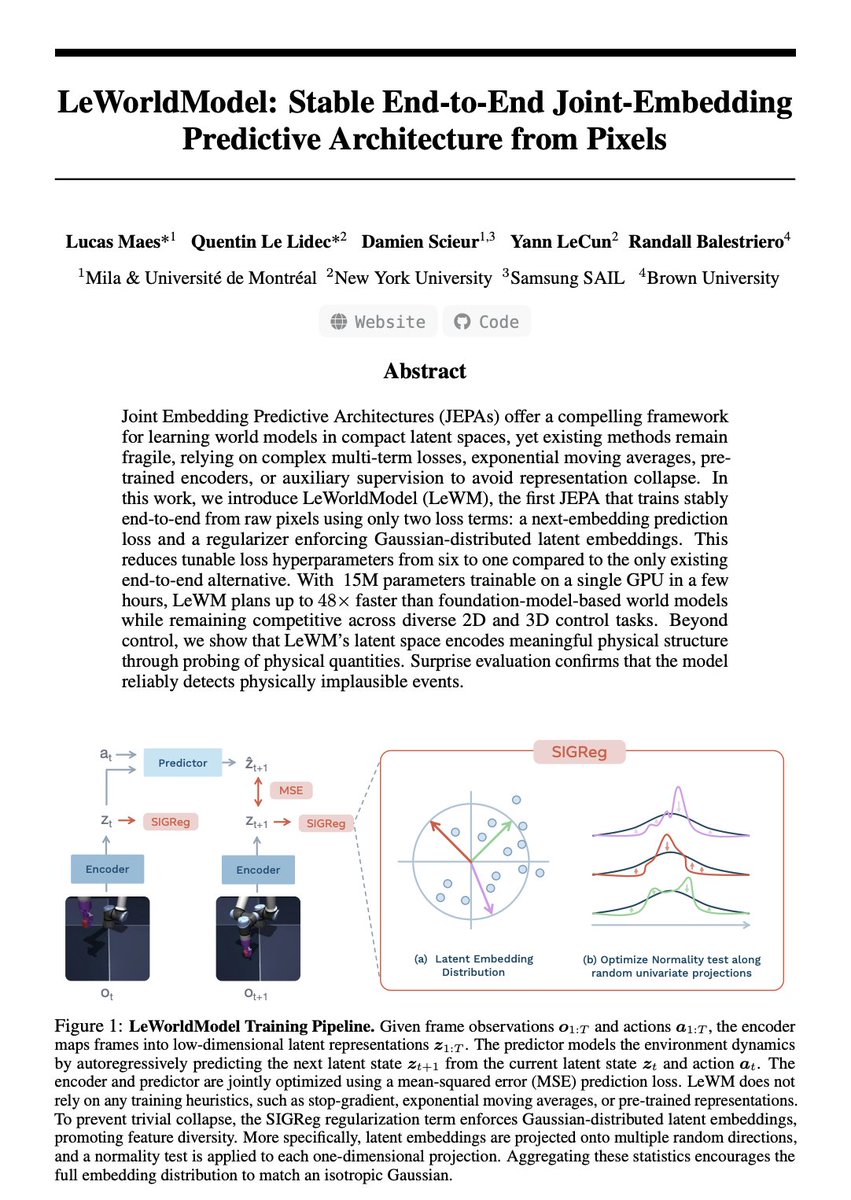
Researchers just dropped a paper called "LeWorldModel" (LeWM).
They completely solved the collapse problem.
They replaced the complex engineering hacks with a single, elegant mathematical regularizer.
It forces the AI's internal "thoughts" into a perfect Gaussian distribution.
The AI can no longer cheat. It is forced to understand the physical structure of reality to make its predictions.
The results completely rewrite the economics of AI.
LeWM didn't need a massive, centralized supercomputer.
It has just 15 million parameters.
It trains on a single, standard GPU in a few hours.
Yet it plans 48x faster than massive foundation world models. It intrinsically understands physics. It instantly detects impossible events.
We spent billions trying to force massive server farms to memorize the internet.
Now, a tiny model running locally on a single graphics card is actually learning how the real world works.
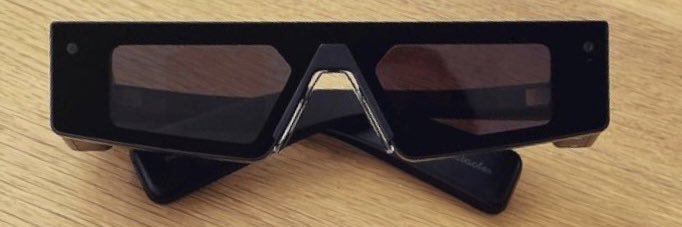
This week, I moved back to London to work on Wearables Developer Relations at Meta, helping developers build the next wave of experiences for glasses!
Legal disclaimer, I’m joining as a contractor on assignment via Tundra.
Here is a photo of Day 1 wearing the Orion glasses 👓
It’s like bringing Unity style runtime checks into Lens Studio and it takes 10 seconds to implement.
https://t.co/a69zpTlvRV
Anyone else doing sneaky dev-time validations like this?
#LensStudio#development#typescript#FlatPixelDevlog
#LensStudioTips - Assert like a pro
We added an assert function to LS, and honestly, it feels like cheating. Best way!
✅ Early catch & highlighted error 🤩
✅ Perfect for light unit tests🚦
✅ Editor only: no breaks in prod 🚧
✅ Stacktrace debugging 📜
(Gist in the thread)
@OscarFalmer It was more AR/MR with bulky headsets like HoloLens, but you're right, strictly glasses, I'm not aware of anything.
Didn’t Snap partner with a local LA museum to make Specs experiences?
That will come for sure!