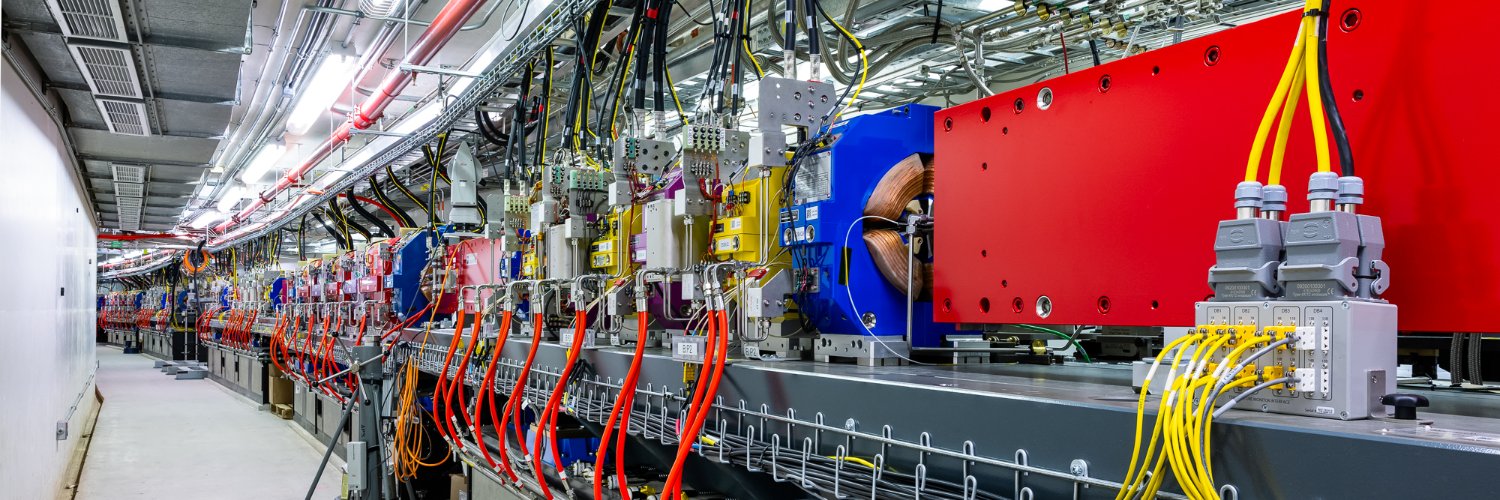
Did you know that the moon and sun's gravitational pull creates tidal forces that even affect the Advanced Photon Source? It's true: These forces subtly deform the APS every day, but don't worry—it's equipped to handle it. 👉 https://t.co/9SlFZWWBlp
Researchers at @argonne are using #AI and supercomputing to revolutionize cancer research. They also leverage the APS to capture protein structures, enhancing visualization and targeting for treatment. https://t.co/3Fvhoxos6v
Exciting news: The APS has reached a key milestone by achieving the full design beam current of 200 milliamps (mA) in our upgraded electron storage ring.
This marks another important step toward the anticipated completion of the APS Upgrade project this summer. Stay tuned!
#FunFact: Wednesday marked 30 years since the APS saw its first light! Check out our website to learn 30 things you may not know about America’s premier X-ray light source - https://t.co/k6UvydBU1d
A biomedicine breakthrough! Using AI and ultrabright X-ray beams at @advancedphoton, a team of scientists led by Nobel Prize winner David Baker created a computational method for generating proteins that bind and signal a wide range of small molecules – https://t.co/OoqqPCt0xu
Daniel Haskel, a group leader at Argonne's @advancedphoton, has been selected as a fellow for the 2025 cohort of the Oppenheimer Science and Energy Leadership Program (OSELP) - https://t.co/ISjSBrh3ng
From repairing cars to beamline engineering, Oliver Schmidt's career journey exemplifies transformation! Learn more about Schmidt's path and his role as the beamline engineering lead for the @advancedphoton upgrade - https://t.co/6Lxtn4Ci8q
Submit a letter of intent by 5 p.m. PST by March 6 for the FICUS program call with @EMSLscience & @JGI: https://t.co/Mz0l2H32QH
Capabilities also available at @advancedphoton, @NEON_sci, & the Bio-SANS beamline through the Center for Structural Molecular Biology at @ORNL.
As part of a multi-institutional team, @argonne scientists used the APS to investigate a material with a highly unusual structure — one that changes dramatically when exposed to an ultrafast pulse of light from a laser.
https://t.co/dn0O84OtQM
The FICUS program call with @EMSLscience and @jgi is open! Submit letters of intent by 5 p.m. on March 6: https://t.co/9mRsBkTQLo
Additional capabilities available at @ORNL's Center for Structural Molecular Biology, @advancedphoton, @NEON_sci.
By developing an innovative additive for a new electrolyte, researchers at @argonne are making progress toward addressing the problems limiting the widespread adoption of lithium-sulfur batteries.
https://t.co/0ZXqDGSdqM
Researchers at @argonne use the @advancedphoton to investigate erbium-doped titanium dioxide as a material for #quantum technologies, focusing on how its structure and defects affect its performance. https://t.co/HndqsPsdM8
What is eBERlight? It's a new program at the Advanced Photon Source to match up scientists conducting biological and environmental research with X-ray techniques that can advance their work. You can learn more about it by watching this video:
https://t.co/xhyAxPIQl8
Andrzej Joachimiak, director of the Structural Biology Center, shares how his decades of work at the APS shaped his career and impacted the scientific world’s understanding of structural biology - https://t.co/oiFT2AHd97
Exciting news! @Argonne has received up to $21.7 million from ARPA-H to advance cancer research and vaccine development. With cutting-edge resources like the APS and Aurora supercomputer, Argonne is set to uncover insights that could revolutionize health outcomes! #CancerResearch
Have you ever wanted to get a behind-the-scenes tour of the amazing scientific tools available at @argonne?
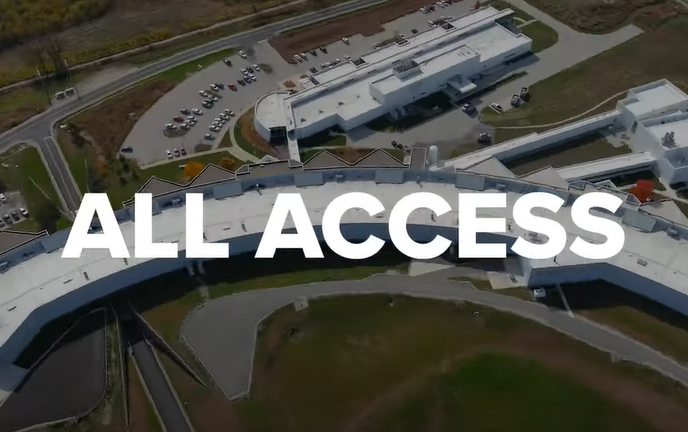
Check out the Advanced Photon Source and learn about where battery research takes place. ⬇️ https://t.co/KiXQyyrBk6