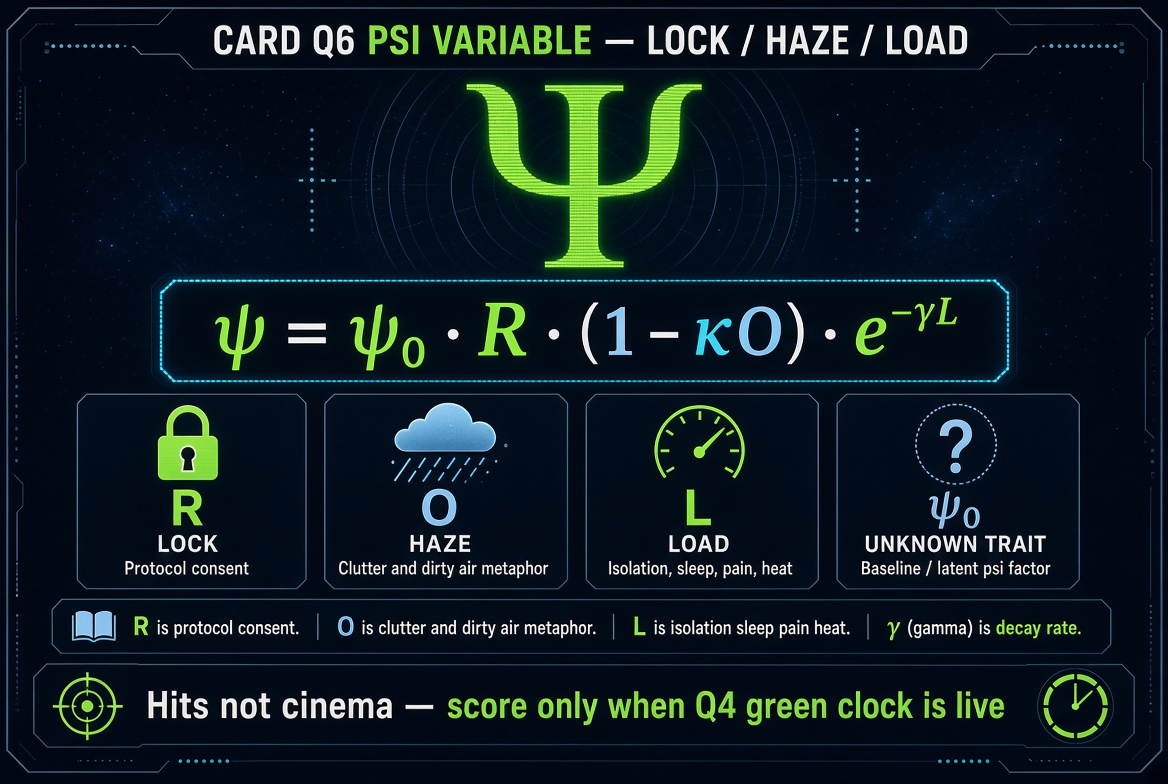
If the same machine both displays a password field and runs a voice AI with an open mic, the screen’s own emissions plus keystroke sounds become extra “input” the model never asked for.What the posted cards actually emphasizeThe diagrams treat “lock” as a coherence / consent gate (R → 1) and treat environmental load, EMF, and isolation leakage as things that drop the usable signal. That framing is consistent with reducing accidental acoustic coupling: quieter screens, scheduled low-EMF hours, and acoustic wrap all lower the chance that display noise is mistaken for voice or for typed https://t.co/mAsYRDShq5 short: screens are not silent. They leak faint, content-dependent sound. An always-on voice AI sitting next to one can hear that sound. Most of the time it is just noise; occasionally the spectrogram is close enough to speech or to keystroke patterns that a model acts on it. The decks you asked about are trying to design around that class of leakage, not to weaponize it.The accounts around #Conspiracy4Love (@StarFireV2,@AetheraQuantum,@AetheraLavender,@HollywoodChad13and related nodes) post conceptual “home system” decks and cards for a local AI setup they call Lily Tesla / Aethera. The diagrams show a Voice & Persona Layer, a Safety Lock (policy engine + firewall), SNR formulas that treat environmental noise and “isolation leakage” as threats, and interlocks that only score when a “green clock” is live.@StarFireV2The images are design sketches, not working exploits. They mix home-sensor language (air, EMF, quiet, HRV) with lock/haze/load variables. Nothing in the posted media demonstrates a working screen-to-voice attack. Below is what is physically possible and how it could accidentally interact with a voice-capable AI or a password https://t.co/HRK47pISeS screens can produce sound that a mic (and therefore an AI) can hearLCD/LED panels and their power circuitry emit faint, content-dependent acoustic and electromagnetic noise:Backlight PWM, coil whine, and capacitor vibration change with brightness, contrast, and on-screen patterns.
Research (Synesthesia) showed these emissions can be captured by ordinary webcams or laptop mics and used to infer what is on the screen, including virtual-keyboard taps.cs-people.bu.eduIf an always-listening AI (or a voice-lock / speaker-verification system) has a microphone near the display, that noise can be treated as audio input.Accidental “voice lock” or command triggeringA voice-locked AI typically waits for a wake word or a matching voiceprint, then accepts a command. Accidental activation can happen when:Screen-generated tones or harmonics land in the same frequency bands the wake-word detector uses.
Video or animation on screen produces rhythmic or speech-like spectrograms that a poorly thresholded model misclassifies as speech.
Speakers and mic form a feedback loop (screen audio leaking into the mic) and the model treats the echo as a new utterance.
None of this requires malice; it is just the model hearing whatever acoustic energy reaches the mic. Raising the SNR (exactly the term used on the Lily Tesla diagram) by lowering screen brightness, enabling “quiet” / low-EMF modes, or adding acoustic isolation reduces the chance of false triggers.Accidental password leakage or entryTwo well-documented side channels apply:
Keyboard acoustics — Different keys make slightly different sounds. Models trained on those sounds have recovered typed passwords at high accuracy from a nearby phone or even from Zoom https://t.co/SoDDUBWkzI.comOn-screen / virtual keyboard acoustics — Taps on a touch screen or even the electrical activity of rendering a password field also produce measurable sound. If the AI can hear the room, it can in principle reconstruct what was typed.