On average, only 20% of Leads are sales ready when they first come in. This means you need a disciplined process known as lead nurturing to develop qualified leads until they are sales ready. Done well, nurturing can result in 50% more sales leads at 30% lower cost per lead.
If you're dating someone you're dating the universe too. You're dating their parents that made them anxiously avoidantly attached. You're dating the movie that taught them how to love. You're dating their exes that shaped them. You're dating the cumulative sum of all choices made through history. Love cannot be compartmentalised.
You're so right! In Feng Shui, we say "If the bright hall isn't open, the energy won't flow." When you face the "mystery," your energy field is chaotic and stagnant. That's the true nature of procrastination—blocked Qi.
Breaking down the steps is like "regulating the Qi" in Feng Shui, untangling messy energy into a clear flow. Once your path ahead is clear (clarity), your action (the Water element) naturally flows. Clear the fog, and the current will carry you.
People think "i know what to do, but i'm not doing it!!!"
You actually don't know what to do. The steps aren't granular enough.
You could "know" that you need to write the sales email, but you don't actually have a framework for the sales email. The ingredients are a mystery
Where there is mystery, there is procrastination
Part of the "work" is diving into the mystery & figuring out the ingredients. Most people disregard this but it's like 80% of the battle. Just doing shit not that hard after you get through the give-yourself-clarity stew
My husband said that when he was a kid he told his dad he just wanted to have fun. In response his dad said, "Son, the people I know who have the most fun are the most miserable."
People always think they're giving up something up by becoming responsible, dedicating their life to a greater calling, saying "no" to the immediate pleasure, doing the difficult thing, but the rewards are bountiful and beautiful. People who pursue fun at all costs always suffer for it. They are like children, bouncing from one whim to the next, unable to see that their slavery to their impulses is the source of their unhappiness, and not the fact they haven't found the "right" fun thing.
All you need to reprogram your subconscious mind is to imagine your best possible self + emotion + volume.
And to take it even further, I personally like to visualize my perfect outcome AND the difficulties I have to face. I already see how I overcome them and that the road will be hard.
Whatever happens, I'm well prepared and just execute at full speed. I really recommend you try it for yourself.
A good salesman told me it takes 10-15 follow ups for a client to buy.
Makes sense. So I just started following up with everyone and got nowhere.
Then, the best salesperson I know told me you can follow up 10 times on one call.
Keep de-risking, present a more reasonable solution every time. This is basically the Jordan Belfort looping method.
You can disagree with Belfort’s tactics, but one thing he is very good at is always coming off as the more reasonable person. The “reasonable man” tone / frame.
The reason it works EVERYONE views themselves as reasonable, and they HATE breaking this identity.
It’s situational depending on the offer (B2C vs B2B etc), but it does work.
If you’re going to follow up 10 times, you may as well do them all on the same call, right as the client is in their peak emotional state to buy, not a week or a month or a year later after.
After the first call you’re just bothering them
“I suck”. Okay, that’s a comparative statement. Suck compared to what?
Trace it back (study compared to WHAT) & you realize you’re using the scoreboard you were GIVEN, by the world, NOT yours. But the default normie one is probably embdded so far into you that you probably never even realized you could change it. You probably didn’t even know you actually already have your OWN, you’re just choosing to not see it, cuz u think other people know better for you than you do. Or you have just been too scared to change it cuz it makes you too different, and that freaks you out (your own intensity)
Game of 1
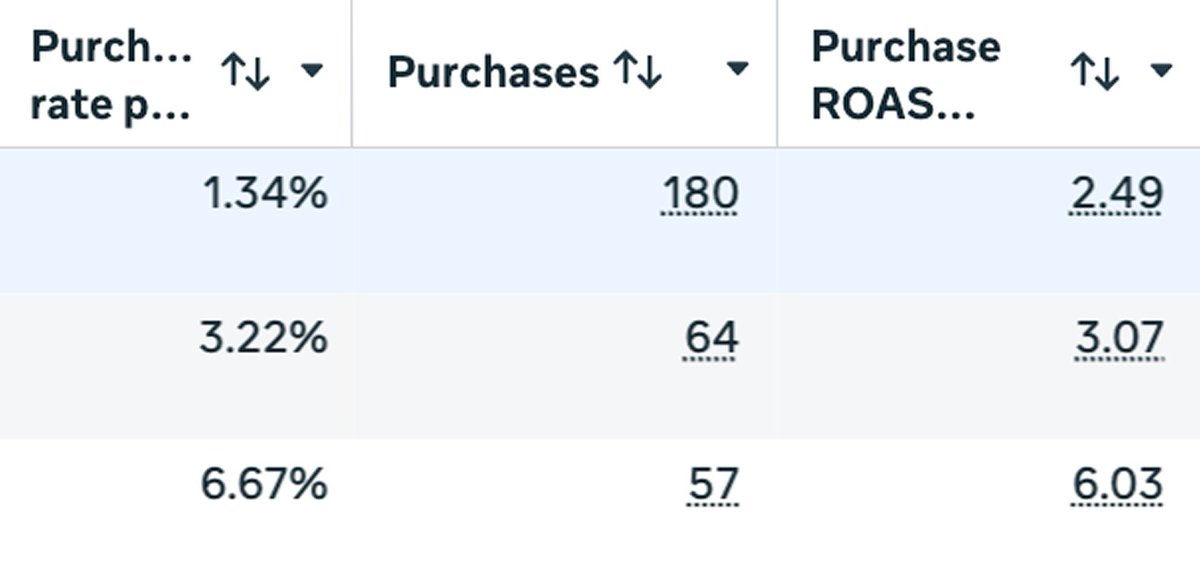
This is how a healthy funnel set up looks like.
TOF - reaching and educating new audiences
MOF - explain product in different angles
BOF - handle objections and create scarcity
Which results in a blended ROAS 2.94
As weird as it sounds, but your TOF main objective is not only getting purchases. But the real power is when you at the same time have high CTR and low CPCs.
Bc that's the moment you bring in so many new ppl into your funnel and Meta knows exactly which ad to show them next.
That's why non-branded ads works best for TOF (community pages, creator pages and even recognized collab ads with celebs).
Build your MOF campaign with product-focused ads (mention the product in the first 5 seconds) and explain the benefits from as many angles as possible.
Inside your BOF campaign, you want to fill it with offer-driven and social proof statics (all branded).
This setup works extremely well bc when you mix MOF and TOF ads inside one campaign, Meta will always go for the lowest-funnel ads because they have the highest chance of getting purchases. The problem is that you will never expand to new audiences.
And exactly THIS should ALWAYS be your main goal when scaling budgets: first build your foundation, then focus on getting new ppl into your funnel (by testing new concepts, personas, angles, etc.).
Scientists shut off the dopamine in some rats and they stopped eating. Food everywhere. They starved in a full cage, not because they hated it. Put sugar on their tongue and they licked their lips. They still liked it. They just lost the drive to go get it.
This is one of the strangest things we know about the brain, and it traces back to a researcher named Kent Berridge at the University of Michigan. Your head runs two different systems. One is wanting, the push that gets you off the couch and moving. The other is liking, the good feeling once you are in it. Dopamine runs the wanting. The enjoyment runs on separate wiring. So you can be sure you will love something and still feel almost no pull to start it.
That is the man in the cartoon, swinging at rock with diamonds all around him. He could see the good stuff. He just could not make himself dig toward it.
Once you see why, the usual story about procrastination stops making sense. We say lazy, or bad with time. Mostly, it is neither. Two psychologists, Fuschia Sirois and Tim Pychyl, argued back in 2013 that it runs on emotion. A task makes you feel something you would rather not feel, even just the small dread of starting, and putting it off makes that feeling vanish on the spot. So you scroll, or you suddenly need to clean the kitchen. Dodging the task is a quick hit of relief, and your brain grabs it. The bill goes straight to future-you, who is left holding the guilt and the deadline.
You can even see it on a brain scan. In 2018, a team in Germany scanned 264 people and matched the scans against how much each person put things off. The big procrastinators had a larger amygdala, the little alarm bell deep in the brain that flags anything risky. They also had a weaker link to the part meant to quiet that alarm and get you moving, a region called the dorsal anterior cingulate cortex. Loud alarm, weak off-switch.
And if this is you, you have plenty of company. A big 2007 review found that 80 to 95 percent of college students procrastinate, that roughly one in five adults does it long-term, and that more than 95 percent of them wish they could quit. Students alone burn about a third of their day on it.
The fix falls out of that same split. If wanting and liking are two different systems, then waiting to "feel like it" is waiting for a bus that may never come. The main treatment for the severe version, called behavioral activation, flips the order. You start first, as small as you can stand, before any motivation shows up. The wanting tends to arrive a few minutes after you begin. The diamonds were there the whole time. You just have to swing the pick before you feel ready.
how to turn your website into a revenue generating machine:
use this free conversion optimization skill
paste this into your coding agent and ask it to make a skill that will audit every landing page, sales page, or lead gen form you build against these 25 points automatically
the framework
1. headline 4-u formula - useful, unique, urgent, ultra-specific (80% won't read past this)
2. above-fold value proposition - customer problem focus, no company story, zero scroll required
3. cta first-person psychology - "get MY guide" vs "get YOUR guide" (90% more clicks)
4. 5-field form maximum - every field kills conversions, progressive profiling for the rest
5. message match precision - ad copy and landing page headline must match, broken promises = bounce
6. social proof near ctas - testimonials with faces and names, placed at decision points
7. cognitive bias stack - loss aversion (fear), social proof (fomo), anchoring (pricing)
8. pas copy framework - problem, agitate, solve. emotion before logic.
9. genuine urgency only - real deadlines, actual limits. fake timers destroy trust forever.
10. price anchoring display - show expensive option first, make real price feel like relief
11. trust signal clustering - security badges, guarantees, policies all visible together
12. visual hierarchy f-pattern - eyes scan f-shape, put your ctas in the path
13. lead magnet hierarchy - templates beat checklists beat guides (instant beats delayed gratification)
14. objection preemption - address top 3 concerns before they think them, faq near cta
15. mobile thumb zone - ctas where thumbs naturally rest, no stretching required
16. one-variable testing - change one thing, measure impact, compound wins over time
17. post-conversion momentum - thank you page sells the next step while excitement peaks
18. cart recovery sequence - email at 1 hour, retarget at 4 hours, incentive at 24 hours
19. reading level grade 6 - smart people prefer simple. 11-word sentences, short paragraphs.
20. tofu/mofu/bofu logic - awareness content is not decision content. match intent precisely.
21. white space = focus - empty space makes ctas impossible to miss. crowded = confused.
22. benefit-first language - features tell, benefits sell, transformations compel
23. micro-commitment ladder - small yes leads to big yes. start with email only.
24. performance tracking stack - heatmaps show problems, recordings show why, events show what
25. weekly optimization ritual - review metrics monday, test tuesday, iterate or scale
how to use this:
on any page audit: scores each item pass or fail, lists top 5 failures ranked by conversion impact, gives one specific fix per failure.
on any new build: checks every item before delivering. won't ship a page that fails items 1-5.
Reverse engineering APIs through network requests is one of the most fun things you can do with Claude Code to automate tasks..
SO many websites are impossible to navigate "deterministically" via the DOM (or through screenshots).
So, I just point Claude Code to use browser_harness by @browser_use (or vanilla playwright) and ask it to sniff network requests on the pages that I'm trying to get info on.
And, I just keep clicking around on the sections of data that I want. And, then Claude Code is generally able to go through the logs to figure out what is the right structure for these APIs and what kind of auth do they need (most are cookie based). We also determine what kind of rate limits exist based on trial and error.
I'm able to use that to construct jobs that allow me to get that data programmatically. There are many use cases for this besides scraping. I use this for random side projects (like the travel CLI), for monitoring websites (for intel), and for many many other use cases.
Every website will soon need to be headless, and we'll need to figure out mechanisms for how we have our agents pay these websites programmatically as well.
Just as we have llms.txt for data and structure, we'll soon need tools.txt for agents to determine what tools exist that can be leveraged.
Stepping away from the dopamine chat box and recording a long, rambling, yet intentional voice memo covering everything you want to accomplish in whatever project you’re working on. Then transcribing that and using it as input to the model, where you then ask the model to ask you questions exhaustively until it knows exactly what to do in order to accomplish your goal
PROPAGANDA IM PUSHING:
- high CPMs are good, you're buying attention that converts
- hook rate has minimal impact on revenue, stop only optimizing for it
- incrementality is the only truth
- broad targeting always wins over a long enough window
- you have to pick one, predictable volume or predictable efficiency
- net new reach is the most critical metric for future NC revenue
- you need 70%+ margins or a 2-3x 12mo LTV to really scale
- statics are the most efficient way to test new angles
- the majority of metrics in ads manager are useless
- spend is the greatest indicator of performance, full stop
- audience exclusions are just suggestions
- incremental attribution often beats 7DC
- test on lowest cost, scale on cost cap
- offer strategy beats creative strategy
- native usually beats high production
- organic feeds outperform the ad library for inspo
- partnership ads are the best cheat code for net new reach
- creative volume is a vanity metric pushed by Big Creative
- increasing TAM is the fix for rising CPAs almost every time
- the more consolidated the account, the better it performs
- marketing events and newness solve most demand problems
We’ve automated every single thing we can @every with AI agents.
And yet there’s way more human work to do than ever. We’ve gone from 4 -> 30 human employees since GPT-3.
I wrote a report on the structural reasons: how AI makes expert competence cheap, why that drives up demand for experts, and why the dynamic only intensifies as we approach AGI.
After Automation: https://t.co/Lb7SUCduAg
I’ve been trying to find good analogies for this.
The argument seems to be: “AI is intelligent because it does intelligent-like things, therefore it is cope to say it’s not intelligent.”
Some analogies:
- “The moon is really bright. Therefore it is capable of luminance.” Here of course we expose a manner of speaking. The moon reflects the sun’s light. The models reflect our own intelligence. The moon will never be a star.
- “A snail on the bed of a tow truck is really fast. Look, it’s moving from A to B at 60mph, it’s clearly fast.” But of course the snail is borrowing the truck’s velocity.
Notice how there is no controversy in calling the technology large language models because the term is perfectly apt: a map of language. This points to language as constructed by humans as the true source of magic, and LLMs being algorithms that can traverse this map at light speeds.
Before you think I’m being pedantic, understand that the nature of the words we use is precisely what’s at stake. That the moon *looks* bright is incontrovertible. Insisting however that the moon itself has any concept of inherent luminance is when you start to gaslight people into deranged realities that they will not stand for. Attempting to appropriate ageless conceptions like consciousness and intelligence to corporate technology by playing axiomatic word games is insanity.
Large language models do what they do and this is non-controversial. Personifying it with human-like attributes however is totally uncalled for, when it is easy enough for us to define new words that better capture the phenomenon.
I’ve been thinking long and hard about this and I think a good phrase for these technologies can be—hear me out:
“large language models”