i don't think people realize what just happened with brain implants in china
for the first time in history, a brain implant has been approved for commercial sale. you can actually buy one.
it's called neo. costs around $15,000.
the question everyone asks first: does it actually work?
here's what the implant does.
a coin-sized chip gets placed on the surface of the brain, right over the area that controls movement.
when a paralyzed patient imagines moving their hand, the chip reads that signal, sends it to a computer, and the computer drives a mechanical glove that moves for them
picking up objects, gripping utensils, handling daily tasks.
all from thought alone.
the whole surgery takes an hour and 40 minutes.
surgeons thin the skull, open a small window, and place two electrodes directly on the surface of the brain.
then they close it up, patients go home within a week.
32 patients with spinal cord injuries were implanted in a clinical trial led by huashan hospital
> ALL 32 regained the ability to grab objects through the glove.
> 100% improvement rate.
> zero adverse side effects.
no other brain implant company on earth has received approval to sell their device commercially.
elon's neuralink is still in clinical trials.
side effects from their more invasive approach have stalled any path to regulatory clearance.
china is the only country where you can buy a brain implant right now.
this is by design.
months before the approval, china published a national policy document with 17 steps to dominate the brain implant industry within 5 years.
they want brain-reading devices to be as common as hearing aids. headbands, visors, earpieces that pick up brain signals...
all mass-produced for consumers.
and the government is coordinating the whole thing.
funding the research, building the manufacturing, clearing the regulatory path, all at once.
the West is moving painfully slow in comparison...still running controlled trials one patient group at a time.
china already has a commercial product, a 72-year-old moving his leg on state television, and a national playbook to own the entire category.
🧠 Printed Neurons That Can “Talk” to the Brain
Scientists at Northwestern University have created artificial neurons that are printed like tiny electronic ink. These neurons are not alive, but they produce signals so similar to real brain cells that living neurons actually respond to them.
In early tests, real brain tissue reacted to the artificial signals — almost like the two were communicating in the same language. This opens the door to future brain-controlled medical devices, smarter implants, and brain-like computers.
It’s a small step in technology… but a big question for the future: where does the human brain end and machines begin?
Northwestern University. (2026, April 15). Printed neurons communicate with living brain cells. Nature Nanotechnology / Northwestern Engineering research release
𝗖𝗵𝗶𝗻𝗮 𝗶𝘀 𝗳𝗶𝗻𝗶𝘀𝗵𝗶𝗻𝗴 𝘁𝗵𝗲 𝗵𝘂𝗺𝗮𝗻𝗼𝗶𝗱 𝗿𝗼𝗯𝗼𝘁 𝗿𝗮𝗰𝗲 𝗯𝗲𝗳𝗼𝗿𝗲 𝗺𝗼𝘀𝘁 𝗼𝗳 𝘁𝗵𝗲 𝗪𝗲𝘀𝘁 𝗿𝗲𝗮𝗹𝗶𝘇𝗲𝘀 𝗶𝘁 𝗵𝗮𝘀 𝘀𝘁𝗮𝗿𝘁𝗲𝗱.
AGIBOT held its Partner Conference in Shanghai last week. The real headline wasn't the new hardware.
It was their CTO standing on stage, telling investors that humanoid R&D season is over.
2026, he said, is "Deployment Year One." Not research. Not demos. Deployment into real factories, real warehouses, real stores.
The manufacturing ramp is getting faster.
1,000 humanoid robots in the first 2 years.
Another 4,000 in the next 12 months.
Another 5,000 in just 3 months after that.
AGIBOT is now shipping more humanoids per quarter than most US robotics companies have built in their entire existence.
Then came the announcements the industry will spend the rest of the year reacting to.
AIMA. The first full-stack open architecture for embodied AI. A unified robot operating system called Link-U, three dev platforms for motion, interaction, and task creation, plus an open agent framework. Any developer can build on top of it. This is the Android play for humanoids.
GO-2. A vision-language-action foundation model with Action Chain-of-Thought reasoning. Planning and execution collapsed into one model.
GE-2. A world model for simulation, strategy testing, and sim-to-real transfer.
AGIBOT WORLD 2026. An open-source, production-grade real-world dataset pulled from actual industrial, logistics, hotel, and commercial sites.
Seven standardized "productivity packages" covering logistics sorting, retail service, security patrol, commercial cleaning, and more. Plug, deploy, bill.
A 5-year, $280 million commitment to seed a global developer and partner ecosystem.
Now look at the competition.
Boston Dynamics has been building humanoids since 1992.
Tesla's Optimus is still climbing its own hype curve.
Apptronik and Agility are well-funded but pre-scale on real deployments.
@AGIBOTofficial has pulled all of this off in three years, with no acquisitions, no legacy platform, and no IPO distractions.
While the West is still asking when humanoids will scale, China is already shipping them by the thousand.
For the last 72 hours since ml-intern launched we have had over 500+ autonomous AI research projects running on the Space at all times.
Some insane ones I saw:
1. A new AI paradigm from scratch — trying to replace transformers with a reasoning architecture based on energy minimization, binary sparse address tables and circular convolution binding. No GPU, no gradients, no training data — pure bitwise operations. Years of research done in 2 days. https://t.co/CE2j5HwybI
2. Someone took LoopLM (ByteDance's recurrent depth transformer with shared layers and infinite depth via looping) and crossed it with BitNet b1.58 (ternary 1.58-bit weights). The result: a model that's both infinitely deep AND uses almost no memory per parameter.
3. Designing a new attention mechanism modeled on the thalamo-cortical circuit in the human brain. Pulling from 2025/2026 research out of MIT, Harvard, and UF. The thalamus gates what information reaches the cortex. They're building a learnable gate that mimics this for transformer attention heads, combined with EEG datasets and a reinforcement learning loop. https://t.co/8QgXnQteVH
The use cases people bring are cooler and more impressive than anything we imagined when we built this.
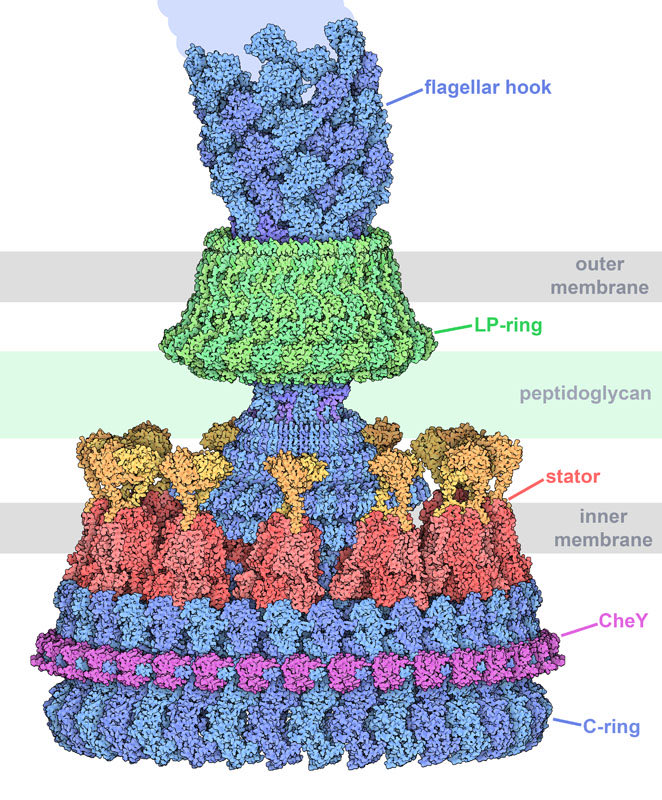
New Quanta article looks at one of the coolest tiny machines in biology - the bacterial flagellar motor. It’s basically a microscopic spinning engine that bacteria use to move.
After decades of trying to fully understand it, scientists are finally figuring out how it actually works. The motor is powered by a flow of charged particles (kind of like a tiny battery), which creates force and makes it rotate.
So what looks like something alive and mysterious is really just an incredibly advanced microscopic machine running on the same basic rules as everything else.
More broadly, the article addresses the idea of a "life force." It argues that no special force is needed to explain life. Instead, biological activity arises from physical processes that operate far from equilibrium, where constant energy flow keeps the system active and organized.
The flagellar motor shows that living systems can be understood as energy driven, self organizing systems. What appears to be uniquely "alive" can be explained by standard physical laws, such as thermodynamics and molecular interactions.
Physics pushed to an extreme level of complexity.
I had dinner once with a top physicist and a top computer scientist and asked what they thought the probability was that we were in a simulation.
They answered simultaneously at 0% and 100% respectively. It was like a double-slit experiment, but with humans.
my results on AI for autonomous progress:
we ran codex+claude for 43 days straight to build a System Verilog compiler/simulator
https://t.co/f0tT0cBtOM
1/ World models are getting popular in robotics 🤖✨
But there’s a big problem: most are slow and break physical consistency over long horizons.
2/ Today we’re releasing Interactive World Simulator:
An action-conditioned world model that supports stable long-horizon interaction.
3/ Key result:
✅ 10+ minutes of interactive prediction
✅ 15 FPS
✅ on a single RTX 4090🔥
4/ Why this matters: it unlocks two critical robotics applications:
🚀 Scalable data generation for policy training
🧪 Faithful policy evaluation
5/ You can play with our world model NOW at https://t.co/SBqVDzYn86. NO git clone, NO pip install, NO python. Just click and play!
NOTE ⚠️
ALL videos here are generated purely by our model in pixel space! They are **NOT** from a real camera
More details coming 👇 (1/9)
#Robotics #AI #MachineLearning #WorldModels #RobotLearning #ImitationLearning
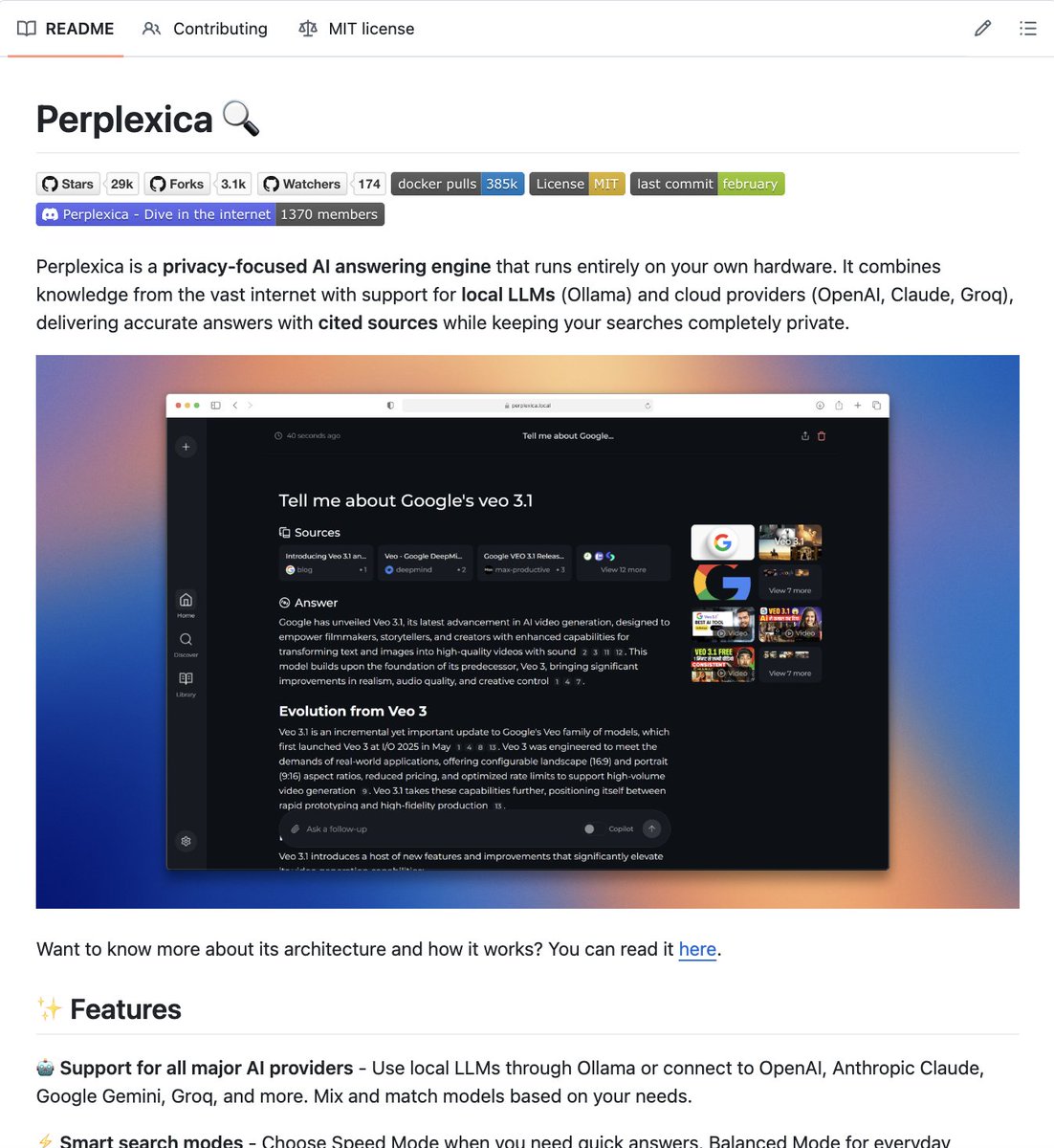
🚨BREAKING: Someone built a full Perplexity clone that runs 100% locally for $0.
It's called Perplexica.
→ Searches the web in real-time
→ Cites every source it uses
→ Works with Ollama local models
→ Multiple search modes (general, academic,
YouTube, Reddit, writing)
→ Zero API costs. Zero data collection.
Perplexity charges $20/month for this.
This runs on your machine for free.
29K stars. MIT license.
(Link in the comments)
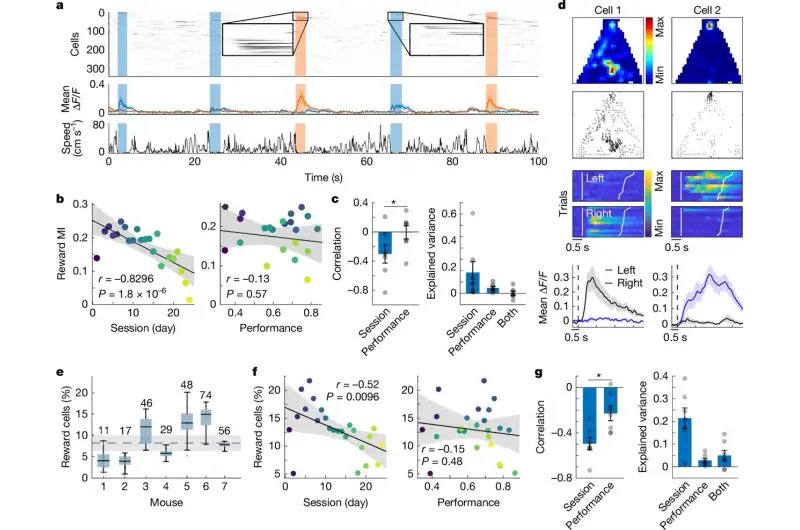
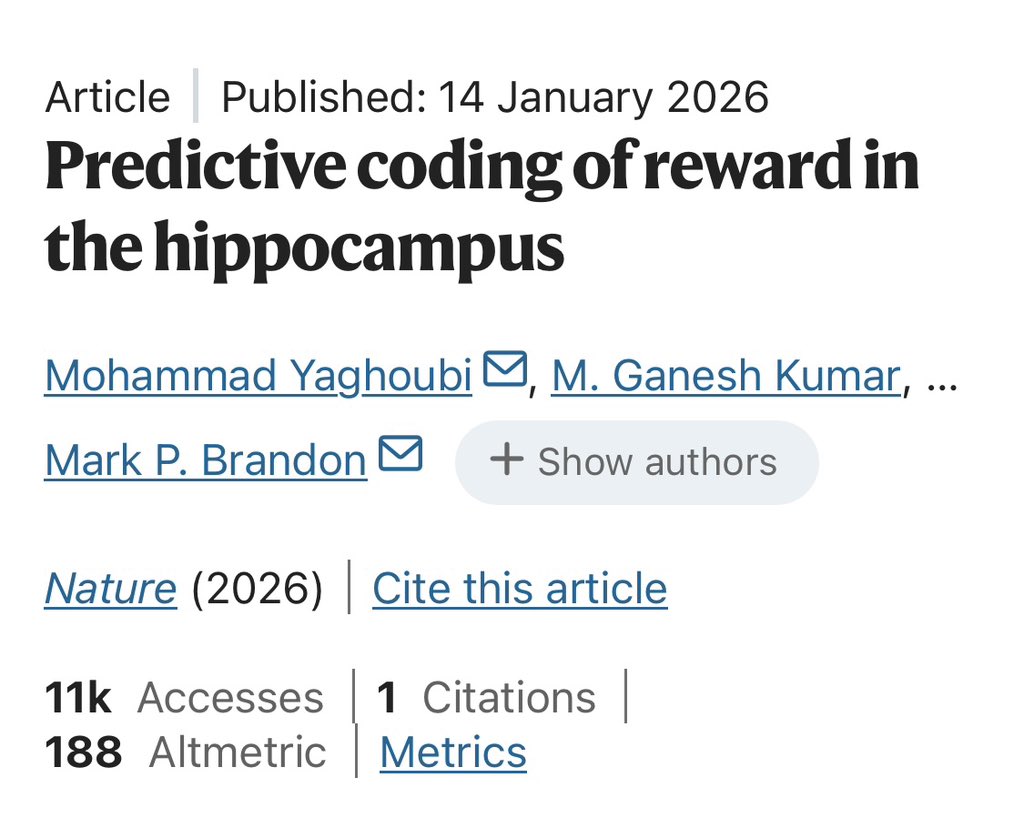
i just finished reading a study published in Nature in January by researchers from McGill & Harvard and it broke my brain a little
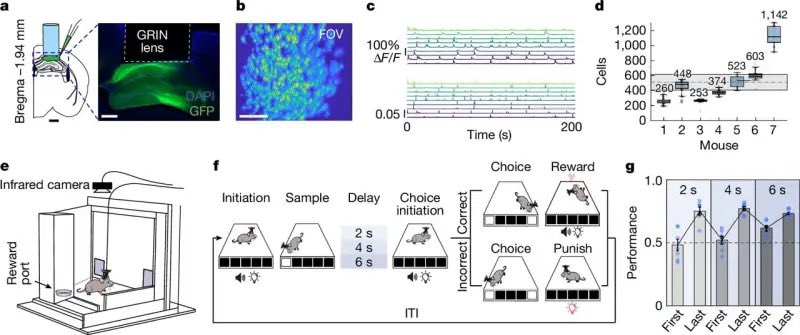
they tracked neurons in the hippocampus over several weeks while mice were learning a complex task and what they found is wild
the hippocampus does way more than store memories like a hard drive, it actively reorganizes them to predict what’s going to happen next, the neurons literally rewire their firing timing to start shooting BEFORE a reward shows up instead of after your brain is basically running a real time simulation of the future built entirely from past experience
and this is where it gets crazy when you think about AI
every foundation model we have right now learns through backpropagation which is a math trick from the 1980s that has absolutely nothing to do with how actual neurons learn, it works absurdly well but it’s also why training GPT-5 burns hundreds of millions of dollars & eats the energy of a small city
your brain does something arguably more impressive on 20 watts which is literally a light bulb
how? because the brain runs on predictive coding, it predicts what’s about to happen at every single moment and only bothers transmitting the stuff it got wrong, everything it predicted correctly gets suppressed
evolution basically invented the most insane compression algorithm imaginable and we’ve been pretending it doesn’t exist for decades
the most fascinating part is that tomorrow’s AI will look absolutely nothing like what we know today:
sparse event driven predictive architectures running on a fraction of current energy & the thing is the solution has been sitting inside your skull for 600 million years, evolution already did the work except nobody in this industry wants to face it because it’s easier to throw billions at compute than to sit down and study how a mouse brain outperforms everything with a light bulb
we’re spending billions reinventing the wheel when a mouse brain already outperforms our best models on the energy of a nightlight, the day this industry sits down & seriously studies what’s happening between our ears everything changes
We just open-sourced Paperclip: the orchestration layer for zero-human companies
It's everything you need to run an autonomous business: org charts, goal alignment, task ownership, budgets, agent templates
Just run `npx paperclipai onboard`
https://t.co/wuDdEmrSMx
More 👇
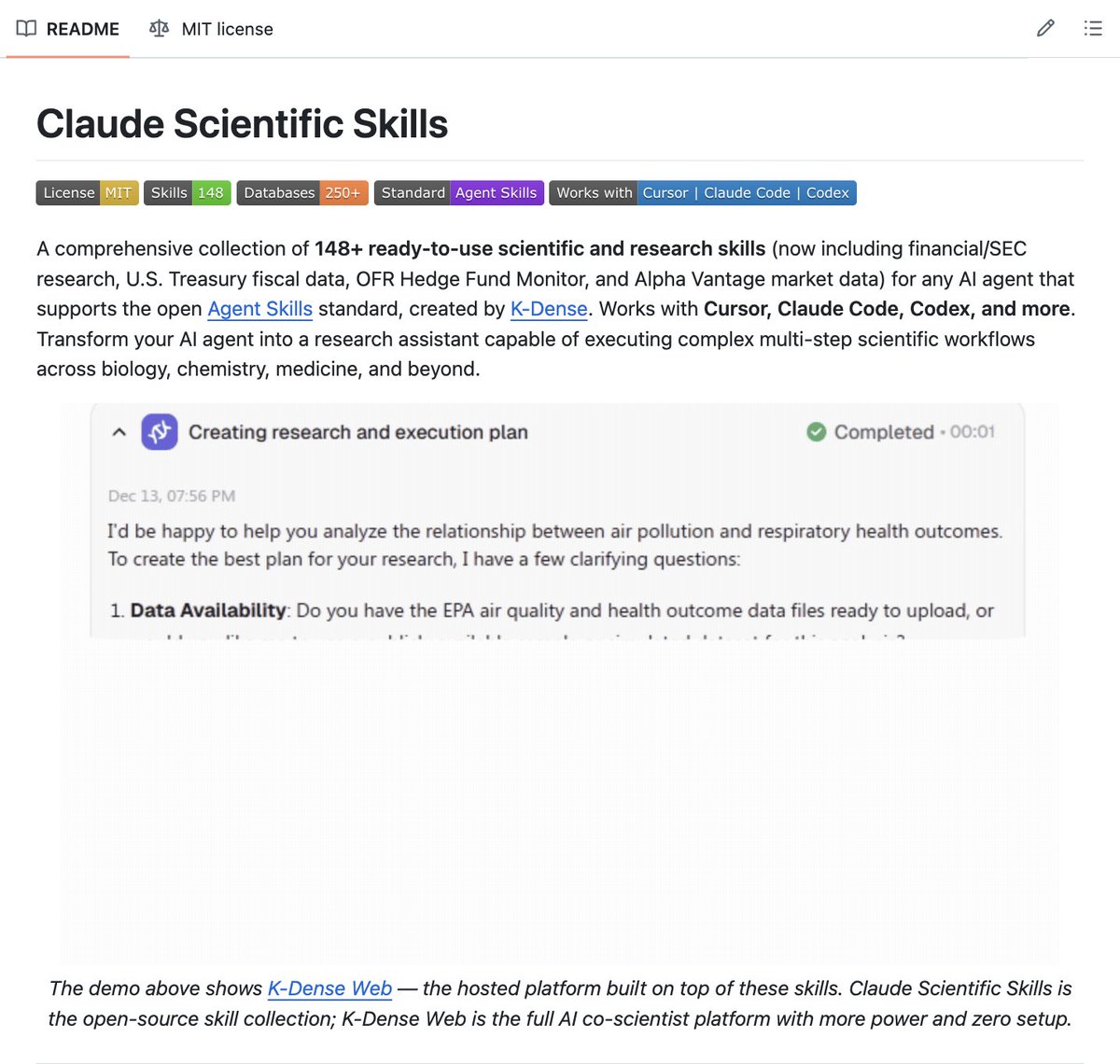
🚨 BREAKING: The most important Claude plugin in existence just dropped on GitHub and nobody is talking about it.
It's called claude-scientific-skills.
140 scientific skills across every major research domain baked into one plugin.
Install it once. Claude becomes a full AI research scientist permanently.
Here's what it can run from a single prompt:
→ Full drug discovery pipelines with real bioactive compound queries
→ Single-cell RNA sequencing analysis with Scanpy
→ Clinical variant annotation with ClinVar and Ensembl
→ Molecular docking against AlphaFold structures via DiffDock
→ Patient to trial matching via live ClinicalTrials. gov data
→ Publication-ready PDF clinical reports generated automatically
Bioinformatics. Cheminformatics. Proteomics. Quantum computing. Medical imaging. Laboratory automation.
All connected to the databases and tools scientists actually use.
One prompt. Real science. Actual results.
This is not a chatbot anymore.
/plugin install scientific-skills@claude-scientific-skills
100% Open Source. MIT License.
Link in the comments.
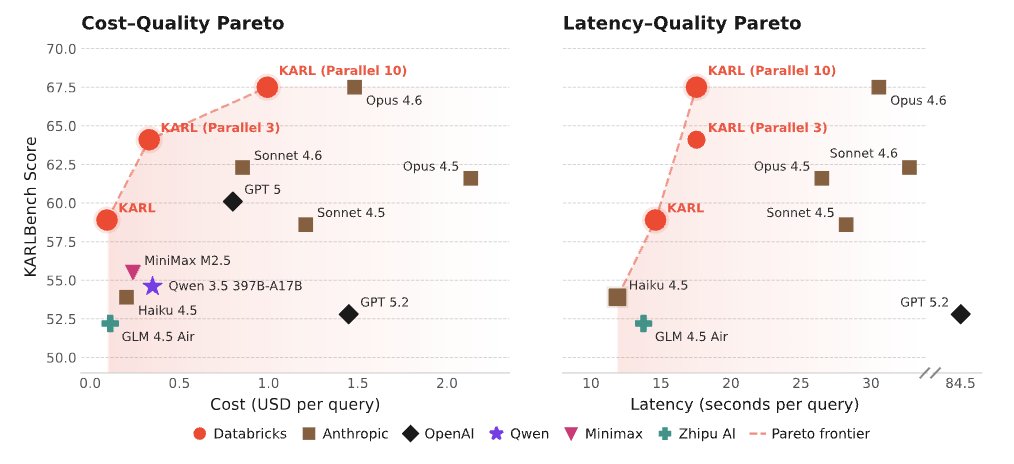
We just released KARL — a knowledge agent trained with reinforcement learning that beats Claude Opus 4.6 and GPT-5.2 on enterprise search, at a fraction of the cost and latency.
🧵
🚨 The #1 problem with local AI is now solved.
There’s a new tool called llmfit that checks your hardware and tells you which models will run well before you download anything.
So instead of guessing and hitting out-of-memory errors…it gives you a ranked list based on your machine.
What it does (in one command):
→ scans your setup (RAM / CPU / GPU / VRAM)
→ evaluates models for quality, speed, fit, and context
→ selects the best quantization automatically
→ labels what’s ideal vs okay vs borderline
The part I like most: it handles MoE models correctly.
Example: Mixtral 8x7B has ~46.7B total params, but only ~12.9B are active per token, and llmfit accounts for that (a lot of tools still don’t).
100% Opensource.
wow
Massive biotech acceleration
The team at Isomorphic Labs has just revealed its next generation AI drug design engine (IsoDDE), which is a huge leap beyond even AlphaFold 3 in accuracy and capability.
This new engine predicts molecular structures, binding affinities, and hidden drug target interactions far more precisely and much faster than traditional methods, enabling rational drug design entirely in silico with breakthrough fidelity.
It represents a massive step toward truly AI driven medicine, accelerating how we discover and optimize new therapeutics and opening up entirely new biological pathways that were previously unreachable with computers alone.
🚨BREAKING: DeepReinforce just dropped IterX and it's the most dangerous thing to happen to CUDA engineers in years.
An automated system that optimizes your code using reinforcement learning and it already beat cuBLAS across 1,000 matrix configs.
Here's how it works:👇