You know that game where you pick petals from a flower to determine if “she loves me / she loves me not” ~ here it’s transformed into a love ring, with hinged panels that open to reveal different options “I love you a little /a lot /passionately/not at all” (France, c 1850)
https://t.co/WiIPUuL49y
@andtartary2 He is King of Nuiche, (after his father was killed).
You can start at p. 257 https://t.co/7L4xc7Mr1a
Or search more for the kingdom of Nuiche.
One of the most incredible sculptures in the world - "The Double Statue of Mephistopheles and Margarita" :
Statue of Mephistopheles and Margaretta, a 19th Century CE, wooden double sculpture featuring two images carved on opposite sides; it portrays two characters from German playwright Johann Wolfgang von Goethe's 1808 CE, play Faust. The obverse depicts the demon Mephistopheles, and the reverse depicts a woman, Margaretta (Margaret or Gretchen). A mirror placed behind the sculpture allows both sides to be seen simultaneously.
In 19th Century CE, sculpture was created by an unknown French sculptor, carved into a block of sycamore wood. The obverse is a depiction of a confident and arrogant Mephistopheles, wearing a hood and boots, and with a smirk on his face. On the reverse side, Gretchen is depicted with her head bowed, appearing as a simple girl with downcast eyes. While identity of the sculptor of this romantic sculpture remains unknown, choice of such a German archetype for a French statue reveals how post 1870 CE, there was a surging interest in things German and topics in countries like France, etc.
The statue is carved from a single block of wood and is exhibited with a mirror placed behind it, allowing viewers to observe both sides at the same time. The dichotomy of good and evil is emphasized by the innocence of the female figure, a demure woman holding a prayer book in her hand, contrasting with depiction of evil exemplified by Mephistopheles.
The statue reflects the themes of good and evil in Goethe's Faust. In the play, Faust is frustrated with his life and attempts suicide. He calls for Satan's help, and the demon Mephistopheles, an agent of Satan, responds. Faust is told that Mephistopheles will serve him as long as he lives, but after his death, Faust would forfeit his soul and become enslaved forever. He agrees, making a deal with the Devil, and as one of his requests for magic, Mephistopheles seduces a young woman named Gretchen (Margaretta) for Faust. She is impregnated by Faust and gives birth to his bastard son. Upon realizing the evil, Gretchen drowns her child and is subsequently imprisoned on charges of murder. She is ultimately hanged, but is granted entry into heaven; Faust is also saved by God because of Gretchen's pleadings. Another literary text where the figures of Margaretta and Mephistopheles feature is The Master and Margarita by Mikhail Bulgakov, which was written between 1928 and 1940, but not published until 1966.
One of the major attractions of the Museum's European Art Section, the dimensions of the statue is 177.2cm, and it was presumably created in late 19th Century CE, in France. Sculpture represents the thin line that exists between the duplicity of good and evil as represented by Margaretta and Mephistopheles, respectively. The male image stands proud in a hooded cloak, heeled boots and has a long, gaunt face with a cynical smile, while Margaretta is shown as a shy, girl with a prayer book in her hand, and downcast eyes, lost in love.
The statue was acquired by the former Prime Minister of Hyderabad Salar Jung I; he acquired it in 1876 CE, during his travels in France. It is one of the most photographed images of the museum. The sculpture now resides in the Salar Jung Museum in Hyderabad, India.
#archaeohistories
Clockwork Robots of Antiquity 🧐
"The Writer" a 240-year-old, 6000 piece drawing machine that was created by Swiss-born watchmaker Pierre Jaquet-Droz, his son Henri-Louis, and Jean-Frédéric Leschot around 1770-1772.
"The Writer has an input device to set tabs that form a mechanical programmable memory, forty cams that represent a read-only program, and a quill pen for output. He is thus able to write any text up to 40 letters long. The text is coded on a wheel where characters are selected one by one. He uses a goose feather to write, which he inks from time to time, and he shakes his wrist to prevent ink from spilling. His eyes follow the text being written, and his head moves when he dips his pen in the inkwell."
A 16th-century German ring that turns into an astronomical sphere Astronomers in the 16th and 19th centuries wore rings that unfolded to become tools for calculations. The rings looked like ordinary finger rings, but were actually armillary spheres.
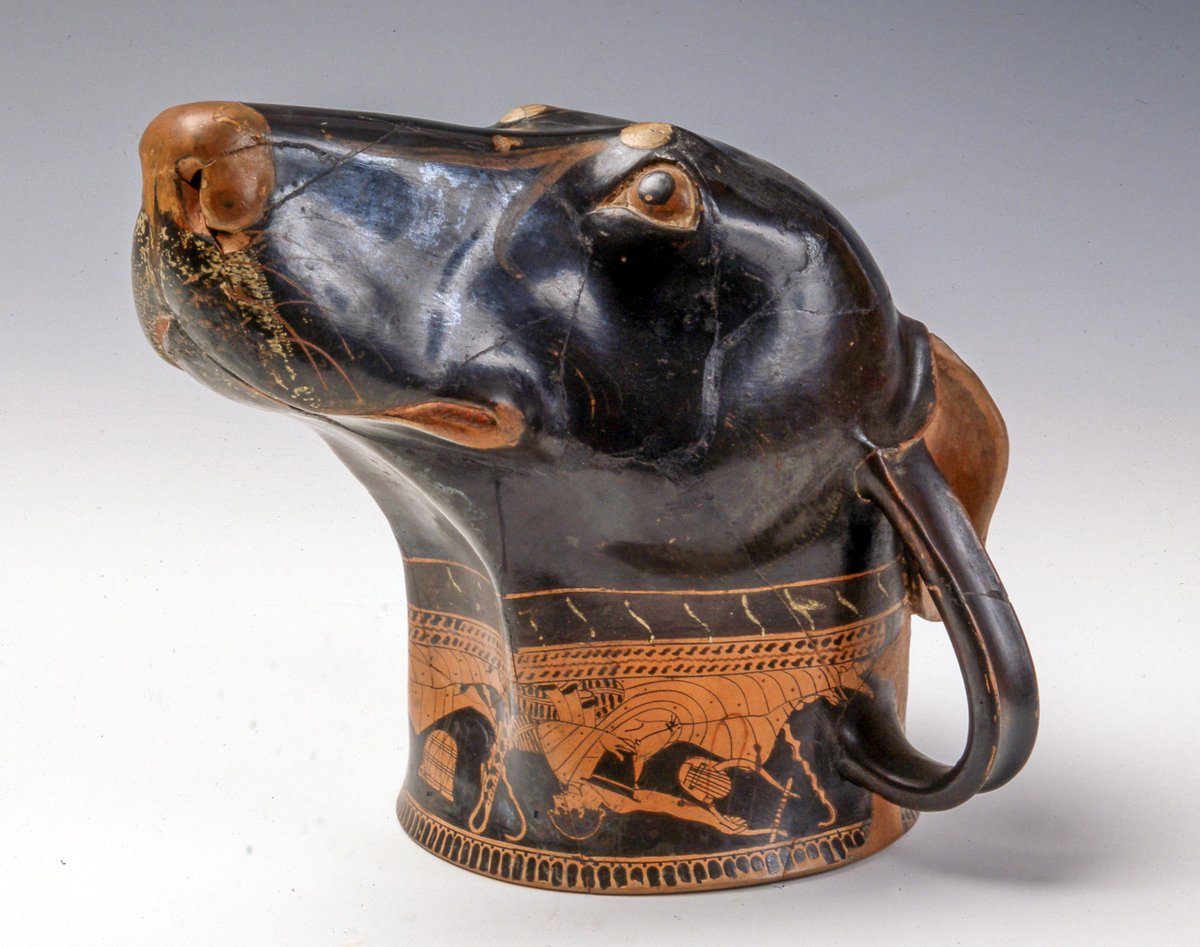
Rhyton drinking cup in the shape of a dog's head. The beautiful vessel is attributed to the prolific ancient Greek potter, Brygos, who was active in Athens between 490-470 BC and whose fine work is known from around 200 surviving pieces.
Intentionally made without a flat base, these ornate animal-head rhytons could not be set down on a table until completely drained of their contents. After downing the last of his wine, an ancient drinker could place the cup upside-down and be greeted by the face of the faithful hound.
Found in tomb 16 of the Celle necropolis near Falerii. 5th century BC, National Etruscan Museum in the Villa Giulia, Rome.
Dating from the 12th century, this remarkable chain-link column adorns the Church of St Lazare in Avallon, France. The image at R shows it surrounded by multiple variations and carvings
World’s coldest village sets new summer temperature record
It was 32 degrees Celsius (89.6F) on Monday in Oymyakon in Russia’s Far East, local media reported
https://t.co/nfTQsWgyie
@Carolynahil@MeghansMole@TheMingingTart From the video, the top pic looks like a "stand-in/body double" that she probably used during the filming of the series. The other 2 are obviously her.