History doesn’t repeat itself, but it often rhymes.
💻 PCs had their operating system.
☁️ Cloud had its hyperscaler.
🧠 AI had its compute layer.
⛓️ Onchain finance has its oracle platform.
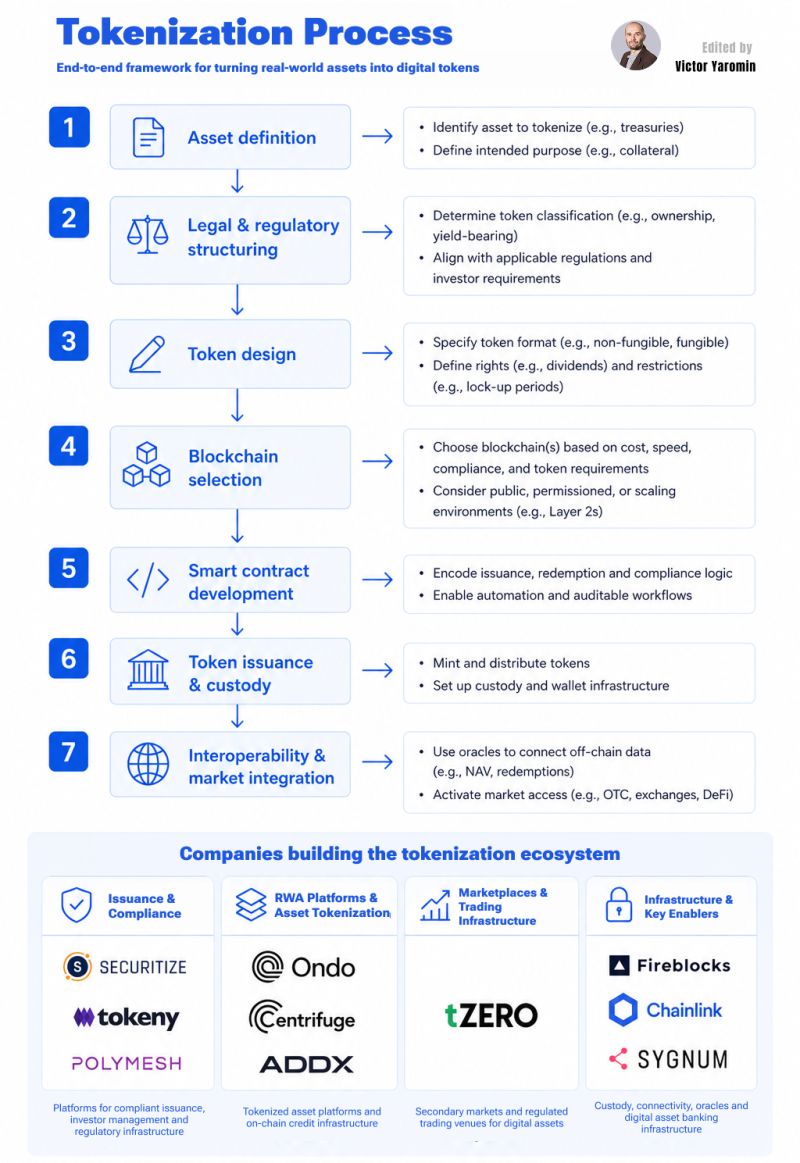
Most people describe tokenization as:
“Take an asset. Issue a token. Put it onchain.”
In reality, tokenization looks much closer to building a miniature financial system around the asset itself.
Before any smart contract exists, teams must define:
- what economic rights the token represents
- which regulations apply
- how custody works
- who can hold it
- how transfers settle
- how compliance is enforced
Then comes the infrastructure layer:
- issuance
- custody
- pricing
- liquidity
- interoperability
- settlement
- secondary markets
Without those layers, a tokenized asset is just an isolated database entry.
That’s why companies like:
Securitize, Tokeny, Ondo Finance, Centrifuge, Fireblocks, Chainlink, and tZERO are building entire layers of the emerging stack.
The important shift:
Once assets become programmable, finance itself starts behaving differently.
Settlement becomes faster.
Collateral becomes mobile.
Yield becomes automated.
Markets become interoperable.
Tokenization is not just “putting assets on blockchain.”
It’s the gradual rebuilding of financial infrastructure into programmable systems.
Tokenized deposits are moving beyond payments.
They are becoming collateral infrastructure for institutional finance 👇
New architectures combining Canton Network + Hyperledger Fabric show how programmable bank money can support:
- collateral mobility
- atomic financing
- margining
- settlement coordination
- cross-chain interoperability
The important shift:
Collateral is no longer static.
Tokenized deposits can now:
- move in near real-time
- remain programmable
- settle atomically
- integrate directly into lending and treasury workflows
The flow increasingly looks like:
deposit, token minting, collateral pledge, automated financing, real-time settlement.
And technologies like DAML smart contracts & interoperability layers are making this operationally viable inside regulated environments.
This matters because institutional tokenization is not only about assets.
It’s about rebuilding:
- liquidity management
- collateral efficiency
- settlement infrastructure
- counterparty coordination
Around programmable financial systems.
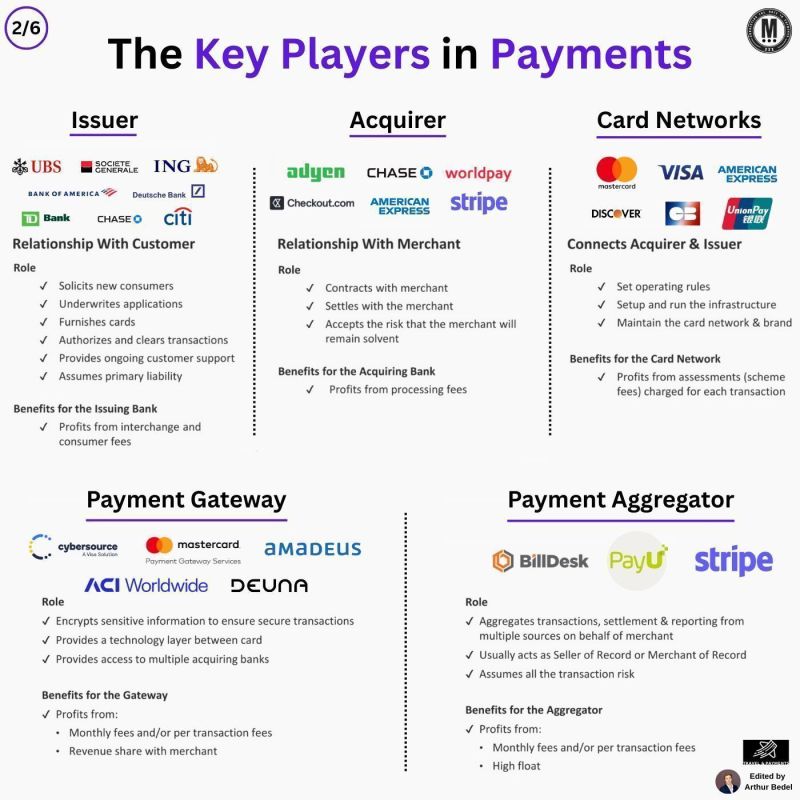
Who really sits behind every card payment?
A single transaction actually involves a full stack of financial players working together:
Issuers:
The banks giving you the card
(Citigroup, UBS, ING)
- Issue cards
- Approve transactions
- Earn interchange, fees & interest
Acquirers:
Enable merchants to accept payments
(Checkout. com, Worldpay, Nuvei)
- Merchant accounts
- Processing & settlement
- Fraud & chargeback management
Card Networks:
The transaction rails
(Visa, Mastercard, American Express)
- Route transactions
- Set rules & fees
- Enable global acceptance
Gateways:
The technical connection layer
(DEUNA, CellPoint Digital)
- Secure data routing
- Fraud tools & authentication
- Merchant dashboards
Aggregators:
All-in-one payment platforms
(Stripe, Paddle, PayU)
- Simplify onboarding
- Act as Merchant of Record
- Bundle payment services
The real insight:
Payments look simple on the surface.
But underneath is a layered economic model where every participant takes a small piece of every transaction.
Banking’s next transformation isn’t about better apps.
It’s about the bank disappearing.
We’ve moved through three phases:
Branches: banking tied to location
Mobile: banking moved to apps
Invisible: banking triggered by context, AI, and automation
The next bank won’t be something you log into.
It will operate in the background of everyday life.
What’s driving it:
- Conversations replacing interfaces
- Personalization at scale
- Hybrid human–AI teams
- Intelligent decision systems
- AI-native banking architectures
The real divide ahead:
Banks rebuilt around AI vs. banks merely using AI.
The winners won’t just add AI on top.
They’ll rebuild the bank around intelligence.