Introducing Muse Glimmer, an open-weight 30B-parameter model optimized for local, always-on agent workflows.
Muse Glimmer delivers strong performance on key agentic use cases and benchmarks compared with leading models in its size category, and is designed to run entirely on consumer hardware like a Mac or PCs with performant GPUs.
In keeping with our long tradition of sharing fundamental AI research, we’re releasing model weights under a permissive Apache 2.0 license.
🧵👇
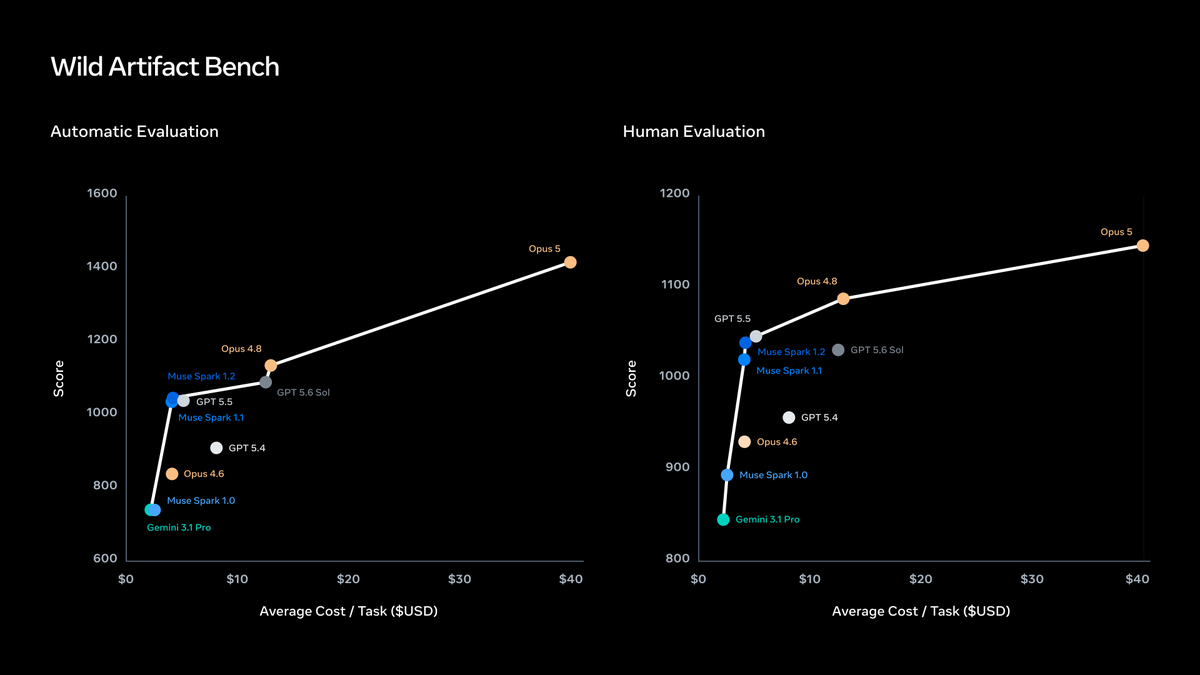
Today we’re also previewing WildArtifactBench, an internal evaluation framework designed to assess agents on complex, real-world tasks across diverse deliverable formats.
By using win rates and Elo scores from human and agentic preference judges rather than strict ground-truth rubrics, it expands task coverage across practical multimodal workflows.
We’re releasing 10 tasks from WildArtifactBench as a step forward in our ability to measure the real practical utility delivered by multimodal agents: https://t.co/UIpdcw8JF2
Internally, Muse Spark is deployed in several areas including media generation. For example, the model works with Muse Image for agentic media generation and produces detailed captions as training data for Muse Image and Muse Video. Muse Spark is also able to translate raw text, image, and video content into signals and insights that can be used in downstream applications.
See more Muse Spark 1.2 evals and demos here: https://t.co/1p45HAWiAN
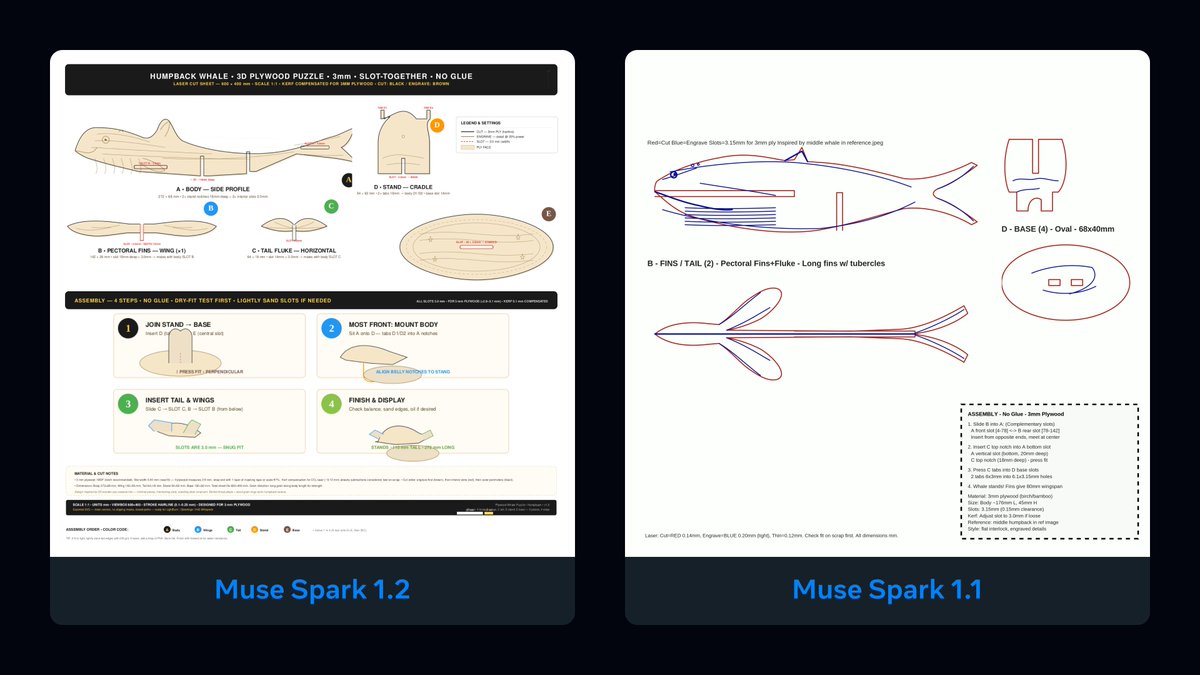
Muse Spark 1.2 supports a broad range of multimodal tasks, from turning visuals into working code to translating perception into physical action. It also brings robust audio-visual understanding to enable video-heavy workflows common in real-world enterprise use.
Today, we’re sharing new evals and demos that illustrate the breadth of the model’s visual understanding and reasoning capabilities.
Let’s start with a demo that shows how Muse Spark parses multimodal observations and calls tools to guide a robot to navigate in an unstructured environment to find a rubber duck.
🧵👇
Muse Spark brings spatial intelligence to robotics. A specialized variant of Muse Spark acts as the robot brain and orchestrator: it takes a user instruction, decodes tool calls, observes the results, and loops until the task is complete.
As shown in this demo, Muse Spark 1.2 can plan sub-tasks for a bimanual robot tidying a desk, distinguishing a hair brush from a makeup brush and placing the lipstick in a drawer.
Meet Muse Glimmer: an open-weight model built for always-on local agents.
30B parameters, Apache 2.0 and tuned for complex multi-step work so it plans, calls tools, hits errors, retries, and sees the task through long-horizon loops.
Muse Glimmer is designed to balance capability against the memory and compute constraints of local hardware.
We couldn’t be more excited to get this in the hands of developers.
Download and start building now: https://t.co/NKBJ0SHrmU
Introducing Muse Glimmer, an open-weight 30B-parameter model optimized for local, always-on agent workflows.
Muse Glimmer delivers strong performance on key agentic use cases and benchmarks compared with leading models in its size category, and is designed to run entirely on consumer hardware like a Mac or PCs with performant GPUs.
In keeping with our long tradition of sharing fundamental AI research, we’re releasing model weights under a permissive Apache 2.0 license.
🧵👇
Muse Glimmer can complete multi-step agentic tasks end-to-end from a single natural language prompt.
In this demo, it autonomously discovers a local Home Assistant instance via network tool calls, queries device APIs, writes a responsive HTML/CSS/JS dashboard from scratch, and deploys a local server for verification.