I’m looking forward to attending the VPA Fall Workshop on September 25th at the Hyatt Regency St. Louis at the Arch.
I’ll also be sitting on two panels:
PANEL · RETAINING CUSTOMERS & PROTECTING YOUR BRAND
PANEL · AI IN VEHICLE SERVICE CONTRACTS
Both topics are very closely connected to what we work on every day at AIM AI.
On the retention side, a lot of the customer’s experience happens after the sale. How quickly you answer the phone, how you handle claims, how you manage cancellations, and whether the customer gets a consistent answer all affect the brand.
On the AI side, I’m looking forward to sharing what we’re actually seeing from real deployments.
What works well today.
Where AI still needs human support.
And how companies are using AI for sales, screening, verification, customer service, training, and claims intake.
I think there’s a big difference between showing a good AI demo and building something that works inside a real VSC operation.
So yeah, it should be a good discussion. If you’re attending, come find me. I’d love to trade notes and hear what everyone else is working on.
#VPAFallWorkshop #VehicleServiceContracts #VoiceAI #WarrantyIndustry
AI doesn’t have to adjudicate an entire claim to create a huge amount of value.
A big portion of a claims adjuster’s day is often spent answering the initial call, collecting information, entering it into the CRM, and preparing the file for review.
That’s exactly the type of work AI can handle today.
In three of our current deployments, the AI is completing close to 80% of what a level 1 claims adjuster does in a day.
The calls are answered immediately.
Hold times are basically nonexistent.
The claim information is collected, documented, and ready for a human to review.
The AI isn’t replacing the judgment of an experienced adjuster. Complex claims, coverage decisions, and potential fraud still need the right human involved.
But the senior claims staff can spend more time adjudicating claims instead of entering information into a system.
I think that’s where companies sometimes get AI wrong.
You don’t have to automate 100% of a position for the economics to work.
Automate the repetitive part. Let your experienced people focus on the decisions that actually require experience.
Most new call center reps don’t struggle because they never saw the script.
They struggle because reading a script and handling a real customer are two completely different things.
You can understand the product and still have marbles in your mouth when someone interrupts you, says they can’t afford it, or asks a question you weren’t expecting.
That’s why we built an AI role-play agent for call center training.
We used approximately 150 real sales calls to organize the objections reps actually hear:
“I need to think about it.”
“I have to talk to my wife.”
“I can’t afford it.”
“What exactly is covered?”
The AI rotates through different scenarios so trainees can’t just memorize one conversation. A second AI then evaluates the call using a ten-point rubric covering areas like product knowledge, compliance, delivery, integrity, and objection handling.
The next step is bigger than scoring one practice call.
We’re working on measuring each trainee’s baseline, tracking improvement across multiple calls, and giving managers actionable reporting.
Because the goal isn’t to prove someone completed training.
The goal is to know whether they’re actually ready to speak with a live customer.
This week we've been working closely with a marketing BPO that needs more call volume.
The interesting part is we're not trying to replace their team.
We're helping them add another layer of labor.
That's a use case for voice AI I think gets overlooked.
Call centers have worked with BPOs for years because US labor is expensive, coverage is difficult, and sometimes you simply need more capacity.
AI can become another option in that same labor equation.
In traditional BPO, you have to interview, hire, and train that ramp can take months.
Rather than switching everything at once, we’re taking a phased approach and using AI as a transitional solution as we scale up.
Start around 25,000 calls a day.
Listen to the calls.
Track CPA.
Fix what needs fixing.
Then move toward 100,000, 500,000, and eventually 1,000,000 calls per day after proving the concept.
The humans don't disappear.
The goal is to use AI for the repetitive volume and let the team spend more time where humans create the most value.
That could mean working aged leads after live reps have already made several attempts.
Or simply giving a BPO additional capacity when a client wants to scale faster than they can hire and train.
Coming from the call center side, this makes a lot more sense to me than the "AI replaces everyone" narrative.
BPOs became valuable because they gave businesses a more flexible way to access labor.
I think AI is going to give BPOs another way to deliver it.
A few years ago, we were working in the vehicle service contract industry and trying to make early versions of AI do something it wasn’t built to do yet.
Screen inbound direct mail calls and transfer it to a live rep.
Sounds simple now.
Back then, it wasn’t.
With the right scripting, the AI sounded fine. But, it couldn’t reliably find the right customer, update the CRM, process a payment, route a call, or hand a call off to a live a rep.
So we stopped waiting for the technology to catch up and started building the missing pieces ourselves.
We built our own phone infrastructure and orchestration layer from scratch.
Integrated with platforms like Inline and Moxy to support search, create, edit, payment processing, note-taking, and disposition workflows.
Taught agents how to screen inbound calls, follow up with opt-in leads, handle overflow, support closers, and work inside the systems VSC companies already used.
It was years of small operational decisions, failed tests, prompt changes, integrations, and listening to real calls.
This fall, I’ve been invited to speak at the VPA Fall Workshop.
I’ll join one panel on retaining customers and protecting the brand, and another on AI in vehicle service contracts and contact centers.
The industry showed us the problems before the technology was ready to solve them.
Now I get to sit in a room with the people shaping that industry and share what we’ve learned by building through those problems.
I truly appreciate it, and I don’t take that lightly..
The VSC industry gave us the problems worth solving.
Now we get to help build what comes next.
One thing I’ve noticed after hundreds of conversations about AI:
The companies that move fastest aren’t always the ones with the biggest budgets.
They’re the ones that treat AI like a partnership instead of a purchase.
This week we met with a company that had already spent hundreds of hours building bots.
Most vendors would have started by replacing everything.
Instead, we talked about what should stay exactly the way it is.
Some of those scripts had been refined over years.
Some of the objection handling came from thousands of sales calls.
Some of the compliance language existed because it had already been battle tested.
Why throw that away?
Good AI isn’t built by ignoring the people who already know the business.
It’s built by learning from them.
The fastest implementations I’ve seen all have one thing in common.
Weekly calls.
Constant feedback.
Small improvements.
No ego.
AI gets smarter.
The business gets stronger.
And both sides end up building something neither could have built alone.
Your best salespeople are probably your best training manual for new hires.
The problem is… most companies have trouble translating this to actual training.
Coming from the call center world, I’ve seen companies spend weeks building onboarding guides, PowerPoint presentations, and resorting to test taking as a measure.
All of that has value.
But that’s rarely what turns someone into a top performer.
The things that actually move the needle are much harder to document.
It’s knowing when to slow down instead of rushing.
It’s recognizing the difference between “I’m busy” and “I’m not interested.”
It’s staying composed when a customer is frustrated.
It’s handling the same objection for the hundredth time without sounding like you’re reading from a script.
Those are skills that come from experience, not from clicking through training modules.
That’s one of the reasons we’ve been getting more requests to build voice AI training agents.
Not because companies want to replace trainers or managers.
Because they want every new hire to get hundreds of realistic conversations before they ever pick up the phone with a real customer.
A voice AI training agent can challenge a rep with tough objections, changing customer personalities, difficult escalations, and real-world scenarios that rarely happen in a classroom. It can give instant feedback, identify weak spots, and let someone practice until the right response becomes second nature.
Whether it’s sales, customer service, claims intake, appointment setting, or lead qualification, confidence comes from repetition.
Your best employees weren’t born knowing what to say.
They became great by having thousands of conversations.
Now businesses have a way to give every new hire those “at bats” much earlier in the learning curve.
I think that’s going to change the way companies approach training over the next few years.
An AI agent can hit its conversion target and still fail.
If it gives the wrong information, skips required language, or mishandles one edge case, the cost shows up later:
Refunds.
Complaints.
Rework.
Lost trust.
Clients questioning every call.
That’s what makes QA and compliance so difficult. The biggest problems rarely appear in a dashboard.
A conversation can look “successful” while the agent makes a promise it shouldn’t make.
A small prompt edit can fix one objection and create three new issues.
I’ve learned that making an AI agent successful takes much more than testing a few perfect calls before launch.
It takes a clear QA scorecard that defines what a good conversation sounds like.
Unpopular opinion: It takes daily listening to real calls, especially the messy ones with interruptions, confusion, and unexpected questions.
It takes one approved master script, tracked changes, clear ownership, and the ability to reverse a bad update quickly.
And it takes a controlled rollout.
Start with a limited number of calls. Find the weak points. Fix what breaks. Then increase the volume.
The goal isn’t an agent that performs well in a demo.
It’s an agent designed to remain accurate, consistent, and reliable as call volumes rise, even when real callers regularly go off-script.
Conversion matters.
But conversion without quality control is just risk moving faster.
What does your team consider serious enough to stop a launch?
7,205 inbound calls.
1,638 completed claims.
This is what happened when one claims administrator stopped treating one-hour hold times as a hiring problem.
Before working with us, callers routinely waited 60+ minutes. Complaints were growing. Dealers and repair partners were frustrated. The company kept hiring people mainly to answer the phone, only to run into the same turnover and backlog.
They manage auto and home claims coming from dealer repair facilities and independent home service contractors.
We helped make AI the first point of contact for new claim intake, existing claim follow-ups, customer resolution, and general questions. Every call and claim update is posted into their data management system.
In June alone:
• 855 auto claims completed
• 783 home claims completed
• 24,705 minutes of staff time saved
What stood out to me was that faster pickup was only part of the result.
The bigger impact came from completing the work behind the call.
That gives experienced claims adjusters more time for complex exceptions, escalations, and cases that actually require domain expertise.
Long hold times are not just a customer service issue. They can become a partner-retention and growth issue.
If you’re a claims administrator, TPA, warranty company, or insurance service team running into this bottleneck, I’m happy to share the workflow that produced these results.
The future of call centers isn’t “no humans.”
It’s humans focused on what matters most.
That distinction gets lost in a lot of AI conversations.
People hear “AI phone agents” and immediately jump to replacement.
But when you actually look at high-volume call center workflows, the first opportunity usually isn’t replacing your best people.
It’s removing the repetitive work that keeps them from doing their best work.
Initial auto warranty claim intake.
Lead qualification.
Booking appointments.
Past due payment reminders and collections.
IVR routing.
Level 1 customer service.
These are the calls that clog up the queue, create 1 hour+ hold times, and force trained reps to spend their day asking the same seven questions over and over again.
Meanwhile, the conversations that actually need human judgment still need humans.
Complex sales.
Edge-case claims.
Angry customers.
Relationship-driven conversations.
That’s where your best people should be spending their time.
Not collecting VIN numbers.
Not confirming addresses.
Not manually typing notes into a CRM after every call.
The companies that get this right won’t be the ones trying to automate everything overnight.
They’ll be the ones that separate the work into two buckets:
What can AI handle consistently?
And where does a human create the most value?
That’s the real change.
Not AI in place of people.
AI in front of people, filtering the noise, cleaning up the intake, and making sure the right calls get to the right person faster.
The call center of the future won’t be empty.
It’ll just have a lot fewer people doing work AI should’ve been doing years ago.
AI agents don’t fail because customers are difficult.
They fail because the system was built for ideal conversations instead of real ones.
In the demo, the customer reads their membership ID clearly.
“Four two seven nine one eight six.”
The agent captures it. The flow continues.
In a real-life scenario, businesses can sometimes use longer IDs. I have one call center where their customer IDs are 15 characters.
A real caller says:
“Four two seven…”
Pause.
“Nine one a b…”
Pause.
“One seven seven…”
Pause.
“Two one…”
Pause.
“Three three four…”
The speech-to-text sends those fragments to the LLM in chunks.
The LLM thinks the caller stopped.
So it repeats the prompt.
Now the caller is annoyed, the workflow is broken, and voice AI gets a bad rap.
Usually, the model is not the problem.
The assumptions are.
You built for clean input. Real customers give you human input.
Slow speech. Background noise. Pauses. Corrections. Half-answers because the caller is preoccupied with something else.
This is why the right team matters more than most AI agencies want to admit.
Voice AI for call centers isn’t just prompts and endpoints. It's operational reality, handled by AI agents trained for real-world scenarios, from routine requests to high-stakes issues.
You need a team that combines AI engineering with real call center domain expertise to design the rules, spot edge cases, and keep the system stable as it evolves.
But it’s the part that keeps the agent from falling apart when real customers show up.
They care that callers don’t repeat themselves five times.
They care that the workflow completes.
They care that the system works when the conversation gets messy.
Perfect demos get attention.
Production agents get repeat business and referrals.
I had a call this week with a call center client where the real conversation was not about how natural the AI sounded.
It was about whether the AI could help them run a better operation.
Could it tell the difference between a lead who genuinely needs a callback and a lead using “I’m busy” as a soft objection before the sale goes cold?
Could it route English and Spanish transfers correctly?
Could it tell when a call is headed into a Google Voice inbox, an AI answering app, or another dead-end path — and move on before the business burns more time and cost?
That’s where AI starts creating real value.
Not in the demo.
In the details.
For call centers, those details matter because small improvements add up fast. A few seconds saved on silence detection. Cleaner transfer labels. Better follow-up. Fewer missed opportunities. More accurate reporting for the team and the client.
For outsourced teams managing volume across multiple accounts, this matters even more.
You’re not just trying to answer calls.
You’re trying to protect quality, control labor costs, keep agents focused on the right conversations, and prove performance with numbers your clients can trust.
That takes more than plugging in an AI agent.
It takes a team that understands call flow, sales handoffs, reporting, QA, routing, compliance, and the weird edge cases that happen every day on live calls.
Not just building an agent that can talk.
Building a system that helps the business capture more opportunities without adding unnecessary friction for the customer or the team.
AI can be a huge advantage for call centers.
But only when it is built around the operation, not forced on top of it.
The companies that get this right won’t just have better automation.
They’ll have cleaner data, stronger performance, and fewer opportunities slipping through the cracks.
The agent isn’t the challenge, getting it to actually live inside the business is.
That’s what clicked for me after a call this week with one of the call centers we support at AIM AI.
We’re the team building and running the agents that sit behind these workflows.
They pick up inbound calls, cover overflow and after-hour marketing calls, run outbound follow-up, handle claims intake, take payments, and hand off to live reps when it matters.
And it confirms the part most AI shops would rather avoid:
The agent itself is headed for commodity status.
Because:
The same voices, models, and a slick demo doesn’t prove it survives contact with a real, chaotic operation.
So what doesn’t get commoditized?
Results.
A call center isn’t shopping just for an AI voice agent.
It’s buying answered after-hours calls that convert to paying customers, resurrected leads that convert to revenue, and qualified buyers delivered to sales people on a platter.
And you don’t get that with a one size fits all prompt.
You get it with CRM integrations, payment flows, compliance rails, transfer logic, call QA, constant testing, and a team that knows the operation well enough to catch the weird edge cases before they become outages.
No one pays extra because the voice sounds “human.”
They pay because fewer leads leak, more conversations turn into contracts, and the business scales without hiring an entire new shift.
The winners will be the ones who can turn AI into a line item the client can measure at month’s end.
One number from today’s AI meeting mattered more than anything else:
12% conversion to sold on overflow calls.
Sales rep converts at 10% on average.
AI agent handles the front end, attempts the payment, and brings in a live rep when the situation needs judgment. That can lower staffing costs, cover hard to staff hours, and recover revenue that would otherwise disappear.
But the meeting also exposed what most AI demos leave out.
1. Payments have to be batched correctly, or you risk duplicates and failed transactions.
2. The human handoff has to happen at the right moment, with the right context, or the customer will hang up.
3. The systems holding the data may have limited APIs, closed desktop apps, and no clean way to trigger real-time follow-up.
So where does the value really come from?
Not the AI agent by itself.
It comes from the developers who build the integrations, the operators who understand the workflow, the sales team that knows where customers hesitate, and the people monitoring the edge cases after launch.
A business doesn’t want “AI automation.”
It wants declined payments recovered, unclosed leads called back within minutes, and more sales completed without adding another full shift.
AI can create huge leverage.
But without the right team around it, even a great model stays stuck as a demo.
The companies that win in 2026 won’t be the ones with the flashiest AI.
They’ll be the ones that can make it work inside a messy, real business.
AI can create massive value for a business.
But only when it’s built, tested, and managed the right way.
Implementing AI is not just “plug it in and let it run.”
There are scripts to refine.
Objections to route correctly.
Compliance risks to avoid.
Payment flows to tighten.
Customer experience issues to catch.
Bugs to fix before they cost real money.
And edge cases that only show up once real people start interacting with the system.
One small wording change can make an AI sound more natural.
One bad trigger can make it offer a discount too early and devalue the sale.
One interruption during a customer ID can create confusion and kill trust.
One payment issue can turn a great customer experience into a support nightmare.
That’s why the right team matters.
AI can absolutely help businesses sell more, save time, handle volume, and improve consistency.
But without the right setup, it can also create friction in the exact moments where trust matters most.
This is where we come in.
We don’t just hand you an AI tool and wish you luck.
We help design the flow, build the logic, write the scripts, test the calls, monitor the issues, improve the customer experience, and keep refining until it works in the real world.
A complete white glove AI implementation.
Because the value of AI is not in the software alone.
It’s in the strategy, the execution, and the team behind it.
#AIImplementation #BusinessAutomation #AIAgents #SalesAutomation #CustomerExperience
Over the last couple of weeks, we've been onboarding a new call center to run our voice AI agents at scale. They manage 350 BPO agents across Mexico, Pakistan, and Costa Rica.
If you know anything about BPO and offshore reps, managing them is brutal. You hire 50 new reps, 5 make it. You deal with power outages, BPO managers swapping out your top agents without notice, and gatekeeping so you never really see who you're working with.
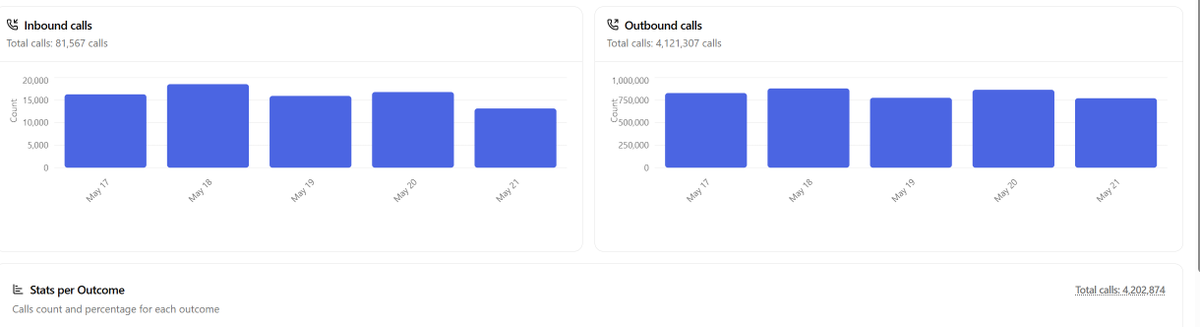
Our goal for this center is 1.5 million calls per day (which would be a 100% of their BPO volume) with voice AI, and right now we're over 750,000, a big milestone for us. Managing the backend to handle this volume has been an exciting challenge. It's all about balancing stability and managing cost per conversion. You need the perfect blend of voice realism and low latency.
Here's what voice AI changes: stability and consistent quality on every call. With human BPOs at high rep count, the top 50% hit profitable conversion levels and the bottom 50% just fill the sales floor. With voice AI, every agent performs.
Based on the last few weeks of reporting, our voice AI agent is consistently converting in the top 25% compared to human reps.
Next week, we're hitting 1 million calls per day. Let's go!
What does it take to achieve a 70% cost reduction for a client? For AimAI, it took relentless focus to create the most ultra-realistic voice AI agents on the market.
This mission led them to test nearly every text-to-speech service out there. They chose Cartesia for three key reasons:
🔹 Unmatched voice realism
🔹 Ultra-low latency for real-time conversation
🔹 Deep customization to create unique, proprietary voices
See how our partnership is helping AimAI gain a competitive advantage and deliver incredible ROI. Link to the full case study in the comments 👇
@sama@nosilverv I feel like there needs to be announcement made. Updates impact our current prompts we build for businesses. We have to scramble to make changes.