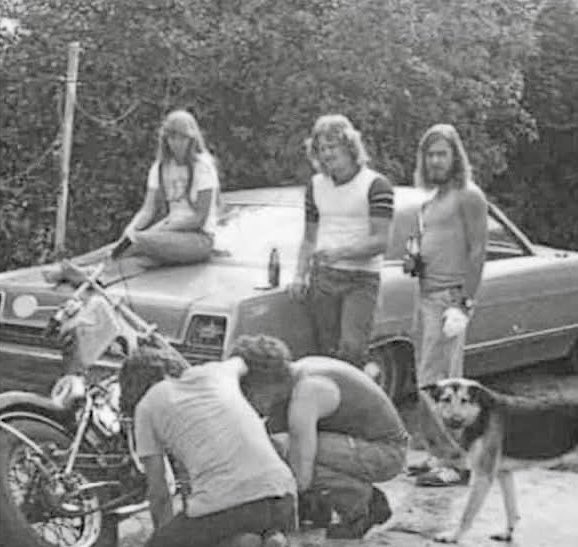
There’s a generation a lot of people forget exists. We were born at the tail end of the Boomers, but we are not culturally the same as people born in the 40s and early 50s. We are Generation Jones.
And honestly, it explains a lot.
We grew up in a world that still felt fundamentally analog, but we were young enough to be dragged headfirst into the digital revolution. We are the bridge generation between rotary phones and smartphones, between slide rules and AI, between Walter Cronkite and algorithm driven media.
We remember when there were only a few television channels and the entire country watched the same thing at the same time. We also adapted to the internet, email, forums, social media, streaming and now artificial intelligence. We lived before and after the technological singularity hit everyday life.
That is not a small thing.
People born in the 40s came of age in a post World War II America that was still industrial, deeply hierarchical and institutionally stable. Their formative years were shaped by the Cold War, Vietnam, the civil rights era and a society where information moved slowly.
Generation Jones came later. We inherited the aftermath of all of that.
We were the kids who watched Watergate destroy blind trust in government. We watched manufacturing begin to collapse. We saw divorce rates explode. We were the first truly latchkey generation in massive numbers. We learned independence early because many of us had to.
We grew up with one foot in old America and one foot in whatever this new thing was becoming.
We played outside until the streetlights came on but we also learned DOS commands. We learned cursive and keyboarding. We had card catalogs and Google searches. We went from vinyl records to cassette tapes to CDs to MP3s to streaming in one lifetime.
We remember maps. We remember memorizing phone numbers. We remember life before GPS and before every human interaction became filtered through a screen.
And because of that, I think Generation Jones developed a very unique perspective. We are adaptable because we had no choice but to adapt. We learned technology as adults instead of being born into it. We remember a slower world but were forced to survive in a rapidly accelerating one.
That creates a very different mindset than either older Boomers or younger Gen X and Millennials.
A lot of us also reject the caricature people now associate with “Boomers.” We were not buying houses for the cost of a sandwich in 1965. The interest rate on my first house was over 14% and that was after buying down a point. Many of us got hit by recessions, outsourcing, pension collapses and economic instability just like younger generations did. We watched promises evaporate in real time.
We understand older generations because we were raised by them. We understand younger generations because we had to evolve alongside them.
That’s why the Jones generation often feels culturally homeless. We are rarely discussed, rarely defined and usually lumped into categories that don’t actually fit us.
But we exist.
We are the human transition point between the industrial age and the digital age.
And frankly, there will probably never be another generation quite like us again.
There's a big difference between a 'team' and a 'group.'
A true team is earned, built on shared principles and mutual respect, not just time spent together. It’s about how we talk about ourselves, share credit, and handle success and failure.
Improvement toolkits & good practice databases are useful but they only take us so far. As much as 80% of the knowledge in an organisation isn't written down. It's not a failure of documentation. it's to do with the nature of the knowledge and the way it gets spread. That's why it is critical that we make time & space for networks, communities of learning/practice, huddles & sharing conversations if we want change & improvement to happen: https://t.co/10ikbAwVBe. Thanks @nickknoco
"Mattering" is the belief that we’re significant to the world around us. When people feel they matter, they feel seen, important & needed through how others treat them. Scholars have deemed mattering to be a core instinct that drives all human behaviour. That’s why, when someone doesn’t believe they matter at work they:
- won’t share their voice if they don’t believe their voice is significant
- won’t use their strengths if they don’t believe they have strengths
- won’t contribute if they don’t believe they have something to contribute
- won’t care as much as if they feel cared for
Actions that leaders/ teams can take: see some excellent articles by @ZachMercurio - "How to Create Mattering at Work": https://t.co/vlxLnrqGWF and "The Cost of Not Mattering at Work": https://t.co/AocAKNMhxm.
Your interaction here is vital. It's more than a click. It is an act of remembrance against forgetting.
Help us commemorate victims, preserve memory & educate the world. Amplify our voice.
Like, repost & quote this message. Encourage others to follow @AuschwitzMuseum.
Judi Dench was on Graham Norton last night to push her new book about her life and work with Shakespeare. After making the point we quote Shakespeare daily without knowing it, this happened:
White privilege doesn’t mean that you’ve never faced hardship or challenges.
It just means that the hardship or challenges you faced were not related to your skin colour.
@JohnAmaechi explains it clearly and brilliantly here.
People at the top are more likely to feel like they have #PsychologicalSafety
They experience a lower baseline threat because they have higher status, autonomy, and certainty. But they assume that people below them feel the same and that’s often not the case. #PsychSafetyWeek
So loved appearing on BBC One - Kids' TV: The Surprising Story, with dearest @Konnie_Huq. It brought back so many wonderful memories #Playschool will remain in my heart forever https://t.co/DG0EQhTgfk
THREAD: Energy Bill Support Grant. I have just been notified that I will get £67 a month off my energy bills under the govt scheme. For enormous numbers of people this support will be absolutely vital. But it won't be vital for everyone, and that includes me. (PLS RT) 1/
child hasn’t read everyday this half term so can’t wear own clothes for school tomorrow. told in front of whole class they are on the ‘uniform’ list. fair or unfair? humiliating or not? good way to promote a love of reading? thoughts please #readingforpleasure#readingculture
Point your time machines for Holland in 1913: I have cleaned and enhanced for you this self-portrait by Dutch photographer Jacob Olie jr. It is an original colour autochrome (not colourised).