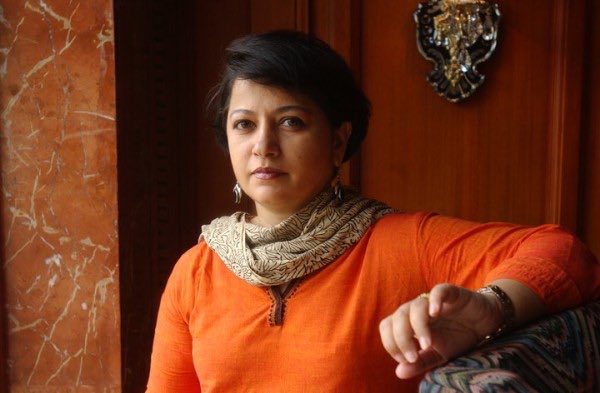
Her name is Sucheta Dalal.
Everyone remembers Harshad Mehta, the man who fooled the stock market and became a legend. Almost no one remembers the woman who caught him.
She was a business journalist at the Times of India in the early 1990s. She had trained as a lawyer, but she chose instead to write about money, and about the people who moved it.
In those years, one man ruled the market. Harshad Mehta, the Big Bull. Share prices did whatever he wanted them to do. He drove imported cars, lived in a sea facing penthouse, and the whole country treated him like a genius. Most journalists wrote adoring stories about him.
Sucheta Dalal did not. She looked at his sudden mountain of wealth and asked one simple question. Where was all this money coming from.
She began to dig. Quietly, through her contacts in the banks and the Reserve Bank, she followed the paper trail. What she found was staggering.
Mehta was pulling thousands of crores out of the banking system using fake receipts, borrowing enormous amounts of public money against paper that was worth nothing, and pouring it into the stock market to push prices higher.
On 23 April 1992, her story appeared in the Times of India. It revealed that the State Bank of India alone was missing hundreds of crores linked to Mehta.
The market crashed. The country erupted. It turned out to be one of the biggest financial frauds India had ever seen.
Because of her reporting, the system was forced to change, and a new watchdog was created to guard the stock market so this could never happen so easily again.
Years later a hit web series told the story of the scam, and millions learned his name all over again.
But long before the cameras, there was just one reporter who refused to be dazzled, and asked where the money came from.
Special Intensive Revision (SIR) of Electoral Rolls (Voter Lists). If the Booth Level officer (BLO) asks you: "Where was your father registered as a voter in the year 2002?", what should be your reply?
Must-read if you have no idea about that information.
Link in bio.
The allegation is not merely about a few MPs switching sides. The deeper charge is that Indian democracy is being systematically manipulated through engineered defections, dummy parties, proxy candidates, pressure tactics, and delays in enforcing anti-defection laws.
The speaker in the clip argues that while defecting politicians must be held accountable for abandoning the mandate given by voters, the larger question is who benefits from these defections and why institutions often fail to act in time. If elected representatives can change sides without immediately facing voters again, then the people's mandate becomes a commodity rather than a democratic trust.
Democracy survives only when votes belong to citizens—not to political brokers, money power, intimidation, or backroom deals. Every defection that overturns a public mandate weakens faith in elections and strengthens the perception that power matters more than principles.
If anti-defection laws are repeatedly bypassed through technicalities, shell groups, or institutional delays, citizens have every right to ask whether democracy is being protected or traded.
Original video:
https://t.co/xyh4zKgwRz
यह एक दुर्भाग्यपूर्ण और कड़वा सच है कि हमने गाय, गोबर, गौमूत्र, गंदगी, जात, मजहब, चोरी, छिनैती पॉकेटमारी, झूठ, छल की सियासत वगैरह से अपने देश भारत की छवि, दुनिया भर में इतनी बिगाड़ रखी है कि यह अब सीधे हमारे देश के रेवेन्यू पर असर डाल रहा है.
एक अकेले #NewYork City में एक साल में 60 Million टूरिस्ट पहुंचते हैं.
जबकि पूरे भारत में एक साल में महज 14 मिलियन पर्यटक ही आते हैं.
यह आंकड़ा #WorldBank के प्रेसिडेंट #Ajay_Banga ने दिया है.
भारत जैसे विशाल देश के पास दुनिया की सबसे पुरानी सभ्यताओं में से एक, हर राज्य में अलग संस्कृति, खान-पान, यूनेस्को वर्ल्ड हेरिटेज साइट्स, हिमालय की वादियां और विशाल समुद्र तट हैं—फिर भी एक अकेला शहर #न्यूयॉर्क पूरे देश भारत से से 4 गुना से ज्यादा पर्यटकों को खींच ले जाता है.
पश्चिमी देशों में एक धारणा बनी हुई है कि भारत में घूमना चुनौतीपूर्ण हो सकता है.जब तक जमीन पर टूरिस्ट पुलिसिंग, साफ-सफाई और पारदर्शी व्यवस्था मजबूत नहीं होगी, आम विदेशी पर्यटक आने से कतराएगा ही.
विदेशी पर्यटकों के लिए सुरक्षा बहुत बड़ा मसला है. विशेषकर महिला पर्यटकों की सुरक्षा, स्वच्छता और स्कैम, ठगी, ओवरचार्जिंग, छेड़छाड़ आदि कई वजहों हैं जो विदेशियों को यहां आने से रोकती है.
रही सही कसर वो भारतीय पूरी कर देते हैं जो विदेशों में घूमने के नाम पर सड़क पर गरबा भांगड़ा करने लगते हैं. होटलों से सामान चुरा लेते हैं. विदेशी महिलाओं को घूर घूर कर परेशान कर देते हैं....
लेकिन इन सबसे ऊपर जो है वो है हम भारतीयों के basic civic sense की कमी. जो अन्य सभी परेशानियों की भी जड़ है...
लेकिन हम तो हम हैं,
हम नहीं सुधरेंगे...
There are roughly 100 influential automotive journalists in India who help shape public opinion and the direction of the auto industry. Yet not one of them is seriously questioning ethanol blending, E85, isobutanol in diesel, or the long-term impact these policies may have on consumers. The silence is deafening.
Why? Because speaking against powerful interests comes at a cost.
I have experienced it myself. When I criticized Mahindra, people connected to the company started making inquiries about me, my earnings, and even attempted to influence me.
Now there are efforts to pursue defamation claims. When I spoke about Tata’s vehicles, I was subjected to personal attacks, and event invitations for my team were affected. Recently, after posting a video about ethanol, I received pressure and threats that ultimately led to the video being taken down.
This is why I openly say that much of the automotive media ecosystem is compromised. Paid promotions, paid tweets, and sponsored narratives are far more common than people realize. I know how these systems work, and I believe that is one of the reasons why very few are willing to speak critically about ethanol-related policies.
The reality is that millions of consumers will be affected by these decisions. Don’t wait for journalists to be your voice people must speak for themselves.
As for me, I will continue to ask questions and share my views. I have never done paid posts, and I never will. No amount of pressure, influence, or money will change that! 🙏🏻
Ethanol for cars is made from crops growing on subsidized fertilizer. The subsidy was for growing crops for food security. But now, tens of thousands of crores of subsidy will be subsumed into manufacturing ethanol. Don't tell me no one told you that before ...
Suhel Seth wrote a wonderful article on Indians. My take on it -
A superb article. The problem is not money, infrastructure, or GDP. It is a lack of values.
Indians got rich faster than they got civilized. We built airports, malls, gated communities, and expressways - but forgot to build respect, courtesy, and consideration for others.
A nation’s character is revealed not by its tallest skyscraper, but by whether its people stand in line, refrain from littering, respect public spaces, and treat strangers with dignity.
Development without values is merely wealth wrapped around disorder.
Overvalued market, falling rupee, unreliable taxation rules, no faith in capcity expansion and foreign manufacturers have taken their investment away. The inward FDI is mostly from tax havens, essentially India's black money returning as FDI.
The problem is not people being uneducated.
The problem is that people are educated just enough to believe what they have been taught, and not educated enough to question anything from what they have been taught.
—Professor Richard Feynman (must watch)
"India is overcrowded" is the most successful gaslighting campaign Indian babus ever ran on their own citizens. They underbuilt the country for forty years and convinced 1.4B Indians to blame themselves for it.
Every overcrowded space you've ever queued in is a supply failure the state engineered, not a demographic accident. Five lifts in a hospital, one working. Seven railway counters, one ticketer. Toll plazas, water boards, municipal offices: built once in 1972, patched once in 1996, abandoned ever since. The only exception is airports, and even those lounges are gigafried at peak.
Why did this happen? 4 reasons, none of them are "too many people."
1. Cost of capital. Rupee down 60% against the dollar in two decades. Inflation 5-7% on paper, 8-10% in reality. Risk-free rates above 7%. No rational allocator underwrites a hospital with a 30-year payback under those conditions. Capital flows into software and consumer brands; anything with a 3-5 year ROI window. Parks, ports, metros, dams, schools need multi-decade underwriting that India's macro structurally cannot support.
2. The regulatory stack is engineered to prevent construction. 50+ clearances across municipal, state, and central bodies for any large project, each with its IAS gatekeeper extracting rent. Real builders give up. The only construction happening at scale is therefore illegal, which is exactly why slums mushroom while sanctioned housing projects sit at 15% completion for a decade.
3. The corruption tax. Budget 15-20% of project cost in bakshish before pouring a single slab. Stacked on top of GST, stamp duty, capital gains, property tax, labour cess. Software shops escape it; they ship from a laptop. Anyone touching cement, steel, or land pays the surcharge in cash, off the books, with zero recourse and zero deductibility.
4. State capacity has collapsed into pure friction. GST portal crashes on filing deadlines. MCA21 is a relic. Every regulator (SEBI, RBI, IRDAI, FSSAI, BIS) optimises for CYA, never throughput. Babus paid 1990s salaries to administer 2026 complexity respond rationally by doing nothing.
India's perpetual undercapacity is a capital allocation story the political class would rather you never learn. The 1.4B is a feature. The people running the country are the bug. Until cost of capital drops, the regulatory fat gets gutted, and the corruption surcharge gets squeezed out, the lifts and the counters and the hospitals will stay exactly as broken as they were when your grandfather first complained about them in 1987.
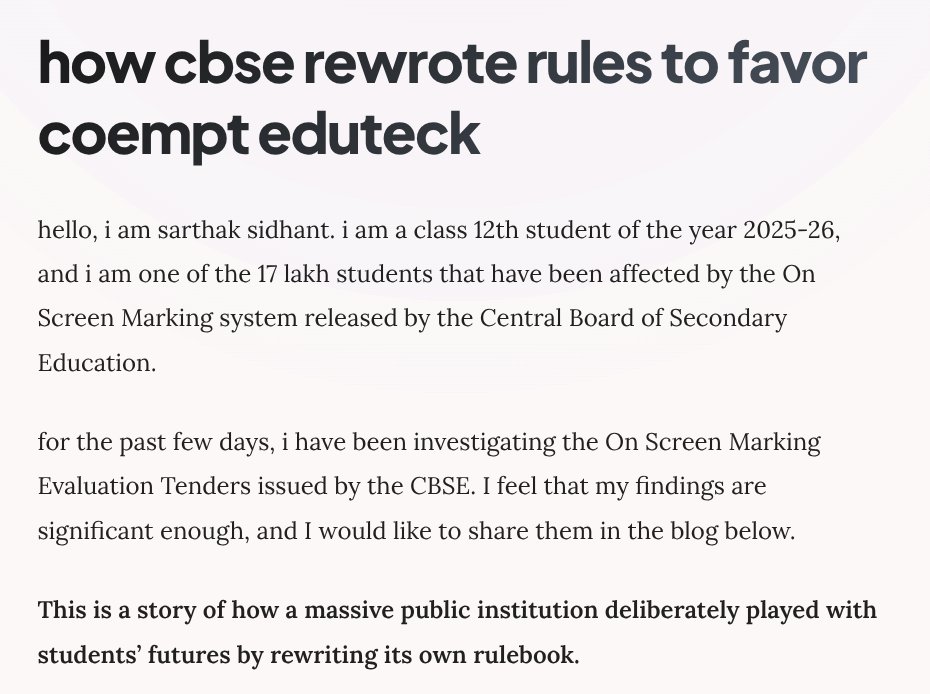
I am a CBSE Class 12 student.
After receiving unexpectedly low marks in Physics, we applied for photocopies of my answer sheets through the CBSE reevaluation process.
Today we received the copies.
And I am shattered because the Physics answer sheet uploaded by CBSE is not mine
INDIA's ECONOMIC CRISIS
The Iran War pulled away the lid from a simmering economic crisis in India, forcing the PM to accept the crisis, though blaming it entirely on the Iran war's aftermath, which is wrong.
From 'sab changa si' to 'crisis of the decade'.
So, what crisis was simmering since 2016?
1) Demonetisation 2016 killed a large per cent of MSMEs that employed millions
2) Hasty patchy GST rollout 2017 destroyed MSMEs even more, concentrating power in large enterprises
3) Corporate tax cuts 2019 added massive profits to large enterprise balance sheets, and they didn't invest more, but discharged debts and bought back shares
4) Covid 2020-21 birthed a huge K-shape recovery in Indian economy and society, widening the haves vs. have-nots gap to colonial levels
5) Lack of employment intensive manufacturing 2014-2026 (but pushing subsidy and capital-intensive PLIS) didn't generate the crores of formal jobs desperately needed
6) India failed to build its AI play completely (2015-2026), with large IT firms focused on comfortable Dhandho outsourcing instead, and now facing a massive restructuring due to AI
7) R&D by private sector remained pathetically low, leading to poor innovation and productization
8) Imports from China rose and rose, leading to a $100 billion merchandise trade deficit annually
9) Foreign investors slowly lost interest in the Indian Story, pulling out their FPI moneys and not bringing in FDI money (thereby now created a BoP crisis) (the arrogance of FM didn't help at all)
10) Real wages did not grow across sectors to match the real lived inflation reality, leading to many social pressures on quality of life.
11) India's own crude oil production dropped significantly from 2015-2025, and import dependence kept rising steadily.
The Iran War blew the lid off of this simmering basket of troubles. Blaming everything on the 70-day old war won't be technically or morally or factually sound at all.
Time to make amends on a war footing, instead of speaking vaguely and spreading more concern back home.
22,00,000 Students Punished!
The decision to conduct NEET again after reports of paper leaks is not just an administrative failure. It is a devastating collapse of trust.
Nearly 22 lakh students prepared for this examination believing that hard work, discipline, and merit would decide their future. Many spent years preparing for it. Parents spent savings on coaching classes, books, travel, and hostel fees. Students put their lives on hold for one opportunity.
And now, because the system failed, they are being asked to go through the entire trauma once again.
That is not just unfair. It is cruel.
A national level examination like NEET is supposed to be among the most secure and credible systems in the country. When papers get leaked, it is not merely a security lapse. It shows how seriously the system takes education. It shows that honesty and hard work remain vulnerable to corruption, incompetence, and organized leak networks.
The bigger question is this. Are we genuinely taking education seriously as a nation?
Somewhere along the way, education stopped being a national priority. We often hear speeches glorifying “hard work” while comparing it to Harvard and dismissing global standards of excellence with slogans and rhetoric. Without understanding one basic fact.
Harvard itself is the reward for hard work.
Hard work only matters when the system itself is fair and trustworthy.
A student can study 12 to 14 hours every day for years. But if one corrupt network or one paper leak can destroy the credibility of the exam, then the idea of merit itself starts collapsing.
And once young people lose faith in fairness, frustration replaces ambition.
This crisis cannot end with a few arrests and press conferences. There has to be accountability at every level. The entire examination system needs serious reform, stronger security, and complete transparency.
Because education is not just another political issue. It is the foundation of the country’s future. Countries are built in classrooms long before they are built in election rallies.
And when faith in education collapses, the future collapses with it.