Karpathy publicó la idea más importante del año y casi nadie la aplica.
16 millones de personas vieron el tweet. La mayoría siguió pidiéndole código a la IA.
Su idea es otra:
Deja de usar la IA para escribir código. Úsala para construir tu segundo cerebro.
Funciona así:
→ Abres Obsidian y montas un vault
→ Lo abres dentro de Claude Code
→ Tiras cualquier fuente en una carpeta: un artículo, una transcripción, un PDF
→ Le dices "ingiere esto"
→ Claude lo lee, lo conecta con lo que ya sabes y lo guarda en un wiki vivo
Cada fuente que añades hace el sistema más inteligente. Se acumula como el interés compuesto.
Montarlo lleva 5 minutos:
1. Instalas Obsidian y montas el vault
2. Le pasas la idea de Karpathy a Claude Code
3. Claude arma tres carpetas: raw para las fuentes, wiki para sus páginas y CLAUDE para gestionarlo todo
4. Preguntas lo que quieras sobre todo lo que guardaste, para siempre
Llevas meses usando la IA para lo más fácil.
Esto es para lo que de verdad importa.
La guía paso a paso está justo debajo 👇
Each box is a system of just three equations, and none of them ever repeats. The path stays inside a fixed region but never closes and never crosses itself.
Three is the minimum. In a flat plane a smooth flow cannot be chaotic, a result known as the Poincaré-Bendixson theorem, so chaos needs a third dimension. Otto Rössler found his shape in 1976 and said he got the idea from watching taffy being pulled and folded.
Start two copies 0.00000001 apart and the gap grows steadily in all four. The pitch of each tone follows its x coordinate.
50 legendary internet rabbit holes you can spend hours exploring👇
1. https://t.co/Rnm6xvS34p — Watch the world via live satellite imagery
2. https://t.co/fPF1bZUxOb — See every plane currently in the sky
3. https://t.co/dnkKR1xnDO — Track all ships at sea in real time
4. https://t.co/scWGSM1150 — Live map of winds and storms
5. https://t.co/3JN6V1PuGW — Watch lightning strikes hitting Earth in real time
6. https://t.co/2HwLWJ4SlE — Live list of recent earthquakes
7. https://t.co/FrcwfRO9UL — Ocean cables carrying the internet
8. https://t.co/JbhMm7KDOp — Watch forests disappear from space
9. https://t.co/FFHGerfWeg — The world's statistics, second by second
10. https://t.co/AQDwQOOtew — Current number of tweets and searches being posted
11. https://t.co/8GY9w6bVVy — Compare the true sizes of countries
12. https://t.co/R29agPW3KI — Maps from centuries ago
13. https://t.co/5cA9slZRHP — Archive of 150,000 historical maps
14. https://t.co/m2lp9UK7pK — World map drawn by volunteers
15. https://t.co/oo9iJrxCSm — Look out the window of a random person around the world
16. https://t.co/8pdmEFYw9y — Virtual walks through cities
17. https://t.co/0SSIxpDcMI — Teleport to a random spot on Earth
18. https://t.co/Fp4C6IrpBI — Catalog of the world's strangest places
19. https://t.co/gPyElwHxNX — Interactive knowledge experiences
20. https://t.co/zf9f8quJcW — Scale journey from atom to universe (Updated HTML5 link)
21. https://t.co/a9V16MN8gg — Explore the solar system in 3D
22. https://t.co/0m2nYHDqG1 — Real sky map in your browser
23. https://t.co/wfbSVapqJW — NASA's astronomy picture of the day
24. https://t.co/PnrH0tVHDQ — NASA's entire visual archive, free
25. https://t.co/tvFDCHdR3F — Visual articles told through data
26. https://t.co/7wkPtTPLDh — The state of the world with real data
27. https://t.co/nuJBsjniXT — What we mistakenly think we know about the world
28. https://t.co/AFIzL5x8OR — Visualizing complex data
29. https://t.co/0RrS3c2Zx2 — World Bank's open data
30. https://t.co/dDeFYvZPOo — Turkey's official statistics database
31. https://t.co/7o82rjIOvw — Archive of millions of books, films, and software
32. https://t.co/hSlNyaVFy2 — 70,000 free books whose copyrights have expired
33. https://t.co/AMiFzHhpIM — Record of every book in the world
34. https://t.co/Qzm14VWuDC — U.S. Library of Congress digital archive
35. https://t.co/byvU6Bmszt — Europe's cultural heritage archive
36. https://t.co/ku3rqFXhAB — America's digital library collection
37. https://t.co/6lYixDs6Mn — Tour museums from home
38. https://t.co/U0RNH1kQ0H — Download artworks in high resolution
39. https://t.co/MAFoAmmaZp — Archive of 250,000 artworks
40. https://t.co/5mu1vAv6VE — Forgotten visual treasures of history
41. https://t.co/tDg0loBP02 — Free archive of culture and education
42. https://t.co/imo0QcFIFh — Met Museum's open collection
43. https://t.co/RkSQ3kJSsw — Family tree of music genres
44. https://t.co/Ln6sYsCCoo — Pick a country and decade to listen to that era
45. https://t.co/zJlsJk8zwR — Turn Wikipedia edits into audio
46. https://t.co/72xSpNBdOZ — Random knowledge well
47. https://t.co/2HUpBR2O2Q — Time, sunrises, and sky events
48. https://t.co/KXNaMOLCQN — Live stream of science news
49. https://t.co/3nExl6BcHH — Free preprints of scientific papers
50. https://t.co/jw7KxeILfA — Visualize data with live code
Save this. You’ll definitely need some of these later. 🔖
Follow @The_techAI for more useful websites, AI tools & tech resources.
Four rotors turn raw thrust into coordinated flight by solving a single elegant equation on the rotation group.
The vehicle’s motion is governed by
m v̇ = −τ R e₃ + m g e₃
together with the rigid-body equation
J Ω̇ + Ω × J Ω = M.
Position and velocity errors are ordinary differences; attitude error is the vee map
e_R = ½ (R_Cᵀ R − Rᵀ R_C)∨
that lives directly on SO(3).
A thrust command
τ = −(−k_x e_x − k_v e_v − m g e₃ + m ẍ_d) · R e₃
and a moment command that cancels Coriolis terms and drives both e_R and e_Ω to zero close the loop. The four motor forces are then recovered by the linear allocation matrix, so the abstract geometric commands become physical rotor speeds.
The mathematics does not approximate the sphere; it works on the sphere itself.
19 year old Japanese student built a trading bot with Claude Code in 2 days.
Used his iPad as a second monitor.
First night: $6,732 profit.
Starting capital: $68.
Total profit so far: $750,000.
[ 𝐍𝐨𝐭𝐞: 𝐅𝐨𝐥𝐥𝐨𝐰 𝐌𝐞 @naiem_bn 𝐅𝐨𝐫 𝐢𝐧𝐬𝐭𝐚𝐧𝐭𝐥𝐲 𝐚𝐮𝐭𝐨 𝐃𝐌]
Here's how it works👇
The bot scans over 50 markets simultaneously.
Syncs live BTC data from Binance every second.
Spots price errors before humans even notice.
The edge is pure speed + pattern recognition.
While traders stare at charts trying to predict the next move, his bot is already executing on mispricing across dozens of markets.
No guessing.
No emotions.
No hesitation.
Just Claude Code logic finding gaps that close in seconds.
He built the entire system in 48 hours:
→ Claude Code handles the trading logic
→ Binance API feeds real-time BTC data
→ iPad displays multi-market monitoring
→ Executes trades when arbitrage windows open
The system runs 24/7.
Every price dislocation = profit opportunity.
Most people are still trading manually, refreshing charts, second-guessing entries.
Meanwhile this 19 year old engineering student turned $68 into $750K by letting Claude Code do what humans can't: process 50 markets instantly and execute without fear.
Why are people still trading manually?
I'm giving away the exact Claude Code setup for free.
24 hours only.
To get it 👇
1️⃣ Comment " Claude "
2️⃣ Like and Repost
3️⃣ Follow @naiem_bn (so I can send it via DM)
Goldmine for AI Engineers! 📌
If you're learning AI, ML, LLMs, or AI agents, don't waste hours jumping between random tutorials.
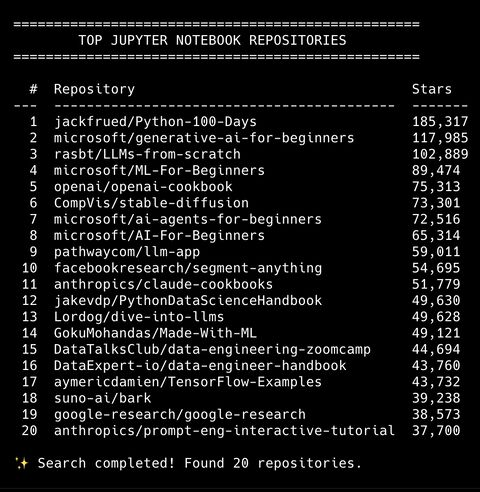
These are 10 repositories I'd actually keep bookmarked - from Python fundamentals to ML, LLMs, agents, and production AI.
1. Python - 100 Days
jackfrued/Python-100-Days
A 100-day Python learning path covering fundamentals, data analysis, web development, and more.
GitHub:
https://t.co/4wgQvkXE5K
2. Generative AI for Beginners
microsoft/generative-ai-for-beginners
A practical introduction to building Generative AI applications.
Covers:
• LLM fundamentals
• Prompt engineering
• RAG
• AI agents
• Fine-tuning
• AI application development
GitHub:
https://t.co/msVKJDOmqv
3. LLMs From Scratch
rasbt/LLMs-from-scratch
Want to understand what's actually happening inside an LLM?
Build one step by step.
Covers:
• Tokenization
• Embeddings
• Attention
• Transformers
• Training
• Fine-tuning
GitHub:
https://t.co/JINAI38zMD
4. Machine Learning for Beginners
microsoft/ML-For-Beginners
A structured 12-week, 26-lesson curriculum covering classical machine learning.
A good starting point if you want ML fundamentals before jumping into LLMs.
GitHub:
https://t.co/PGAj8GdlIc
5. OpenAI Cookbook
openai/openai-cookbook
A collection of practical examples and guides for building applications with OpenAI models.
Useful when you want to move from:
Learning → Building
GitHub:
https://t.co/n1Gu2273nY
6. Stable Diffusion
CompVis/stable-diffusion
Interested in generative image models?
This repository contains the original Stable Diffusion implementation and research code.
GitHub:
https://t.co/r1sPdSQgSR
7. AI Agents for Beginners
microsoft/ai-agents-for-beginners
A practical course for understanding and building AI agents.
Covers:
• Agentic AI
• RAG
• Agent frameworks
• Tool use
• Multi-agent systems
GitHub:
https://t.co/mQncZRuIyz
8. AI for Beginners
microsoft/AI-For-Beginners
A structured 12-week, 24-lesson introduction to AI.
Covers:
• Neural networks
• Computer vision
• NLP
• Deep learning
• Classical AI
GitHub:
https://t.co/UuSrvYalBd
9. LLM App
pathwaycom/llm-app
Focused on building practical LLM applications.
Explore:
• RAG
• AI pipelines
• Enterprise search
• Real-time data
• Vector search
GitHub:
https://t.co/DXcibjxGn3
10. Segment Anything
facebookresearch/segment-anything
A foundation model for promptable image segmentation.
Worth exploring if you're interested in computer vision and multimodal AI.
GitHub:
https://t.co/otXdFtpZO3
Don't bookmark all 10 and forget about them.
Pick based on where you are:
Python → Python-100-Days
ML → ML-For-Beginners
AI Fundamentals → AI-For-Beginners
LLMs → LLMs-from-scratch
Generative AI → Generative-AI-for-Beginners
Agents → AI-Agents-for-Beginners
Building → OpenAI Cookbook / LLM App
Computer Vision → Segment Anything
Pick one.
Build something.
Then move to the next.
(a + b)² = a² + 2ab + b² is first a fact about tiling.
A square whose side is the sum of two segments splits cleanly into a square of the first, a square of the second, and two rectangles that share those lengths.
The identical dissection with a minus sign produces the twin identity (a − b)² = a² − 2ab + b².
Both rest on the same principle that later rearranges the region a² − b² into the single rectangle (a + b)(a − b).
The Mathematics of Large Language Models — A Readable Guide to LLMs, Transformers, Diffusion, Neural Networks, and Generative AI: https://t.co/3sDIaIroX8
A single neuron does three things and nothing more: weigh its inputs, bend the result with a
curve, then quietly shrink its own mistakes.
z = Σᵢ wᵢxᵢ + b a = 1/(1 + e⁻ᶻ) ŷ = a
That gentle S-shape is the entire reason deep networks can separate data that no straight line
ever could. The same unit now flags tumors, pilots drones, and predicts markets.
It has one goal: make the average distance between ŷ and truth as small as possible.
Linear algebra, then a nonlinearity. That is the art.
The Alcubierre Warp Drive is a theoretical idea proposed by physicist Miguel Alcubierre in 1994. Instead of pushing a spacecraft through space faster than light, it suggests expanding space behind the ship and contracting space in front of it, allowing the craft to ride inside a "warp bubble" while remaining locally at rest.
The equations shown here come from Einstein's theory of general relativity and describe the geometry of that warp bubble. They do not prove that a working warp drive can be built. Current models require forms of negative energy that have never been produced in the amounts needed, making the concept purely theoretical for now.
It is one of the most fascinating ideas in modern physics because it challenges how we think about distance, motion, and the limits of interstellar travel without violating Einstein's local speed limit.