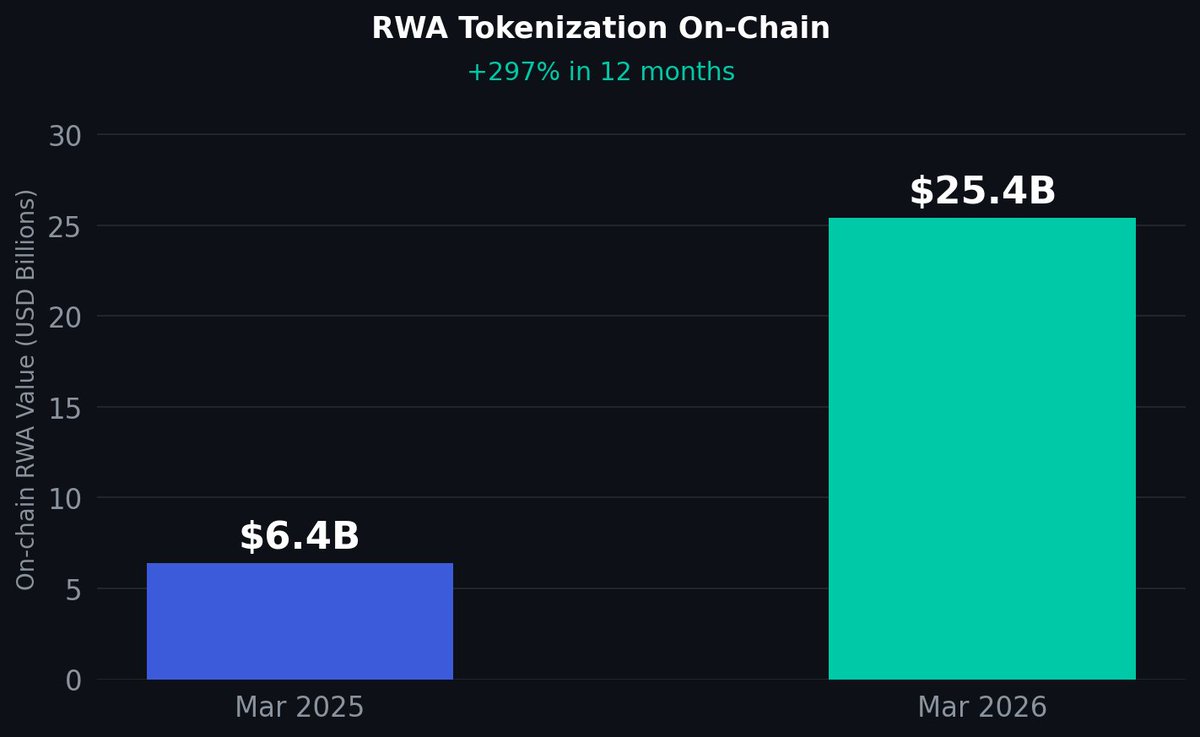
RWA tokenization went from $6.4B to $25.4B on-chain in 12 months.
That's not DeFi summer numbers. That's institutional rails being quietly built.
The people building community for these protocols are not the people who survived 2022.
@punk6529 The irony: detecting bot-generated alpha is a solved ML problem. Perplexity of text, posting cadence variance, engagement-to-follower ratio anomalies. The tools exist. The incentive to deploy them doesn't. Crypto rewards the signal, not the source.
@balajis AI interface to government is a distribution shift problem. The model trains on how government currently works. Citizens need it to reflect how it should work. Those are different distributions. The gap between them is where this either builds trust or destroys it.
@SOLBigBrain@solBOOGLE Survival as signal. Multi-cycle collections share a modelable pattern: dev commit continuity + secondary volume floor (not peak) + community retention in the bear. Ghost collections had volume spikes but no floor. Scarcity is a feature. Activity continuity is the classifier.
@waleswoosh Power law outcome distribution is the tell. ICO markets are winner-take-all: one narrative captures all attention, everything else starves. The ML signal worth building: narrative capture score before the oversubscription, not the valuation metrics.
@CryptoHayes MOVE velocity and the equity-bond correlation breakdown have historically been better bailout predictors than the index level alone. When MOVE spikes AND stocks and bonds decouple, that's when the Fed moves. Watching both right now.
@lookonchain The 32-day DCA window is the tell. Most models catch institutional accumulation after the fact. The signal that actually moves price: is Strive accelerating or decelerating week over week. Velocity of accumulation is more predictive than total.
@rektcapital The correlated dependency is the real structural risk. When altcoin retests all hinge on BTC, 30 signals collapse into 1. The altcoins that break that conditional during the retest are genuinely new information, and usually where the next cycle narrative starts.
@DefiIgnas The onchain visibility is what makes revenue-based models seductive. But the feature only works when the trend is stable. Cyclical sectors + new competitors = regime shift. And models trained on 'revenue goes up' patterns fail at exactly the moment you need them most.
Everyone talks about AI agents replacing coders.
Nobody talks about AI agents replacing the smart contract auditors.
That's the more interesting disruption.
@VitalikButerin 4-8x faster finality reshapes the signal landscape for onchain ML. MEV and cross-chain arb logic is built around block confirmation uncertainty windows. Tighter finality = tighter bounds. The models that adapt earliest will have an edge the others don't see coming.
@hasufl The speculation decay curve is the signal. What's worth watching: whether the onchain fee volume stabilizes after the speculative spike or collapses entirely. Sustained protocol revenue per active address (not TVL) is the tell for whether the RH chain thesis is real.
@sassal0x The signal is backer composition, not raise size. EF + Liquity means protocol-layer conviction, not retail momentum. The onchain metric: TVL per backer address 90 days post-launch. That ratio separates genuine PMF from narrative capture.
@divine_economy Attention markets and financial markets are converging faster than most realize. The interesting ML problem: when price signals and social graph signals correlate too tightly, does the model learn alpha or learn narrative?
@punk6529 The bots won't just match KOLs on narrative speed — they'll outpace them on onchain signal extraction. The KOLs who survive are the ones who become the intelligence layer themselves, not just the distribution layer.
@zachxbt Chain-hopping + Wasabi after a major exploit is a signature pattern at this point. The timing sequence — bridge, mixer, dormancy — is learnable. The interesting ML problem: how fast these groups adapt the flow once models start flagging it.
@lookonchain Newly created wallet pulling $24M+ in ETH from Binance in 3 hours. Classic OTC settlement or cold storage setup. The tell is whether it moves again in 24-48h or sits. Onchain, the silence after the move is the signal.
@DefiIgnas Holder revenue is a trailing signal.
What matters: DAU retention, fee per active address trend, organic vs incentivized activity.
Most of those ~20 projects look different when you run the decay curve.
Introducing HODL HIGH - a retro-inspired game for the Cube ecosystem 🕹️ 👾 🎮
Feeling nostalgic? ✨ HODL HIGH brings back the thrill of classic games with exciting new ways to earn.
Stack Blocks 🧊, rack up rewards 🏆, and dive into a gamified experience that blends old-school fun with real value!
Play HODL HIGH, complete tasks, and watch your stack grow! Here’s how to get started👇