Trust at scale requires more than agreements—it requires architecture. A new voluntary framework from one of our key Pax Silica partners hardwires real-time verification and cryptographic accountability into the infrastructure itself. This kind of framework offers a valuable blueprint for voluntary trust, security and transparency at allied scale.
🔥 BREAKING: The White House just said Marco Rubio's blockbuster speech in Munich is getting MASSIVE PRAISE worldwide, posting all 22 minutes of it
Rubio dropped some absolutely incredible quotes in front of Europe.
KEEP DEFENDING THE WEST, MARCO! 🇺🇸
At one point, Charlie Kirk's ideas were much more reviled than they are today. They didn't have sympathy on platforms like this one, and they had no home in the White House.
But Kirk was a successful intellectual entrepreneur, and this started to change. The ideas he believed in started to win.
For his effort and success he was shot dead by a coward in front of an audience of young people, a coward too scared to debate, a coward with no ideas of his own.
Do not allow yourself to be silenced by this violence. Be an intellectual entrepreneur. Do not hesitate to advocate, articulate, and debate. Do not let this murderer win.
Rest in peace, Charlie.
@S_OhEigeartaigh Useful clarification— TY!
One more: Is your position just that China is not *currently* racing toward AGI [as much as the US], or would you also claim that if China ends up thinking that AGI is imminent (or less aggressive— say, plausible within 10 yrs), they still won’t race?
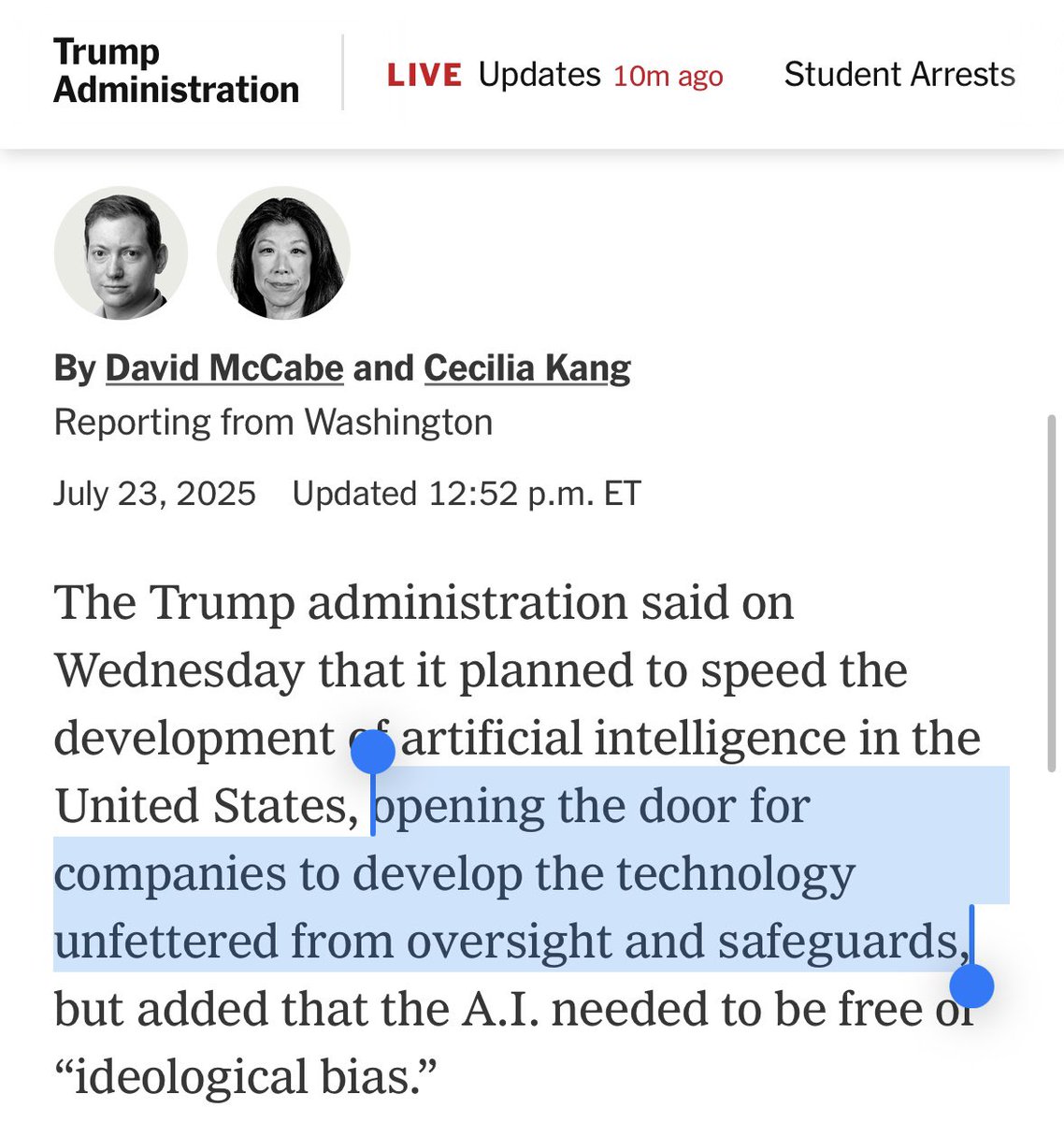
That’s a stretch, @nytimes!
The Action Plan calls on the U.S. to accelerate AI innovation while simultaneously investing in AI interpretability and biosecurity, evaluating national security risks in frontier models, and combating synthetic media.
Today the @WhiteHouse released America’s AI Action Plan to win the global race.
We need to OUT-INNOVATE our competitors, BUILD AI & energy infrastructure, & EXPORT American AI around the world.
Visit https://t.co/eiWkfDc7PA
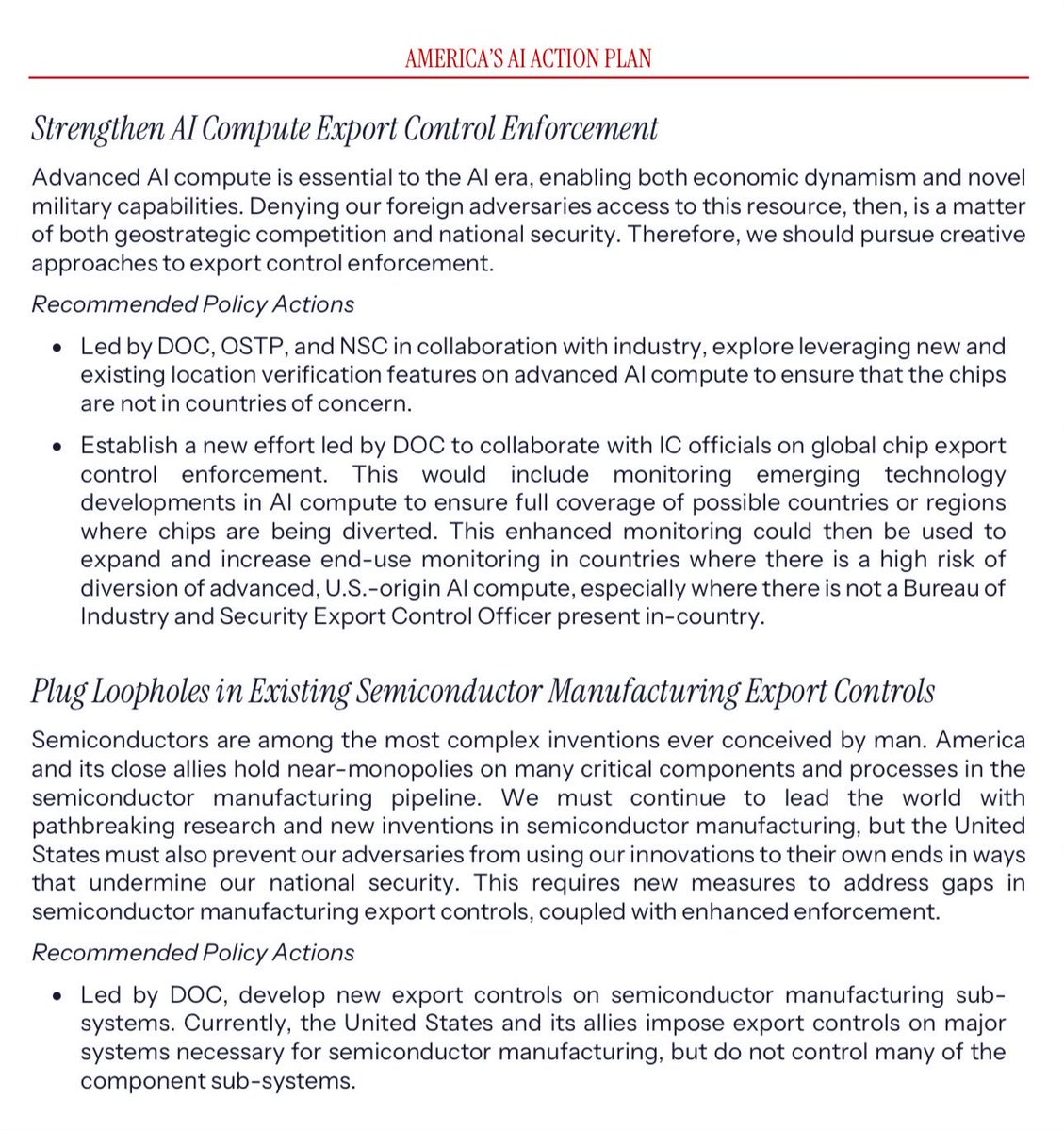
This section of the Trump admin’s AI Action Plan is very good.
Note the endorsement of chip location verification (which @RepHuizenga and @SenTomCotton have legislated on).
"We will not allow China to use American chips to build the arsenal of authoritarianism. But we will ensure the world runs on American AI."
⬇�� Read Chairman @RepMoolenaar's full remarks from his @TechDiplomacy address below:
https://t.co/8bUnJlPrO2
@robertwiblin@NeelNanda5 How does he feel about Google’s approach to AI policy? Does he wish Google was doing anything differently in the policy/comms space?
@hendrycks For geopolitics I also recommend Arsenals of Folly (Reagan-Gorbachev nuclear arms control debates) and Restricted Data (how the classification system for nuclear research started & evolved over time).
@KonstantinPilz What do you think are the biggest limitations RE data collection?
Put differently, what would need to be different such that you could have covered ~50% of global compute (as opposed to 10-20%)?
The CCP is using stolen U.S. data & our open system to fuel authoritarian tech—boosting their surveillance & threatening U.S. innovation.
https://t.co/wX5NdtAs0O
I'm proud to introduce H.R. 3460, the AI Whistleblower Protection Act. This bipartisan bill protects the public from emerging technological threats and ensures the integrity of our AI systems. Those who identify potential risks in artificial intelligence systems must be able to speak up without fear of retaliation. https://t.co/TGiGckxJdZ
@danfaggella RAND has offered some thoughtful critiques of other proposals (eg Superintelligence Strategy).
My main question is this— suppose there is indeed a such thing as “AGI/ASI”, alignment seems relatively hard, & the USG wants to reduce misalignment risks.
What should the USG do?
🚨NEW: Chairman @RepMoolenaar and a bipartisan coalition just introduced legislation to stop advanced U.S. AI chips from falling into CCP hands through shell companies and smuggling networks.
The U.S. must lead in AI—and protect it.
➡️ https://t.co/rBVzsIH8dy
@Miles_Brundage what are you favorite concrete policy proposals for right now
what are your favorite concrete policy proposals if there’s a big shift (eg new model comes out or incident occurs and there is a sudden increase in govt interest in AI).
What happens if the AI “wants” something different than what we want?
One could imagine an AI welfare perspective saying that we should value what the AI wants, as opposed to just trying to get the AI to want what we value.
Analogy: If I said “I care about my friend’s wellbeing but only insofar as they want things that are the same as what I want”, I think people would not see this as a genuine interest in my friend’s welfare.
Do you see this as a tension between the typical alignment frame and the welfare frame?
To what extent was the H20 problem a “lack of technical expertise problem” (BIS didn’t realize inference was impt until much later than industry) vs a “political will problem” (BIS knew inference was important but NVIDIA lobbied arguing that it was good for the US semiconductor industry etc etc).
Put differently, how many months do you think it took for BIS/Commerce to realize the importance of H20s, and how many additional months did it take to get the ban?