🚨#BREAKING: Watch as a massive swarm of bees descends on the White House press corps’ Pebble Beach media area on the North Lawn of the White House after forming a hive in a nearby tree with some witnesses describing the scene as a bee tornado
Astronomers have discovered 11 more moons around Saturn, bringing its total to 285--by far the most of any planet in the solar system.
The true number may be unknowable, if you count every ring particle as its own little moon.
https://t.co/EzkN9ztJ0D
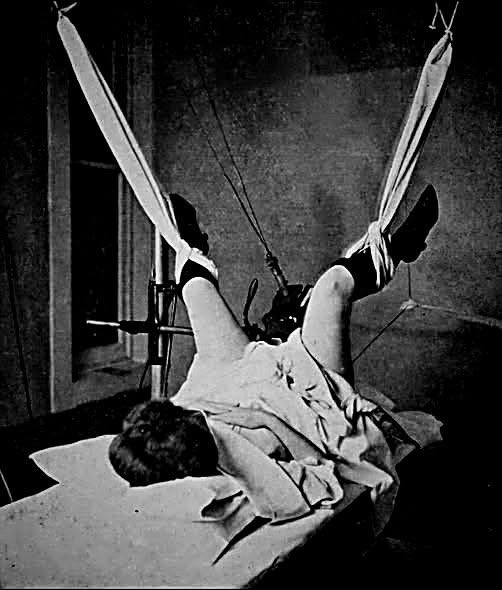
Her legs are lifted into fabric slings beneath a ceiling crowded with wires, and the machine above her hums with a sound that feels more industrial than medical. It is 1920, and this is what hope looks like when science is still learning how to fight cancer.
She lies on a narrow hospital bed with advanced cervical cancer, a diagnosis that in her time usually carries the quiet certainty of death. By spring, her physicians have marked her case as hopeless, with little left to offer beyond comfort.
There are no imaging scans mapping the tumor’s shape, no digital monitors calculating dosage with precision. There is only an X-ray tube, electrical current, and doctors willing to attempt something radical.
They suspend her legs not for dignity but for access, positioning her body carefully beneath the crude apparatus. The radiation beam is directed intra-vaginally toward the cervix in treatments that stretch nearly two hours at a time.
The room smells of heated metal and antiseptic as physicians document every detail of the experiment. They record the amperage of the tube, the distance from the radiation source, and the exact position of her body.
Radiation at the dawn of the twentieth century is both miracle and mystery. Doctors understand it can destroy tissue, but they do not yet fully grasp how deeply it can damage healthy cells along with malignant ones.
For this woman, the alternative is certain decline. Pain has become constant, weakness has hollowed her body, and conventional remedies have failed.
So she endures the hum of the machine and the invisible rays directed into her body. Each session feels like a negotiation between desperation and discovery.
Then something unexpected begins to happen. The tumor starts to shrink, and the malignant growth that once advanced relentlessly shows signs of retreat.
Her weight stabilizes, her blood work improves, and she reports a sense of well-being she has not felt in months. In a ward accustomed to loss, cautious optimism replaces resignation.
But the treatment exacts a price. She suffers intense nausea and fatigue, symptoms doctors describe as “X-ray sickness,” without fully understanding the biological cause.
There are no refined safety standards, no shielding protocols developed over decades of research. This is medicine operating at the edge of knowledge, guided by observation rather than certainty.
The image of her treatment is not taken to shock future generations. It is recorded to teach other physicians how to position the patient and manage the wires and rays.
What appears crude by modern standards is, in its moment, an act of scientific courage. The doctors believe that sharing their process may transform experiment into method.
Every modern radiation oncology suite traces its lineage back to scenes like this. Behind today’s precise beams and carefully calculated doses stands a woman in 1920 who lay beneath a humming machine and chose hope over surrender.
Want to change the world IRL? Start in Minecraft.
In the free Good Trouble DLC, explore global civil rights movements, meet changemakers, and learn how to stand up, speak out, and build a better world.
Download from the @MinecraftMarket: https://t.co/ajS0X9TEaZ
@OldWorldKeith@AutismCapital True… and if you leave the fries out long enough they become lethal projectiles 😉 (IF they haven’t been overcooked already) ��