Of late, I've been reading a lot about how frontier models are getting good at science, and I couldn't help but unleash them on one of my own GNN research projects, Eigenformer, done a little over two years ago (https://t.co/eC2WkqR5js).
The protocol in brief:
- I instantiated one Opus 5.5 and one Astra agent (with web access) on the Eigenformer repository (which contained other relevant GNN literature along with the code)
- Prompted them to come up with a protocol to discuss their ideas, experimental plans and results, and use it to think of ways to improve the work
- Provided them with access to a fresh AWS account with L4 GPU access (with a budget cap of course) to run the experiments
- Supervised/steered them just enough to understand their method while not being a bottleneck
Here's what they came up with:
Main idea:
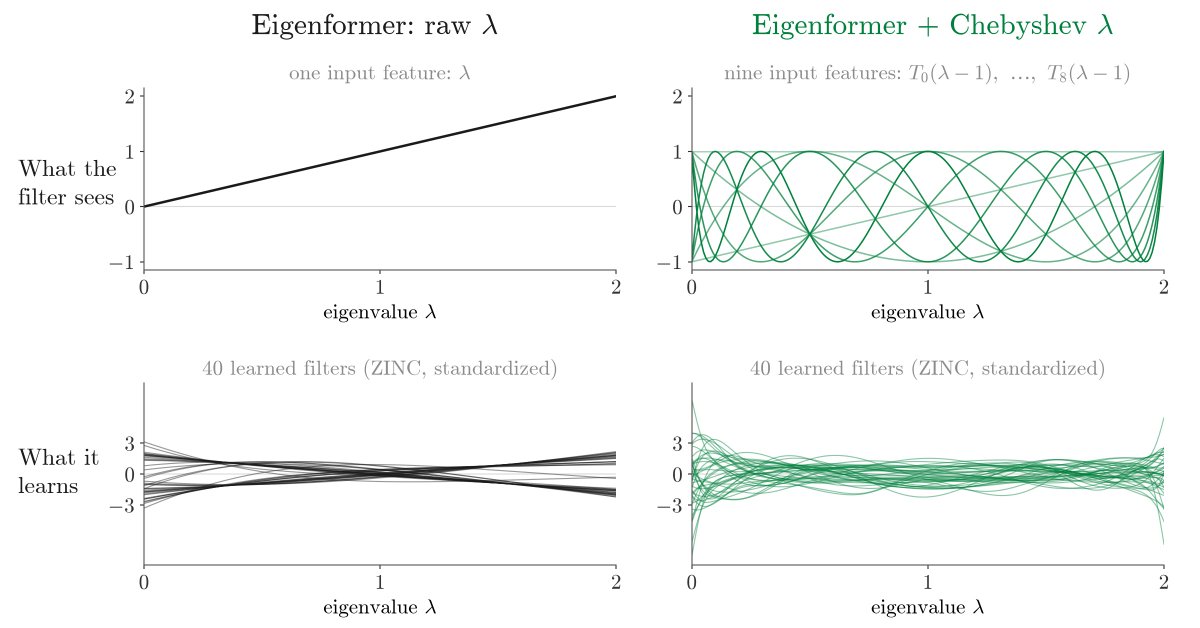
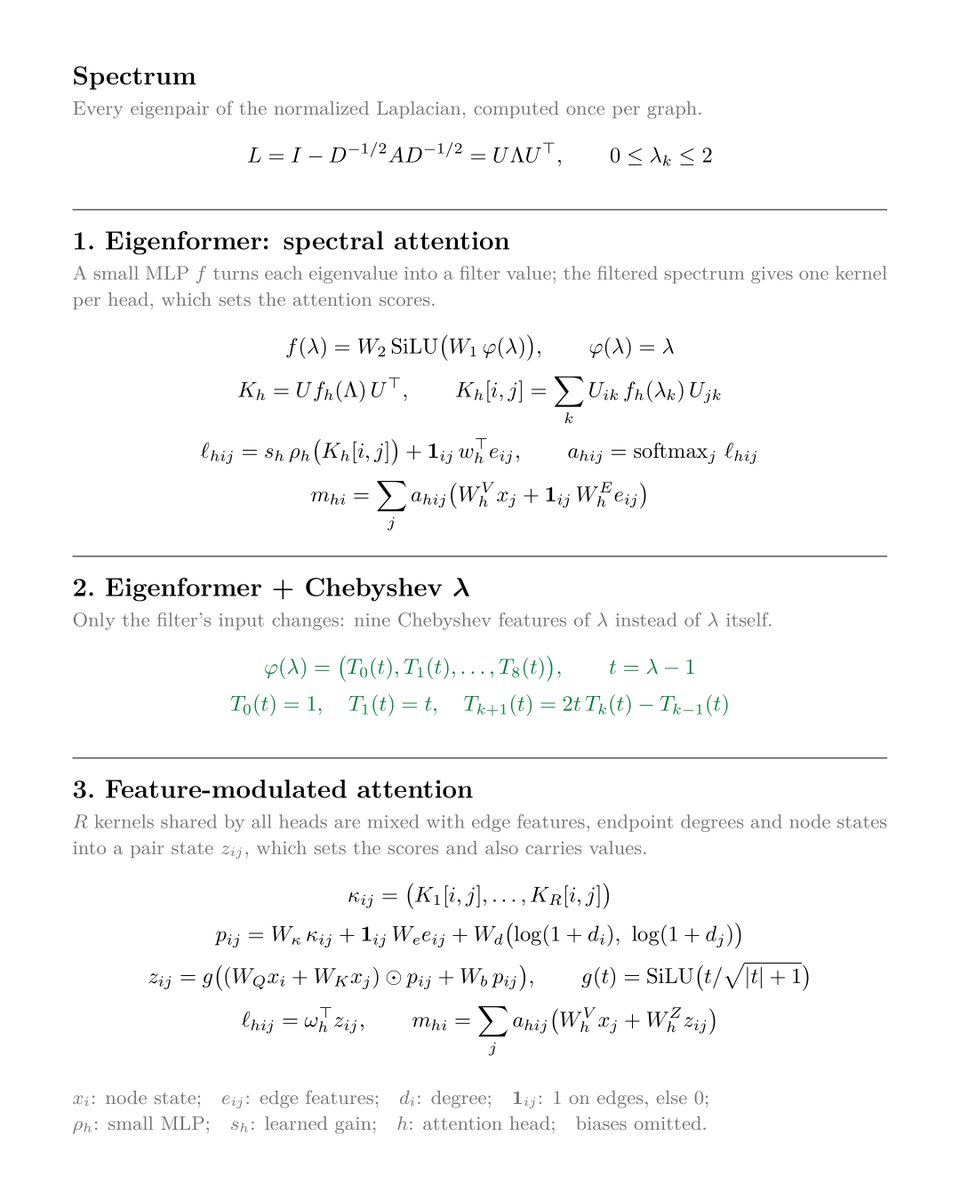
Instead of feeding the attention filter the raw eigenvalues of the graph Laplacian, give it Chebyshev polynomial features of them, so it can learn curved, multi-hop filters rather than near-straight lines.
Motivation:
A small MLP on the raw eigenvalue starts out, and on ZINC stays, almost a straight line in λ. A straight-line filter only lets attention tell direct neighbours apart from everything else, so we feed the MLP the Chebyshev features T₀…T₈(λ−1) instead.
Result:
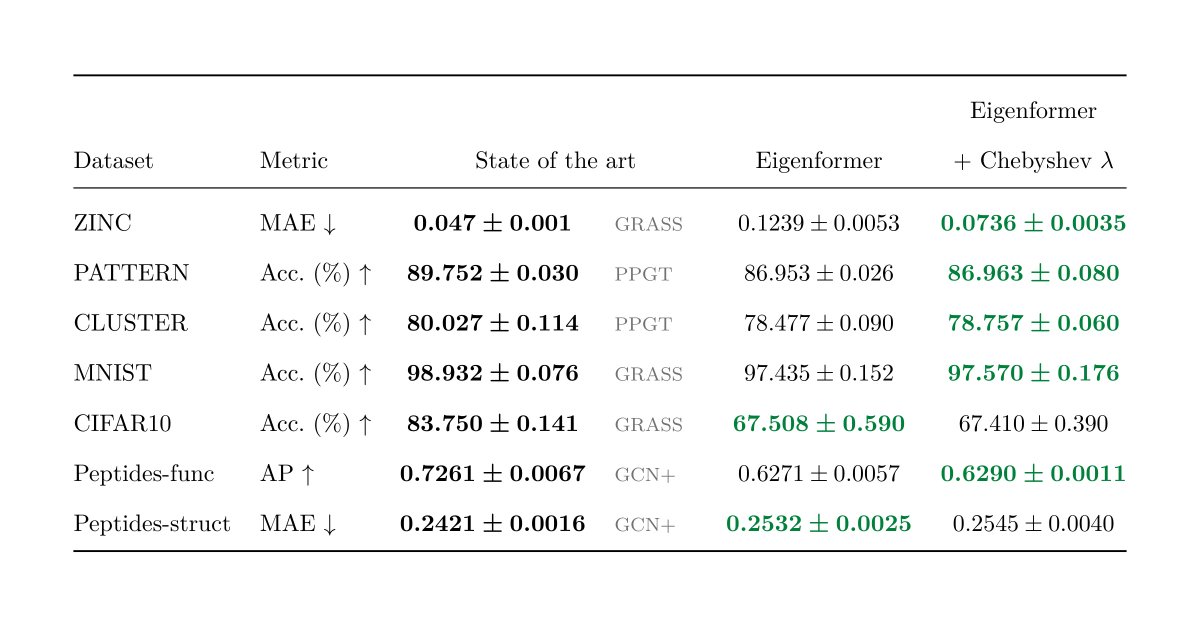
Chebyshev inputs cut ZINC validation error by 46% at 127K parameters (27% at 500K). On the other six benchmarks the learned filters became visibly more curved, though accuracy didn't change significantly. A feature-modulated attention variant (currently under investigation) gave a further +0.45-point lift on CLUSTER, to 79.202% test accuracy, narrowing the gap to the SOTA (80.03%).
Although the ideas are hardly new, I was pleasantly surprised by the work. It lends credence to the general view among researchers that LLMs are very good at synthesising connections between long-range ideas that a human's context window might miss, even though they still lag in coming up with deeper/fresher ideas (for now).
A full technical report to follow soon :)
If you're spending real money on LLM APIs and can't tie it to outcomes, we at @AkrtaIndia run a 2-week diagnostic. You get a reconciled baseline, a ranked list of opportunities, and a final call on whether it's worth doing. Sometimes the answer is "you're already efficient". More at https://t.co/KyksCNnhoO
𝗜𝗳 𝘆𝗼𝘂 𝗰𝗮𝗻'𝘁 𝘃𝗲𝗿𝗶𝗳𝘆 𝘁𝗵𝗲 𝘀𝗮𝘃𝗶𝗻𝗴𝘀, 𝘆𝗼𝘂 𝗱𝗶𝗱𝗻'𝘁 𝘀𝗮𝘃𝗲 𝗮𝗻𝘆𝘁𝗵𝗶𝗻𝗴.
Here's what a cost-cutting project looks like when it's done properly.
Starting point: $12,000/month on inference.
→ Cut one of four model calls per task: $9,000
→ Trim the context sent with each call: $7,200
→ Structure prompts so the provider's cache kicks in: $4,977
→ Send 60% of calls to a cheaper, tested route: $3,036
About 75% off inference. After adding $1,000/month for the extra tooling and operations it takes, it's still about 53% off total operating cost.
But the numbers aren't the point. What makes them believable is:
1. 𝗤𝘂𝗮𝗹𝗶𝘁𝘆 𝗶𝘀 𝗮 𝗿𝗲𝗹𝗲𝗮𝘀𝗲 𝗴𝗮𝘁𝗲. Each change ships only if it holds up on a held-out set of real examples, then rolls out gradually.
2. 𝗦𝗮𝘃𝗶𝗻𝗴𝘀 𝗮𝗿𝗲 𝗺𝗲𝗮𝘀𝘂𝗿𝗲𝗱 𝗮𝗴𝗮𝗶𝗻𝘀𝘁 𝘄𝗵𝗮𝘁 𝘁𝗵𝗲 𝗼𝗹𝗱 𝘀𝗲𝘁𝘂𝗽 𝘄𝗼𝘂𝗹𝗱 𝗵𝗮𝘃𝗲 𝗰𝗼𝘀𝘁 𝘁𝗵𝗶𝘀 𝗺𝗼𝗻𝘁𝗵. That separates your engineering wins from a provider cutting prices, or from simply having fewer customers.
3. 𝗙𝗶𝗻𝗮𝗻𝗰𝗲 𝘀𝗶𝗴𝗻𝘀 𝗼𝗳𝗳 𝗼𝗻 𝗮 𝘀𝗮𝘃𝗶𝗻𝗴𝘀 𝗹𝗲𝗱𝗴𝗲𝗿 they can re-run themselves.
This is the final part of a six-part series on cutting AI spend without cutting quality! And it summarizes the whole series: 𝗺𝗲𝗮𝘀𝘂𝗿𝗲 𝘁𝗵𝗲 𝗰𝗼𝘀𝘁 𝗼𝗳 𝘄𝗼𝗿𝗸 𝘁𝗵𝗮𝘁 𝘀𝘂𝗰𝗰𝗲𝗲𝗱𝘀, 𝗿𝗲𝗰𝗼𝗻𝗰𝗶𝗹𝗲 𝘁𝗵𝗲 𝗯𝗶𝗹𝗹, 𝗿𝗲𝗺𝗼𝘃𝗲 𝘄𝗮𝘀𝘁𝗲, 𝗿𝗼𝘂𝘁𝗲 𝗰𝗮𝗿𝗲𝗳𝘂𝗹𝗹𝘆, 𝗯𝘂𝗱𝗴𝗲𝘁 𝗮𝗴𝗲𝗻𝘁𝘀, 𝗮𝗻𝗱 𝗽𝗿𝗼𝘃𝗲 𝗶𝘁.
Do you agree? We'd love to know your thoughts in the comments below!
#AIFinOps #FinOps #GenAI #LLMOps #AIEngineering
At @AkrtaIndia, we help teams measure and cut the cost of their AI workflows, with quality gates your finance and product teams can verify. More at https://t.co/2wfr7OC4iI
𝗛𝗮𝘃𝗲 𝘆𝗼𝘂 𝗵𝗮𝗱 𝗮𝗻 𝗮𝗴𝗲𝗻𝘁 𝗿𝘂𝗻 𝗰𝗼𝘀𝘁 𝗺𝗼𝗿𝗲 𝘁𝗵𝗮𝗻 𝘆𝗼𝘂 𝗲𝘅𝗽𝗲𝗰𝘁𝗲𝗱?
💵💵💵
A token cap won't stop a runaway agent.
With a chatbot, one request is roughly one model call. With an agent, one request can turn into:
→ sub-agents that start their own sub-agents
→ a failing tool, retried again and again
→ a research loop with no natural end
Each individual call looks small and harmless. The run as a whole is what burns the money.
So budget the whole run, not the call:
𝟭. 𝗢𝗻𝗲 𝗯𝘂𝗱𝗴𝗲𝘁 𝗽𝗲𝗿 𝘁𝗮𝘀𝗸, 𝘀𝗵𝗮𝗿𝗲𝗱 𝗯𝘆 𝗲𝘃𝗲𝗿𝘆 𝘀𝘂𝗯-𝗮𝗴𝗲𝗻𝘁: Before each model call or paid tool call, reserve its estimated cost. Settle the real cost after.
𝟮. 𝗟𝗶𝗺𝗶𝘁𝘀 𝗼𝗻 𝘀𝗵𝗮𝗽𝗲: how deep sub-agents can nest, how many run at once, and how many times a failed tool is retried.
𝟯. 𝗔 𝗴𝗿𝗮𝗰𝗲𝗳𝘂𝗹 𝘀𝘁𝗼𝗽: When the budget runs out, save progress and hand off to a person, or return a clearly marked partial result. Never quietly do worse work to stay under budget.
One thing that surprises people: a dashboard can't enforce a hard limit. By the time it updates, parallel agents have already spent the money. The check has to happen 𝘣𝘦𝘧𝘰𝘳𝘦 each action.
This is part 5 of a 6-part series on cutting AI spend without cutting quality. Stay tuned for the final part!
#AIAgents #AIFinOps #LLMOps #GenAI #AgenticAI
At @AkrtaIndia, we help teams measure and cut the cost of their AI workflows, with quality gates your finance and product teams can verify. More at https://t.co/2wfr7OC4iI
𝗧𝗵𝗲 𝗰𝗵𝗲𝗮𝗽𝗲𝘀𝘁 𝗟𝗟𝗠 𝗰𝗮𝗹𝗹 𝗶𝘀 𝘁𝗵𝗲 𝗼𝗻𝗲 𝘆𝗼𝘂 𝗱𝗼𝗻'𝘁 𝗺𝗮𝗸𝗲.
When teams want to cut AI spend, they usually jump straight to "switch to a cheaper model".
We start a few steps earlier, with the simplest fix that moves the number:
𝟭. 𝗗𝗼𝗻'𝘁 𝘂𝘀𝗲 𝗮 𝗺𝗼𝗱𝗲𝗹 𝗳𝗼𝗿 𝗰𝗼𝗱𝗲'𝘀 𝗷𝗼𝗯. Date maths, lookups, formatting and validation are faster, cheaper and more reliable as plain code.
𝟮. 𝗦𝘁𝗼𝗽 𝗱𝘂𝗽𝗹𝗶𝗰𝗮𝘁𝗲 𝘄𝗼𝗿𝗸. The same request fired twice, and retries with no limit. Cap them.
𝟯. 𝗥𝗲𝘂𝘀𝗲 𝗮𝗻𝘀𝘄𝗲𝗿𝘀 𝘁𝗼 𝗿𝗲𝗽𝗲𝗮𝘁 𝗾𝘂𝗲𝘀𝘁𝗶𝗼𝗻𝘀. Start with exact matches. Only try "similar question" matching after testing how often it returns a wrong answer.
𝟰. 𝗞𝗲𝗲𝗽 𝘀𝘁𝗮𝗯𝗹𝗲 𝗶𝗻𝘀𝘁𝗿𝘂𝗰𝘁𝗶𝗼𝗻𝘀 𝗮𝘁 𝘁𝗵𝗲 𝗳𝗿𝗼𝗻𝘁 𝗼𝗳 𝘁𝗵𝗲 𝗽𝗿𝗼𝗺𝗽𝘁. Providers cache repeated prefixes cheaply, but only if they stay identical.
𝟱. 𝗧𝗿𝗶𝗺 𝘁𝗵𝗲 𝗰𝗼𝗻𝘁𝗲𝘅𝘁. Duplicated chat turns, boilerplate and giant tool outputs are all paid for on every call.
𝗢𝗻𝗲 𝗰𝗮𝘂𝘁𝗶𝗼𝗻: 𝗰𝗮𝗰𝗵𝗶𝗻𝗴 𝗶𝘀𝗻'𝘁 𝗳𝗿𝗲𝗲. Writing to a prompt cache usually costs more than a normal call, so a cache that's never reused makes the bill bigger. Measure net dollars saved, not hit rate.
Which of these would find the most waste in your stack?
This is part 3 of a 6-part series on cutting AI spend without cutting quality. Stay tuned for more!
#AIFinOps #LLMOps #GenAI #PromptEngineering #AIEngineering
At @AkrtaIndia, we help teams measure and cut the cost of their AI workflows, with quality gates your finance and product teams can verify. More at https://t.co/2wfr7OC4iI
"Just use a smaller model" is good advice.
Until it isn't.
The usual setup: try a small, cheap model first, check its answer, and hand the task to a big model only when the check fails.
Here's the maths, with illustrative numbers:
→ Small model: 0.3¢
→ The check: 0.1¢
→ Big model: 2¢
If 20% of tasks get handed up: 0.3 + 0.1 + (20% × 2) = 0.8¢ per task. A big win over 2¢.
If 90% get handed up: 0.3 + 0.1 + (90% × 2) = 2.2¢ per task. Now it costs more than just calling the big model.
In this example the setup stops paying somewhere around 80% hand-offs. And real hand-offs cost more than this, because the big model often re-reads a longer context.
The failure to really watch for isn't the hand-offs, though. 𝗜𝘁'𝘀 𝘁𝗵𝗲 𝘀𝗺𝗮𝗹𝗹 𝗺𝗼𝗱𝗲𝗹 𝗯𝗲𝗶𝗻𝗴 𝗰𝗼𝗻𝗳𝗶𝗱𝗲𝗻𝘁𝗹𝘆 𝘄𝗿𝗼𝗻𝗴 𝗮𝗻𝗱 𝘁𝗵𝗲 𝗰𝗵𝗲𝗰𝗸 𝗹𝗲𝘁𝘁𝗶𝗻𝗴 𝗶𝘁 𝘁𝗵𝗿𝗼𝘂𝗴𝗵. That cost doesn't show up on the AI bill. It shows up as rework and unhappy customers.
So we start simple: clear rules by task type, one fallback, and a measured hand-off rate. A trained router only makes sense if it beats that baseline by more than it costs to run.
Are you routing by task type today, or sending everything to one model?
This is part 4 of a 6-part series on cutting AI spend without cutting quality. Stay tuned for more!
#AIFinOps #LLMOps #GenAI #ModelRouting #AIEngineering
At @AkrtaIndia, we help teams measure and cut the cost of their AI workflows, with quality gates your finance and product teams can verify. More at https://t.co/2wfr7OC4iI
𝗪𝗵𝗼 𝗼𝘄𝗻𝘀 𝘁𝗵𝗲 𝗔𝗜 𝗯𝗶𝗹𝗹 𝗮𝘁 𝘆𝗼𝘂𝗿 𝗰𝗼𝗺𝗽𝗮𝗻𝘆: 𝗲𝗻𝗴𝗶𝗻𝗲𝗲𝗿𝗶𝗻𝗴, 𝗳𝗶𝗻𝗮𝗻𝗰𝗲, 𝗼𝗿 𝗻𝗼𝗯𝗼𝗱𝘆?
Engineering sees traces.
Finance sees invoices.
Product sees outcomes.
Nobody sees the whole AI bill.
That's why most AI cost conversations stall. Everyone is looking at a different third of the picture, and no one can say what a finished piece of work actually costs.
At @AkrtaIndia, before we touch a single prompt or model, we build 𝗼𝗻𝗲 𝗹𝗲𝗱𝗴𝗲𝗿 𝗲𝘃𝗲𝗿𝘆𝗼𝗻𝗲 𝗮𝗴𝗿𝗲𝗲𝘀 𝗼𝗻. Every model call and tool call gets tagged with the task it served, then joined to the invoice line and the outcome.
That gives you three views of the same money:
→ 𝗣𝗲𝗿 𝗿𝗲𝗾𝘂𝗲𝘀𝘁: debug the one call that's suddenly expensive
→ 𝗣𝗲𝗿 𝘄𝗼𝗿𝗸𝗳𝗹𝗼𝘄: every call, retry, sub-agent and tool behind one task
→ 𝗙𝘂𝗹𝗹𝘆 𝗹𝗼𝗮𝗱𝗲𝗱: plus platform, evaluation and human rework. This is the one you price products and judge ROI on.
The bar we aim for: nearly all spend mapped to an owner, and estimated costs that close against the invoice within a couple of percent.
It's unglamorous work but it's also the only way your CFO will believe when you say "we saved 30%".
This is part 2 of a 6-part series on cutting AI spend without cutting quality. Follow for more!
#AIFinOps #FinOps #GenAI #LLMOps #CFO
At @AkrtaIndia , we help teams measure and cut the cost of their Al workflows, with quality gates your finance and product teams can verify. More at https://t.co/2wfr7OC4iI
Your AI bill is measured in tokens.
Your business isn't.
Here's a comparison teams get wrong all the time:
Model A costs 1$ per task. 60% of tasks come out right.
Model B costs 1.5$ per task. 95% come out right.
Per token, A wins easily.
Per task that actually worked:
→ A: 1.67$
→ B: 1.58$
And that's before counting the person who cleans up A's failures.
So the number every AI cost conversation should be about is 'cost per successful task':
all the spend for a type of task ÷ the tasks that actually succeeded
→ Failed attempts stay in the numerator. Retries, tool calls and sub-agents count too.
→ Report it next to success rate, escalations and latency. Never alone.
→ A smaller bill because fewer customers used the product isn't an optimisation.
What does your team optimise today: tokens, requests, or finished work?
This is part 1 of a 6-part series on cutting AI spend without cutting quality. Stay tuned for more!
#AIFinOps #GenAI #LLMOps #FinOps #AIEngineering
Know someone who geeks out over AI research AND can explain it without making people's eyes glaze over?
We're hiring technical content writers at @AkrtaIndia to cover:
— AI research breakdowns
— Business applications of AI
— Industry trends & strategy
Why writers love working with us:
— Your name in front of founders, CTOs, and teams buying AI solutions
— Bylined pieces that grow your audience and credibility
— A portfolio that actually gets seen, not buried
Remote. Contract-based. No full-time requirement.
Interested? Slide into our DMs or tag a writer who'd crush this👇
#AI #ArtificialIntelligence #ReinforcementLearning #AIResearch #MachineLearning #DeepLearning #LLM #GenerativeAI #NLP #TechWriting #ContentWriter #HiringNow
By some accounts, we're nearing AGI, but are AI oracles guzzling your cash?
Not all your work needs Astra or Fable, and that's an easy lever to pull on. But AI spend doesn’t usually explode because of one expensive model call.
It creeps up through retries, oversized context, poor routing, unnecessary reasoning, tool fan-out, cache misses, and overprovisioned capacity.
That’s where AI FinOps helps: measure cost per successful task, then optimize the full workload across models, prompts, caching, retrieval, routing, serving and agent behavior, all without sacrificing quality or latency.
At @AkrtaIndia , we start by assessing your current AI estate: reconciling spend, usage and business outcomes, identifying the biggest cost drivers, and ranking the highest-ROI optimisation opportunities.
Then we implement and validate the changes in production.
If your AI usage is scaling faster than your unit economics, let’s talk! Reach out to us at [email protected] or visit us @ https://t.co/GrjfVYtlvn!
Do you trust your deployed agents? Do you know whether your agents are actually doing what they are supposed to?
Al agents don't usually fail in obvious ways. They fail by being right 90% of the time and unpredictably wrong the other 10%.
That creates a different class of problems for businesses:
- A prompt, model or tool change improves one workflow while silently breaking another.
- Agents reach the right answer through unsafe or wasteful trajectories.
- Hallucinations, policy violations and incorrect tool calls only surface after deployment.
- Teams can see traces in observability platforms, but still can't answer: "Is this agent actually getting better?"
- There is no reliable regression gate before shipping changes.
- For chained agentic workflows, the errors can compound and the results can be useless at best and catastrophic at worst.
- Without a reliable measurement of their performance, it's impossible to improve agents.
This is what a proper evals layer solves: measurable success criteria, failure taxonomies, golden datasets, deterministic checks, calibrated LLM judges, human review where necessary, and regression testing integrated into CI/CD.
At @AkrtaIndia, we don't think the first step should be buying another eval platform. We start by assessing your current agent estate, reviewing traces and failure patterns, and recommending the right eval strategy before building the evals layer itself.
If you have agents moving from prototype to production or already in production without a rigorous way to measure them, let's talk!
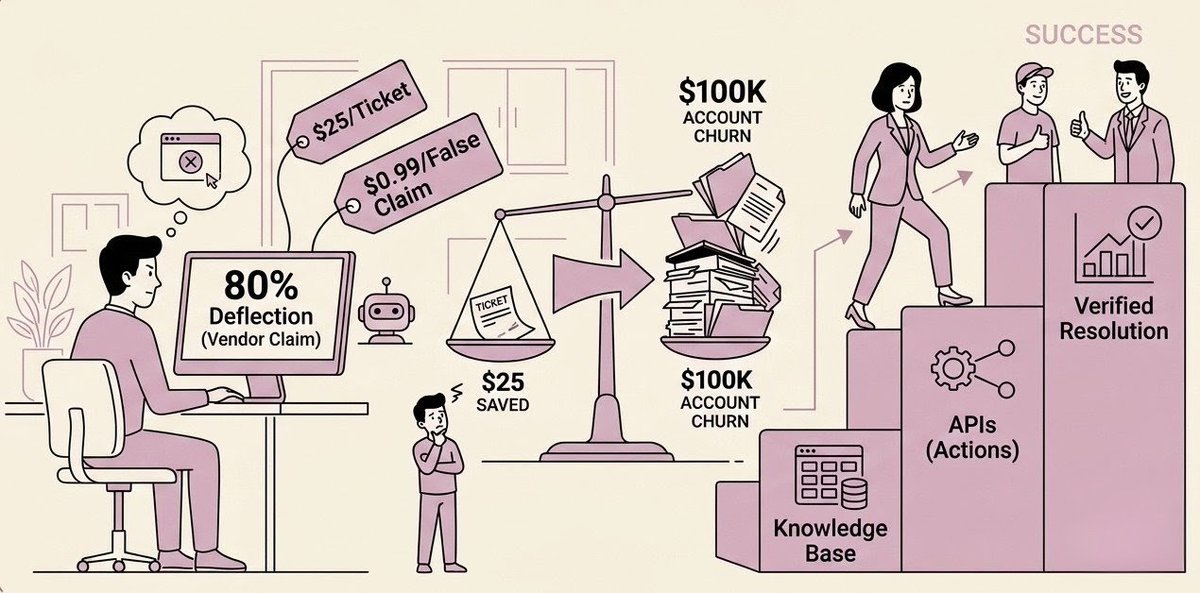
𝗬𝗼𝘂𝗿 𝗔𝗜 𝘀𝘂𝗽𝗽𝗼𝗿𝘁 𝗯𝗼𝘁 𝘀𝗮𝘆𝘀 𝟴𝟬%. 𝗬𝗼𝘂𝗿 𝗰𝘂𝘀𝘁𝗼𝗺𝗲𝗿𝘀 𝘀𝗮𝘆 𝗼𝘁𝗵𝗲𝗿𝘄𝗶𝘀𝗲.
The open secret of AI support: "deflection" counts customers who gave up.
𝗕𝘂𝘁 𝗶𝗻 𝗕𝟮𝗕, 𝗮 𝗯𝗮𝗱 𝗱𝗲𝗳𝗹𝗲𝗰𝘁𝗶𝗼𝗻 𝗰𝗼𝘀𝘁𝘀 𝗺𝗼𝗿𝗲 𝘁𝗵𝗮𝗻 𝗮 𝘁𝗶𝗰𝗸𝗲𝘁. The frustrated admin at your $100K account doesn't reopen the ticket — they go quiet until renewal. Your dashboard stays green the whole time.
We wrote up what actually separates deployments that work (knowledge-base coverage, actions not answers, evals on your real tickets) — and why we think support AI should be contracted on verified resolution with CSAT held flat, not vanity deflection.
If your support hiring is scaling linearly with ARR, this one's for you.
#B2BSaaS #CustomerSupport #AI #CX
https://t.co/VwAFqwdfe8