Intelligence (in its broadest definition as the ability to find solutions to problems) is one of three things:
1. Brute-force search over the solution space
2. Serving the solution from prior memorization
3. Brute-force search from a starting-point served from memory
And so,
Intelligence = Memorization ⊕ Brute-force search
The Lean FRO and Mathlib Initiative have released a joint statement on the Lean verification of the Riemann Hypothesis.
On November 20, Levent Alpöge released a proof of the Riemann Hypothesis as a Lean library of 17 million lines of code. Over the past day, the Lean and Mathlib communities worked together to verify it. The statement certifies the proof as correct and describes how it meets all necessary verification criteria.
Congratulations to Levent on this achievement, and thank you to everyone in the community who contributed to the verification.
Full statement: https://t.co/edxEbkodw7
Switched both ways: CUDA graphs (one launch per token) plus torch.compile fusion (about 1,500 kernels down to 557). That took it from 13.9 ms to 3.86 ms per token. The annoying part is what's left after that: every kernel still costs a few µs on the GPU itself, and graphs can't fix that.
Taking the exact same decode code to an NVIDIA B200, with 2.1× the memory bandwidth (6.63 vs 3.15 TB/s, measured), went mostly as predicted:
• the floor for one token dropped 2.1×
• at batch 128 the B200 delivered 2× the H100's throughput
• eager PyTorch stayed CPU-bound
A few surprises:
• 𝗕𝗮𝘁𝗰𝗵 𝟭 𝘄𝗮𝘀 𝗼𝗻𝗹𝘆 𝟭.𝟳𝟮× 𝗳𝗮𝘀𝘁𝗲𝗿 (𝟱𝟵% 𝗼𝗳 𝘁𝗵𝗲 𝗻𝗲𝘄 𝗳𝗹𝗼𝗼𝗿 𝘃𝘀 𝟳𝟮% 𝗼𝗻 𝘁𝗵𝗲 𝗛𝟭𝟬𝟬). Every kernel pays a fixed few µs that faster memory doesn't shrink: a matmul that reads almost nothing still takes 3.7 µs, and one token is 557 kernels. vLLM hits the same wall.
• 𝗡𝗩𝗙𝗣𝟰, 𝗕𝗹𝗮𝗰𝗸𝘄𝗲𝗹𝗹'𝘀 𝗵𝗲𝗮𝗱𝗹𝗶𝗻𝗲 𝗳𝗼𝗿𝗺𝗮𝘁, 𝗰𝘂𝘁 𝘁𝗵𝗲 𝗯𝘆𝘁𝗲𝘀 𝟯.𝟲× 𝗯𝘂𝘁 𝘁𝗵𝗲 𝘁𝗶𝗺𝗲 𝗼𝗻𝗹𝘆 𝟴%. At batch 1 its matmul ran on about a quarter of the GPU, so it read memory at a third of the bandwidth.
• The newer, Blackwell-native attention kernel 𝗿𝗲𝗮𝗱 𝘁𝗵𝗲 𝗞𝗩 𝗰𝗮𝗰𝗵𝗲 𝗹𝗲𝘀𝘀 𝗲𝗳𝗳𝗶𝗰𝗶𝗲𝗻𝘁𝗹𝘆 𝘁𝗵𝗮𝗻 𝘁𝗵𝗲 𝗼𝗹𝗱𝗲𝗿 𝗼𝗻𝗲 did on the H100 (82% of bandwidth vs 100%).
𝗧𝗮𝗸𝗲𝗮𝘄𝗮𝘆: Faster memory doesn't make small kernels faster. It just makes their fixed cost show.
Medium post: https://t.co/49a7LhOTpq
Code and data: https://t.co/3XbsAQ6YT2
#LLM #GPU #CUDA #Blackwell
Opus and I spent the last couple of days down in the trenches with an H100 trying to figure out what really happens during an 8B model's decode step.
One token of Llama-3.1-8B should take 4.76 ms, the time to read its 15 GB of weights. Plain PyTorch took 16.4 ms. A few findings:
• The GPU sat idle half the time, waiting on the CPU to launch 1,583 tiny kernels.
• CUDA graphs + torch.compile = 6.63 ms, within 6% of vLLM.
• INT4 reads 3.8× fewer bytes but is only 2× faster. Fewer bits ≠ faster!
Medium post: https://t.co/4f4PkaHDbF
You don't need a software factory. You need an abstract software factory provider which can instantiate concrete software factories without coupling the client to a specific software factory implementation. Have some fucking self-respect.
this is disgusting and toxic af
you're stealing the idea, open source or not
any of us could build a clone in 20 minutes. we don't share them for 2 minutes of glory, because all it does is make dev work worthless and teach people that apps should be free
you're not only killing his work, you're killing the industry of which you're part, dumb af
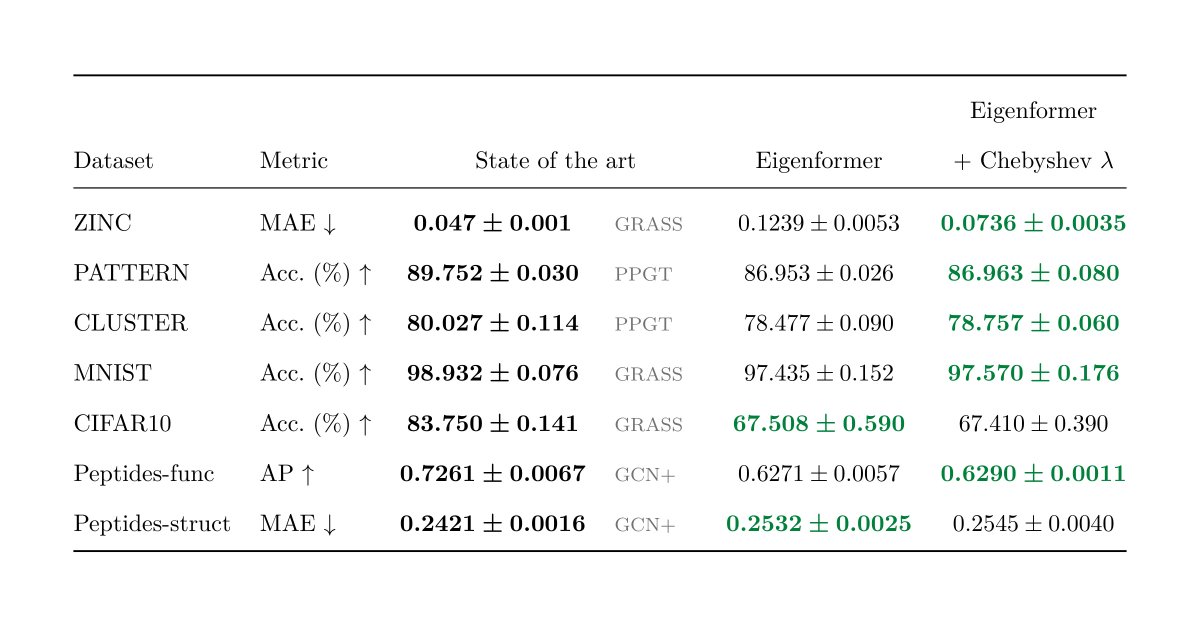
Of late, I've been reading a lot about how frontier models are getting good at science, and I couldn't help but unleash them on one of my own GNN research projects, Eigenformer, done a little over two years ago (https://t.co/eC2WkqR5js).
The protocol in brief:
- I instantiated one Opus 5.5 and one Astra agent (with web access) on the Eigenformer repository (which contained other relevant GNN literature along with the code)
- Prompted them to come up with a protocol to discuss their ideas, experimental plans and results, and use it to think of ways to improve the work
- Provided them with access to a fresh AWS account with L4 GPU access (with a budget cap of course) to run the experiments
- Supervised/steered them just enough to understand their method while not being a bottleneck
Here's what they came up with:
Main idea:
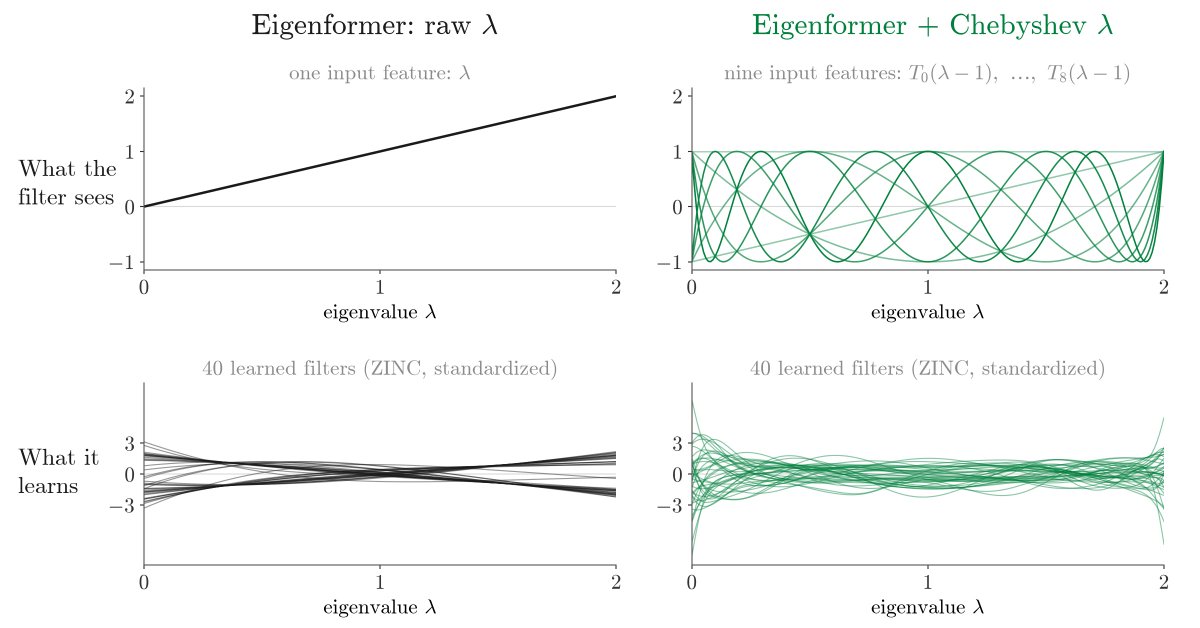
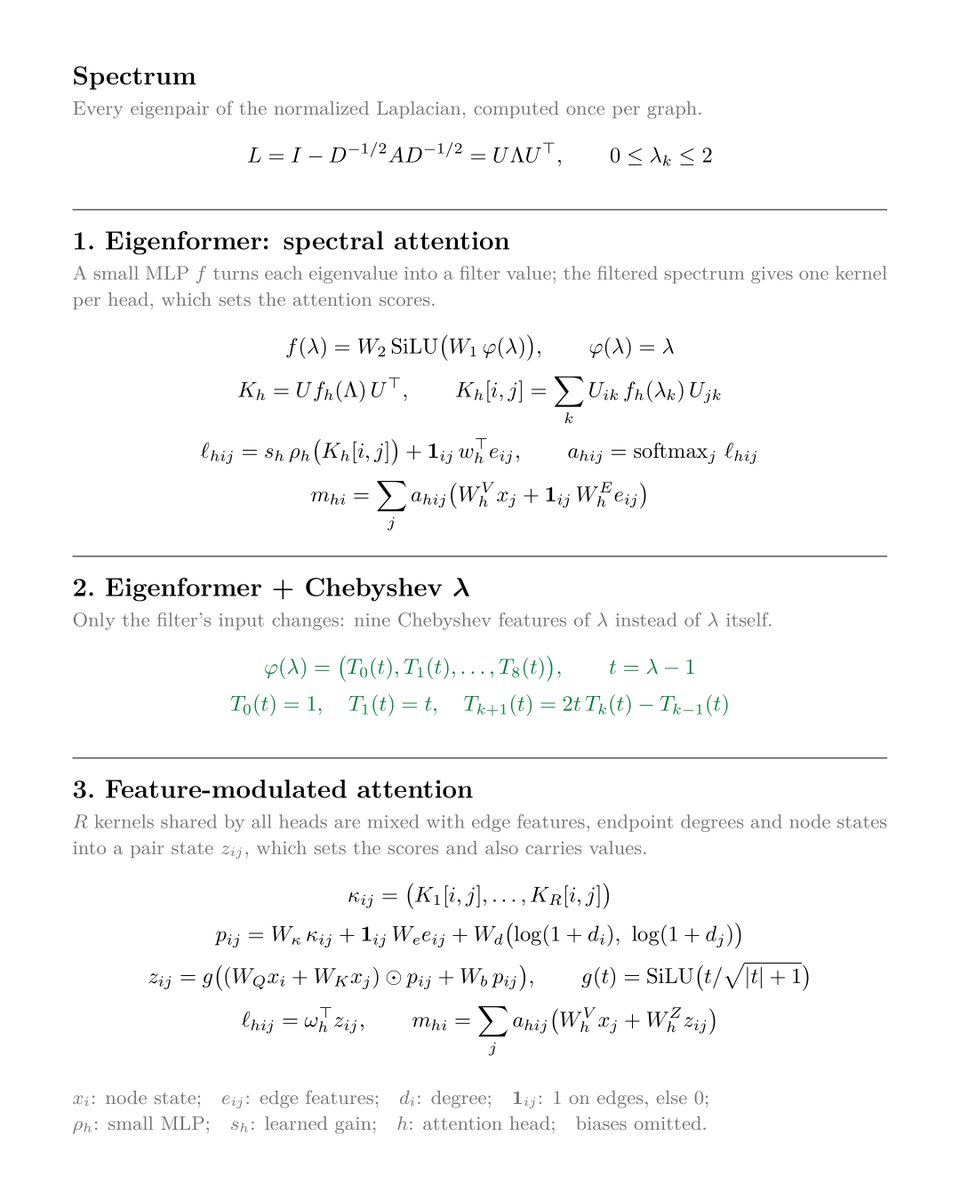
Instead of feeding the attention filter the raw eigenvalues of the graph Laplacian, give it Chebyshev polynomial features of them, so it can learn curved, multi-hop filters rather than near-straight lines.
Motivation:
A small MLP on the raw eigenvalue starts out, and on ZINC stays, almost a straight line in λ. A straight-line filter only lets attention tell direct neighbours apart from everything else, so we feed the MLP the Chebyshev features T₀…T₈(λ−1) instead.
Result:
Chebyshev inputs cut ZINC validation error by 46% at 127K parameters (27% at 500K). On the other six benchmarks the learned filters became visibly more curved, though accuracy didn't change significantly. A feature-modulated attention variant (currently under investigation) gave a further +0.45-point lift on CLUSTER, to 79.202% test accuracy, narrowing the gap to the SOTA (80.03%).
Although the ideas are hardly new, I was pleasantly surprised by the work. It lends credence to the general view among researchers that LLMs are very good at synthesising connections between long-range ideas that a human's context window might miss, even though they still lag in coming up with deeper/fresher ideas (for now).
A full technical report to follow soon :)
𝗜𝗳 𝘆𝗼𝘂 𝗰𝗮𝗻'𝘁 𝘃𝗲𝗿𝗶𝗳𝘆 𝘁𝗵𝗲 𝘀𝗮𝘃𝗶𝗻𝗴𝘀, 𝘆𝗼𝘂 𝗱𝗶𝗱𝗻'𝘁 𝘀𝗮𝘃𝗲 𝗮𝗻𝘆𝘁𝗵𝗶𝗻𝗴.
Here's what a cost-cutting project looks like when it's done properly.
Starting point: $12,000/month on inference.
→ Cut one of four model calls per task: $9,000
→ Trim the context sent with each call: $7,200
→ Structure prompts so the provider's cache kicks in: $4,977
→ Send 60% of calls to a cheaper, tested route: $3,036
About 75% off inference. After adding $1,000/month for the extra tooling and operations it takes, it's still about 53% off total operating cost.
But the numbers aren't the point. What makes them believable is:
1. 𝗤𝘂𝗮𝗹𝗶𝘁𝘆 𝗶𝘀 𝗮 𝗿𝗲𝗹𝗲𝗮𝘀𝗲 𝗴𝗮𝘁𝗲. Each change ships only if it holds up on a held-out set of real examples, then rolls out gradually.
2. 𝗦𝗮𝘃𝗶𝗻𝗴𝘀 𝗮𝗿𝗲 𝗺𝗲𝗮𝘀𝘂𝗿𝗲𝗱 𝗮𝗴𝗮𝗶𝗻𝘀𝘁 𝘄𝗵𝗮𝘁 𝘁𝗵𝗲 𝗼𝗹𝗱 𝘀𝗲𝘁𝘂𝗽 𝘄𝗼𝘂𝗹𝗱 𝗵𝗮𝘃𝗲 𝗰𝗼𝘀𝘁 𝘁𝗵𝗶𝘀 𝗺𝗼𝗻𝘁𝗵. That separates your engineering wins from a provider cutting prices, or from simply having fewer customers.
3. 𝗙𝗶𝗻𝗮𝗻𝗰𝗲 𝘀𝗶𝗴𝗻𝘀 𝗼𝗳𝗳 𝗼𝗻 𝗮 𝘀𝗮𝘃𝗶𝗻𝗴𝘀 𝗹𝗲𝗱𝗴𝗲𝗿 they can re-run themselves.
This is the final part of a six-part series on cutting AI spend without cutting quality! And it summarizes the whole series: 𝗺𝗲𝗮𝘀𝘂𝗿𝗲 𝘁𝗵𝗲 𝗰𝗼𝘀𝘁 𝗼𝗳 𝘄𝗼𝗿𝗸 𝘁𝗵𝗮𝘁 𝘀𝘂𝗰𝗰𝗲𝗲𝗱𝘀, 𝗿𝗲𝗰𝗼𝗻𝗰𝗶𝗹𝗲 𝘁𝗵𝗲 𝗯𝗶𝗹𝗹, 𝗿𝗲𝗺𝗼𝘃𝗲 𝘄𝗮𝘀𝘁𝗲, 𝗿𝗼𝘂𝘁𝗲 𝗰𝗮𝗿𝗲𝗳𝘂𝗹𝗹𝘆, 𝗯𝘂𝗱𝗴𝗲𝘁 𝗮𝗴𝗲𝗻𝘁𝘀, 𝗮𝗻𝗱 𝗽𝗿𝗼𝘃𝗲 𝗶𝘁.
Do you agree? We'd love to know your thoughts in the comments below!
#AIFinOps #FinOps #GenAI #LLMOps #AIEngineering