STROKE at the age of 34.
Runs 5k on weekends.
Normal blood pressure.
No diabetes. No smoking.
But ONE common stress relief habit quietly tore a major blood vessel and caused a massive brain attack.
A medical thread on what actually happened 👇
Instead of watching an hour movie, watch this. In 14 minutes, an Anthropic engineer who wrote Building Effective Agents will teach you more about building agents right than most developers figure out on their own in months.
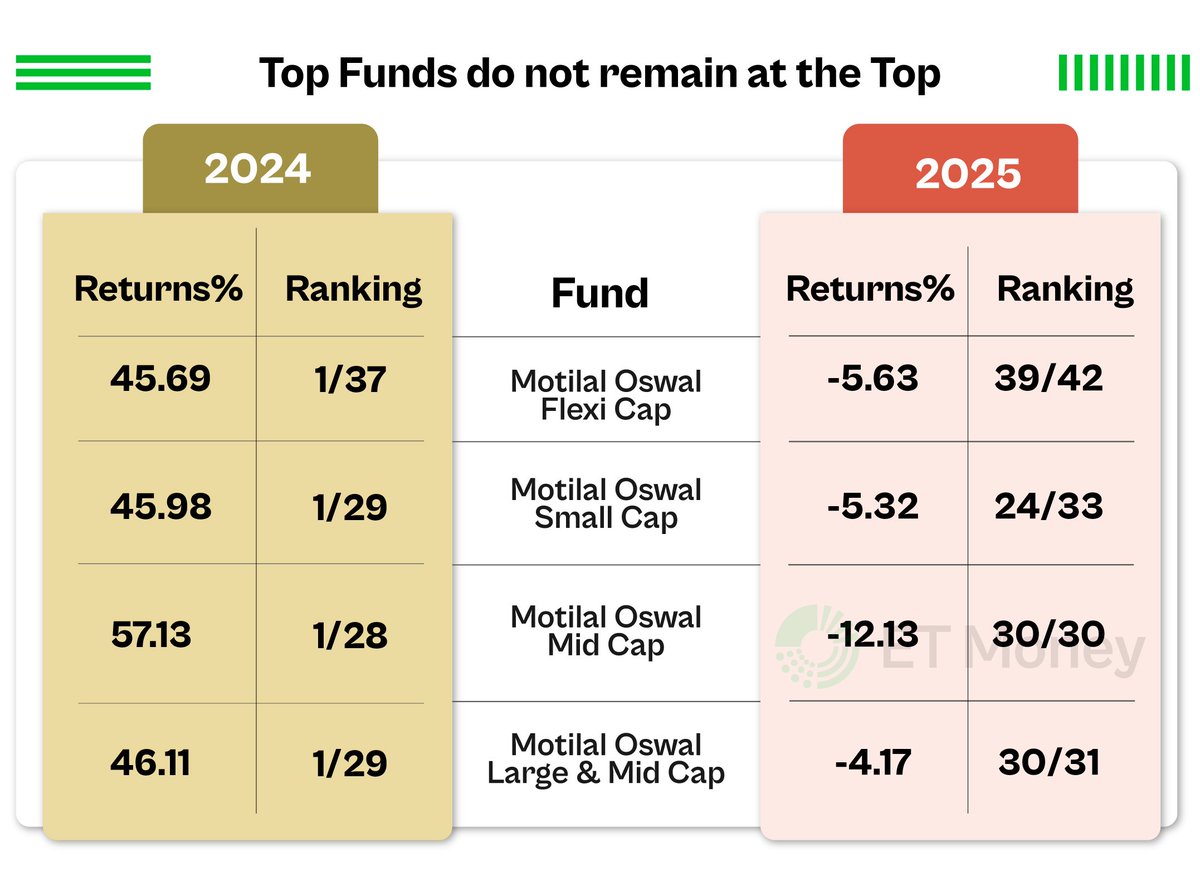
Many schemes from Motilal Oswal Mutual Fund dominated charts in 2024.
Across categories, they were ranked #1.
Then came 2025… and the same funds slipped to near the bottom.
This raises a SERIOUS question 👇
Should you chase last year’s top funds?
A 🧵
Wife explaining her husband's job to her close friend.
Wife: "He sells software to companies."
Her friend: "Oh nice, like apps?"
Wife: "No. Big software. For running whole businesses."
Friend: "Oh, like Microsoft?"
Wife: "No. A German company. SAP."
Friend: "What's SAP?"
Long pause.
Wife: "Well.... It's… hard to explain. Basically he flies somewhere, finds whats broken in their business, spends 18 months with fixing it, and then everyone panics on this thing called go-live or something."
Friend: "And they pay him for that?"
Wife: "Sometimes they fire him first. Then they call him back."
35+ years in this industry.
She nailed it in 90 seconds.
For all those who wanted it to be another full member T20 World Cup like the ODI World Cup, the first two days of the tournament is a reminder that the sport has to grow and the T20 format is the best vehicle for it #T20WorldCup
The authorities, sponsors, organisers, media and the athletes did their job, But, the ultimate success factor for the @PuneGrandTour is that the Punekars owned up this event and showcased the spirit of Pune.
So proud to be witnessing this mammoth event bring the city I call home go all out and how!
Congratulations to all!
If you want to get started with global investing, here's our webinar recording & guide
Among other things, we cover:
1) Why invest outside India
2) Which feeder funds are open
3) Funds are in GIFT
4) How to choose a US broker
5) Rules under LRS
https://t.co/XX7KfZSAB4
Why Do You See BMWs, Audis, and Mercedes Selling for ₹5–10 Lakhs?
Here’s the Real Reason.
A lot of people get shocked when they see premium cars like BMW, Audi, or Mercedes being sold for ₹5–10 lakhs.
Sometimes you’ll even find relatively newer models from 2019, 2020, 2021 at unbelievably low prices.
How is that even possible?
Well, here is the part most people have absolutely no idea about.
1. Every Car Has a CVD Value
When you buy a car, insurance is mandatory.
Along with that, every car is assigned a CVD value, which means Current Vehicle Depreciated Value.
This is the value of the car after accounting for yearly depreciation, and insurance uses this number to determine how much they will pay in case of heavy damage.
2. When a Luxury Car Meets With an Accident
Luxury cars have extremely expensive parts and repairs.
Example: A BMW 3 Series meets with a big accident and goes to the workshop.
The repair estimate comes to ₹25–30 lakhs.
Very common and very normal for these brands.
If the car’s CVD value is around ₹35–40 lakhs, the insurance company will not repair it. Instead, they will categorise it as a:
→ Total Loss Vehicle
Meaning:
It is cheaper for the insurance company to pay the owner the CVD amount and write off the car completely, instead of repairing it.
3. What Happens to the Car After Total Loss?
Most people believe total loss cars get scrapped.
Absolutely not.
Insurance companies sell these vehicles to specialised vendors who rebuild cars from scratch. These vendors buy the car for around:
→ 50–60% of the CVD value
If CVD was ₹30 lakhs, the vendor gets it for ₹18–20 lakhs.
4. Vendors Rebuild the Entire Car
These vendors use:
- Used parts
- Imported parts
- Fabricated parts
- Refurbished structural components
They rebuild the entire vehicle and bring it back to showroom-like condition.
Even official workshops sometimes declare a car “non-repairable”, but these vendors can still rebuild it.
5. Then It Goes Back Into the Market
Once restored, the vendor sells the car for ₹25-27 lakhs to a used-car dealer, and that dealer then sells it to a customer at ₹30L.
So, an ₹80 lakh car is now available in the market for ₹30 lakhs after passing through multiple hands.
Here, the example I used refers to a newer model that is barely 2–3 years old and lightly driven. The CVD for older cars is much lower, which is why those models are available at even cheaper prices.
The catch is:
→ Buyers never get to know it was a total loss car.
There are many ways to hide that history once the car changes jurisdictions or goes through non-authorised channels.
6. The Truth Behind “Unbelievably Cheap Premium Cars”
Whenever you see a nearly-new Mercedes, BMW or Audi at an extremely low price, you can be almost certain:
It was a total loss car rebuilt by a vendor and pushed back into the used-car market.
Most people have no idea this ecosystem even exists.
If you ever wondered why these cars sell for such insanely low prices, now you know how the entire chain works behind the scenes.
Jane Street – Why it deserves Our Gratitude: Exposing the Fragile Underbelly of India's Markets
I’ve been watching the markets for years - managing wealth, building portfolios, witnessing booms, crashes, scams, reform cycles, and regulatory knee-jerks. But nothing baffles me more than the convenient outrage we summon when someone wins “too much” within a system we ourselves designed.
As everyone celebrates SEBI's order barring Jane Street from trading and clawing back thousands of crores in what it calls unlawful gains, the powers that be might have put a firm nail in the coffin of progress and learning.
@Nithin0dha of @zerodha pointed out how trading volumes have dropped sharply after this. But here's a different view: Jane Street didn't damage the market; they just used the rules we made and won big. This exposes how our markets lack depth. Instead of gloating in their momentary misery, we should use this to push for better regulations that build strength, not block smart players.
Grudging Jane Street's luck, strategy, and its deft execution and exploitation of India's shallow markets is like watching a cunning fox raid a poorly guarded henhouse, seizing every chance while others scramble, unaware of the fierce spirit of resilience and reform needed to level the playing field.
Remember… – during demonetisation – People died in ATM queues, but they found solace in the idea that someone richer was potentially losing more. That's the essence of what we witnessed with SEBI vs. Jane Street.
Schadenfreude dressed as patriotism.
Our Markets Can't Handle Even Small Flows
The mutual fund industry has grown to `₹75 lakh crore in assets as of June 2025, thanks to campaigns like "Mutual Fund Sahi Hai" that pushed 20% of household savings into stocks at absurd, unsustainable valuations.
Our total stock market value is around ₹454 lakh crore. That sounds big, but it's not deep enough. In the US, founders like Jeff Bezos or Jensen Huang sell billions in Amazon or Nvidia shares, and the prices barely move. Liquidity is strong there, with lesser counterparty risks. There is NO counterparty existing in India in case of panic.
In India, even a 2% redemption from mutual funds - about ₹1.5 lakh crore - could cause a tectonic fall. Based on daily trading volumes of ₹1-2 lakh crore and how thin our market is, this could push Nifty down by 5-10% in a few days. Bank Nifty, where five banks make up 80%, might fall 10-20%.
Consider this: even a few thousand crores or sometimes just a few hundred crores of trades in the cash market can swing the indices dramatically by 1-2%, exposing the shallow liquidity in underlying stocks. Yet, the real game unfolds in options, where notional turnover towers over cash by 10 times or more, blindsiding gullible, unaware retail players with sudden volatility and massive losses they never see coming.
We've seen this before: small outflows in 2020 amplified drops by 10-15%. With so much “rainy-day” money moving to stocks in the last 5-7 years, one small event could start a chain reaction. It's ironic - we talk about our economy in the global pecking order, but our markets shake from minor shifts. Should they be this fragile? Should a small amount of capital really shake one of the most traded indices in what we claim is one of the most resilient economies?
Rules That Limit Growth, Not Protect It
SEBI wants to safeguard investors, but some rules do the opposite. Circuit filters stop trading at 10%, 15%, or 20% moves, to prevent panic. But they just delay problems and make volatility worse when trading restarts. This happens only in India - why not let prices move freely like in the developed markets? Bans on stocks when open interest rises too much? That's another odd rule that traps money and scares away big players.
Options trading shows the gap clearly. In evolved markets, anyone can write options or act as a market maker, even for long-term contracts up to 5 years. Liquidity exists for far-out strikes, and even Indian ADRs like Infosys, Wipro, ICICI, and HDFC Bank have more depth in the options market there. I logged into a friend's account and tried to place an order for Jan ‘26 and Jan ‘27 (in ICICI and HDFC options and it was smooth as a hot knife on butter.
In India, I keep calling my broker struggling to place an order (for the same month expiry) and waiting for some big market maker to create an OI of 3 lots and traded volume of 2 – What a joke, really.
There is no counterparty for many-many simple trades in India, and liquidity vanishes beyond the current month. Jane Street made profits legally in this setup – We shouldn’t be fining them. We should be worshipping and thanking them in the Gurupurnima week for giving us the biggest lesson in recent stock market history.
Our system invited them to play, and now we are complaining that they scored too much.
Dostoevsky rightly said - "The surest way to be happy is to find a fault in someone else". The true measure of integrity lies in fixing our own flaws before we start indicting others for playing by the very rules we set.
Indian Markets: Over-Regulated and Under-Innovative?
SEBI's decision to bar Jane Street from trading, for me, sadly reinforces the idea that we're still a long way from being a truly free market, like the US. It paints a picture of an environment where free thinking and innovation struggle to genuinely thrive. Just look at the S&P 500 – new-age businesses, the real wealth creators, make up about 30% of it. Compare that to our Indian main indices, where a whopping 45% are comprised of financial companies, essentially the oldest form of business: lending and borrowing.
Bank Nifty, where just five banks make up 80% of the index - in my opinion, almost opens the gates for anyone with deep pockets to develop strategies and gain disproportionately by trading these indices and stocks separately.
The Real Issue: Envy Over Reform
Thomas Sowell said, "Envy was once considered to be one of the seven deadly sins before it became one of the most admired virtues under its new name, 'social justice'. We're happy about Jane Street's troubles, but it's our market that's hurting - volumes down, less innovation. Remember George Soros and the Bank of England in 1992? It hurt short term but led to growth.
Jane Street could do the same for us: Force Changes.
We shouldn't treat long-term FDI better than short-term FII money. All capital helps if we let it flow freely. Free markets create some inequality at first, but they build wealth. Over-regulating keeps us stuck with old businesses like banking dominating our indices, not new ones like in the S&P 500 or NASDAQ.
Collaborate with Jane Street and its ilk – Don’t deride them.
We should collaborate with Jane Street and find ways to use their intelligence, making them part of our system. After all, they've earned billions from us - why not turn that into a partnership for deeper markets?
Top policymakers should gain hands-on experience: give them real money to trade options and futures themselves. Let them see the system's problems, weak points, and lack of depth and breadth firsthand.
They should be allowed, through their organizations, to open brokerage accounts with reasonable capital. Each one should have an account at E*TRADE, Charles Schwab, or Fidelity. They should be asked to spend a few hours on real-time trading, do some actual trades, experience how those markets operate, and feel the ease of doing business. Then, draft policies based on that real-world insight. This would build a robust learning curve, turning regulators into informed players instead of distant rule-makers.
Jane Street's temporary exit isn't a win. 10 more will emerge under a different name. - It's a reminder that we need to evolve.
A moat around mediocrity is the fortress of the fearful, where innovation drowns in the stagnant waters of complacency, shielding the average from any form of greatness.
Hotel rates are highly seasonal & crazy expensive. It's taken me years to find value for money options in Mumbai hotels. Story from Business Standard. My list so far?
1) Sea Green
2) Strand
3) Westend
4) Bentley
5) YWCA
All in Colaba. Usually in the 4-6k range.
The Ghosts We Inherit: India's 'New Money' Story
My mother reuses tea leaves until the water runs clear. My friend's father keeps a wooden box in his closet, with carefully folded bills arranged by denomination. Another's maintains a small diary tracking every household expense down to the last rupee. These aren't quirks – they're battle scars from a generation that survived on less.
We are their children. We carry their financial trauma in our wallets, even as we tap them against sleek payment terminals at craft coffee shops.
पुणे शहरातील शाळांना २५ जुलै, २०२४ रोजी सुट्टी !
हवामान विभागाने येत्या काही तासांत पुणे शहर, भोर, वेल्हा, मावळ, मुळशी, हवेली तालुक्यातील खडकवासला परिसरात अतिमुसळधार पावसाचा इशारा दिला असल्याने (रेड अलर्ट) या भागातील शाळा २५ जुलै रोजी बंद ठेवण्याचे आदेश जिल्हाधिकारी तथा जिल्हा आपत्ती व्यवस्थापन प्राधिकरणाचे अध्यक्ष डॉ. सुहास दिवसे यांनी दिले आहेत.
#पुण्याचा_पाऊस
What Pune needs in the next 5 years.
Number 1: a good leader who can push the following projects to work with state government and central government in one strong voice.
What are the mega projects we should seek for our city:
1. Metro Expansion and metro with parking connectivity.
2. Ring Road to ease traffic within city peripheral areas.
3. Expressway to Mumbai to be upgraded. Expressway till Kolhapur and Sambhaji Nagar.
4. IIT For Pune. IIM For Pune.
5. Forts to be maintained. Thukai of ASI should be done by the MP.
6. River Rejuvenation Project to be done by Central Govt. PMC has failed.
7. AIIMS has to come to Pune. Many private hospitals looting citizens. Only DMH and Sasoon are rocking it.
8. Koyta Gang menace to be dealt with iron hand.
9. Illegal encroachment need to be stopped. Increase in criminal activities to be dealt with iron fist. It’s Local level issue but with strong leaders, even corrupt PMC can be put to task.
10. Smart city project needs to be expanded.
11. Water chori, light chori needs to be stopped. Tanker Maria needs to be handled.
12. Solar power has to be promoted in big way and central schemes should be brought to households by MP.
Pune needs someone who has weightage at Mumbai and Delhi alike.
We are number 1. If we want to remain so then we need nothing less than number 1 to lead us.
What is that you want Pune to have in the coming 5 years.