Engineer | Big fan of Modi and his policies for India ! Not interested in politics though😀 Sports lover ❤️ | MSD ,CR7, Federer fan 😎| RTs are not endorsement
@narendramodi Handful of private hospitals accept Ayushman Bharat cards. Please ask the team to conduct ground visit and check reality. People are starving of such a wonderful scheme.
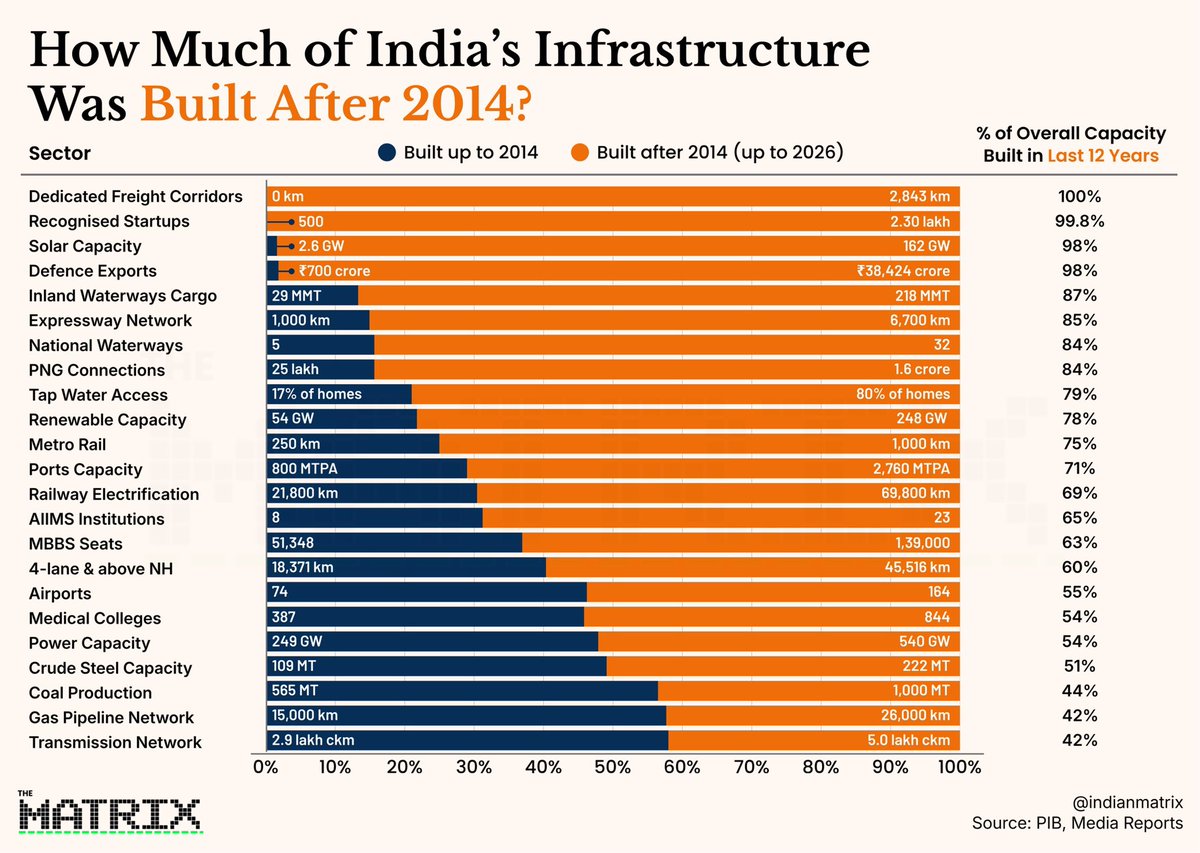
How much of India's infrastructure was built after 2014?
• 100% of Dedicated Freight Corridors
• 98% of Solar Capacity
• 85% of the Expressway Network
• 79% of Tap Water Access
• 75% of Metro Rail
• 71% of Port Capacity
• 69% of Railway Electrification
• 60% of 4-Lane National Highways
Infrastructure is built over decades.
But some decades build more than others.
Facts below (1/5):
In 2025, average earnings per hour (EPH), excluding tips, for a delivery partner on Zomato were ₹102.
In 2024, this number was ₹92. That’s a ~10.9% year-on-year increase. Over a longer horizon also, EPH has shown steady growth.
Most delivery partners work for a few hours and only a few days in a month. But if someone were to work for 10 hours/day, 26 days/month, this translates to ~₹26,500/month in gross earnings. After accounting for fuel and maintenance (~20%), the net earnings for the partner are ~₹21,000/month.
Note: Earnings per hour are calculated on total hours logged in, including the time when the partner might be waiting to receive an order. Earnings per “busy hour” will be higher but that’s not the right metric to look at.
On top of this - delivery partners earn 100% of tips given by customers. The average tip per hour in 2025 on Zomato was INR 2.6 and in 2024 was INR 2.4 per hour. Tips are transferred instantly, with zero deductions. We absorb the payment gateway processing cost ourselves. About 5% of the orders get tipped on Zomato; 2.5% on Blinkit.
Last one on this topic, and I have been holding this in myself for a while.
For centuries, class divides kept the labor of the poor invisible to the rich. Factory workers toiled behind walls, farmers in distant fields, domestic help in backrooms. The wealthy consumed the fruits of that labor without ever seeing the faces or the fatigue behind it. No direct encounter, no personal guilt.
The gig economy shattered that invisibility, at unprecedented scale.
Suddenly, the poor aren't hidden away. They're at your doorstep: the delivery partner handing over your ₹1000+ biryani, late-night groceries, or quick-commerce essentials. You see them in the rain, heat, traffic, often on borrowed bikes, working 8–10 hours for earnings that give them sustenance. You see their exhaustion, their polite smile masking frustration with life in general.
This is the first time in history at this scale that the working class and consuming class interact face-to-face, transaction after transaction. And that discomfort with our own selves is why we are uncomfortable about the gig economy. We want these people to look our part, so that the guilt we feel while taking orders from them feels less.
We aren't just debating economics. We are confronting guilt. That ₹800 order might equal their entire day's earnings after fuel, bike rent, and app cuts. We tip awkwardly, or avoid eye contact, because the inequality is no longer abstract. It's personal.
Pre-gig era, the rich could enjoy luxury without moral discomfort. Labor was out of sight. Now, every doorbell ring is a reminder of systemic inequality. That's why debates explode. It's not just policy. It's emotional reckoning. Some defend the system (“they choose it”), others demand change (“this isn't progress, its exploitation”).
And here’s the uncomfortable twist: the unsaid ask of clumsy ‘solutions’ isn’t dignity. It is about returning to invisibility.
Ban gig work and you don’t solve inequality. You remove livelihoods. These jobs don’t magically reappear as formal, protected employment the next day. They disappear, or they get pushed back into the informal economy where there are even fewer protections and even less accountability. Over-regulate it until the model breaks, and you achieve the same outcome through paperwork instead of slogans: the work evaporates, prices rise, demand collapses, and the people we claim to protect are the first to lose income.
And then what happens?
The rich get their old comfort back. Convenience returns without faces. Guilt dissolves. We go back to clean abstractions and moral posturing from a distance. The poor don’t become safer, they become invisible again: back in cash economies, back in backrooms, back in shadows where regulation rarely reaches and dignity isn’t even debated.
The gig economy just exposed the reality of inequality to the people who previously had the luxury of not seeing it. The doorbell is not the problem. The question is what we do after opening the door.
Visibility is the price of progress. We can either use this discomfort to build something better (which we keep doing continuously as delivery partners are our backbone), or we can ban and over-regulate our way back into ignorance. One of those choices improves lives. The other simply helps the consuming class feel virtuous in the dark.
The real minimum wage is ₹0.
It is called unemployment.
Millions of people in India are unemployed.
In many small towns and cities, guys in their early 20s leave their houses on a bike, loiter around all day, drink and smoke with their friends and gamble on cellphone games. Countless families are struggling with this - financial burden + social ills.
Quick commerce tech-companies have created jobs for lakhs of such people. None of them are forced to work with these companies. They are free to leave and do something else. But they decided to earn a respectful living. More than the national average, more than ₹0.
They believe - for the skill they possess, effort that is required, and money they make - this job is better than any other job available in the market. Every person has the right to make that choice for their career. Just like the one you have made with your current job.
GoodPeople™ are always free to create better jobs. Talk is cheap. Till then, the wages these 'evil' and 'exploitative' capitalists provide, will help them pay their children's school fees, and buy groceries for the month. Their life is better with this job, than it was, without it.
This is the reaction of India’s Former High Commissioner to Pakistan and Ambassador to China Amb. Gautam Bambawale after watching #Dhurandhar. @AdityaDharFilms
The 8.2% GDP growth in Q2 of 2025-26 is very encouraging. It reflects the impact of our pro-growth policies and reforms. It also reflects the hard work and enterprise of our people. Our government will continue to advance reforms and strengthen Ease of Living for every citizen.
Can I urge the Pune Municipal Commissioner @navalMH to involve that famous contractor Recondo to revive Pune’s roads?
They did the JM Road 50 years ago too well and were thereafter banished forever.
Bring them back. They still exist.
You are wrong, @RahulGandhi.
PM @narendramodi is not afraid of President Trump. PM Modi understands the long game and his diplomacy with the U.S. is strategic. Just as @POTUS will always put America’s interests first, so will PM Modi do what is best for India. And I applaud that. That’s what Heads of State do. They do and say what is best for their country.
I don’t expect you to understand this type of leadership because you don’t possess the acumen to be PM of India. Best to return to your “I hate India” tour that has an audience of one - you.
Pune never fails to impress: beautiful city, great enterprising people and inspiring energy!
The Defence Committee meeting was productive, but traffic discipline needs urgent attention.
It took 1.3 hours to cover just 20 km to the airport — what a waste of time for every Punekar on the road each day.
Rash driving, no helmets, rule violations and excessive honking are serious concerns that can be fixed. The @PuneCityTraffic must act with passion and purpose, and citizens must cooperate.
With better enforcement, use of smart cameras and civic discipline, Pune can truly become a model city for road safety.
#PuneTraffic
I have decided to donate my match fees from this tournament to support our Armed Forces and the families of the victims who suffered from the Pahalgam terror attack. You always remain in my thoughts 🙏🏽
Jai Hind 🇮🇳