This math checks out. That's a crazy amount of broadcast power, definitely capable of generating jam-resistant signals or overwhelming local signals to jam other comms/radar.
People are focused on consumer ARPU, but I think major money will come from the military first.
Regarding the SpaceX/Grain transaction, I think this is moderately net positive for AST. First, the negative. Another swath of spectrum (which would have been useful in 6 months on Block 2), which the MNO’s couldn’t control due to FCC limits on amount of low band each can control, would have been a big boon to $ASTS. The biggest would be the ability to use this to kill urban area grey zones. 1:1 frequency reuse with undeployed, nationwide low band would have be a huge attraction to customers and MNOs accelerating adoption with a superior product.
Now, we have to wait for the Ligado spectrum for similar abilities. Further, Ligado is not in current phones, which Grain was. OTOH, it will share much of the same desirable propagation characteristics as it is on the lower end of midband spectrum and it includes Canada (a market w/ high ARPU and 2/3 major MNO’s locked up).
The biggest benefit, as stated by others, is that this makes AST the last bulwark against SpaceX for the MNOs that currently own 90-95% of US mobile customers. TMo probably has to sign at worse terms than ATT/VZ or be left out in the cold. Easy to forget in the bubble of X but half the US dislikes Elon. What percent of Mobile subscribers is SpaceX therefore going to get? Even if you say they eventually get 25% of total US customers, AST signs with the 3 major MNO’s because of this and has access to 75%. Some think this makes an MVNO defection by one of the big 3 more likely, to preferentially cannibalize the other two, which I don't see at all. In this instance of defection, we maintain the current status of 66% AST/33% SpaceX but doesn't get SpaceX cooperation in international markets. D2D is probably a duopoly (don't put much credence to Amazon/Lynk/Equatys) with AST getting access to all of the customers of TMo/Vz/ATT.
Ultimately, you have to decide if you think SpaceX can capture most of the world's mobile subscribers or if the MNO's maintain their lead because AST's white label, core integrated broadband service will be the partner of choice for most MNOs. It is telling that Starlink hasn't signed any Tier 1 MNO's in the past 6-12 months and Deutsche Telecom (and thus TMo will follow) has said that they are working on network integration w/ AST. DT previously said they would only include Starlink Mobile on 2GHz and it looks increasingly likely they will lose their allocation.
I think SpaceX will pull a reverse build on their new low band spectrum. They’ll put up a bunch of low band capable satellites for broad coverage (and to meet buildout requirements) and later have towers in urban areas because these will be more more spectral efficiency and high penetrance in to buildings. Some have theorized that this forces the MNO’s to make the AST service as good as possible (i.e. donating more spectrum as evidence by Abel’s tweet that they control 1000 MHz LB/MB spectrum), to negate any advantage that SpaceX has, and I agree with that. The second order effect will be that this pushes AST to be included in every single plan from the big 3, because you don’t want SpaceX picking off your subscribers with it's D2D offering. This probably lowers ARPU, but vastly increases adoption percentage. D2D was always headed to 100% adoption, with 6G making NTN-TN integration a key feature, but it is now vastly accelerated.
Looking at $asts stock price, you would have thought their facility got nuked or something. Let’s breakdown the space x transaction. On paper, ast lost out to space x on this grain transaction. There’s no other way of saying that and it’s a fact. Kudos to space x- they now have access to low and mid-band spectrum, so they have the ingredients to start competing directly with MNO’s now.
What are the implications? Ast and space x are increasingly now approaching this connectivity problem in a completely different manner. Space x is going completely vertically integrated, direct to consumer. It is safe to assume with this transaction, MNO partnerships will be far and in between moving forward. Ast meanwhile has always been B2B, via partnerships with the MNO’s. They are becoming less and less of direct competitors via their business models.
Implications for ast? As with other things, yet again this is another event that helps pull their opportunity forward. If ast were in talks with T-mobile, deutche telecom, those talks just became a much higher priority and the likelihood of a deal happening sooner just significantly went up. It was also inevitable that satellite plans would get baked into cellular plans, but now that offering is pulled forward with starlink. If you’re an MNO, you now have to offer a majority of your plans with satellite, otherwise you risk losing your customer to space x. Yet again, the intrinsic value of ast just got higher. They are now a keystone species for telecom- ast’s success will be directly correlated with customer retention for the MNO’s. Also, grain has 14mhz of low band spectrum-the MNO have 1000mhz of low& mid band spectrum combined between them. The odds are much higher now that ast will have more access to it moving foward, if mno's have any sense of self-preservation.
From a fiscal standpoint, I have always trusted the company and never questioned when they raised capital. Perhaps some of the most recent raise could have been in plans for grain- instead, they are now sitting on a warchest so they can ride out the volatility until rates stabilize and macro improves. One less headache to think about.
It’s always been this narrative that any news with space x causes ast to go down. Unfortunately, it still seems analyst coverage on ast still has room for improvement. It’s a Friday- if you’re an institution and you don’t really understand what the hell is going on, you have to sell first and ask questions later. You cant afford to be late or sit on sidelines- this is the Wall street way. I fully expect in the coming weeks that the market will realize that they got this wrong, much like with the echostar transaction a while ago and should result in net buying later.
The risk/reward of owning ast has never been better. I’ve been an owner since 2021 so quite frankly, this is just a flesh wound-the company has been through way worse and got through the valley of death. The thesis is intact, the TAM keeps expanding, and the strategic value of ast continues to exponentially rise. If you can ride out the volatility, the stock will reward those that are able to sift out the noise
@thekookreport@tottaway22 Man goes to doctor. Says he's depressed. Says his investments lost value. Doctor says, 'Treatment is simple. Great clown Pagliacci is in town tonight. Go and hear his T-Mobile thesis. That should cheer you up.'
Man bursts into tears. Says, 'But doctor... I am Pagliacci.'
Arrived a week ago based on traffic cams. Still a nice update.
No update on BB17-19. If you're on board with my previous statements (SX NDA means no updates on completed batches because it means they're waiting on SX)... no update means the sats are ready.
@Defiantclient2@tottaway22 One caveat to my plan: I believe SX makes clients keep shipping containers on prem until integration is complete, so they can rapidly clear payloads out if a problem is found. I don't expect the shipping containers to leave the Cape until around 10/23.
@tottaway22 Yeah, that is a weird statement on its own.
Hyper-optimistic outlook: CRS-35 clears the integration facility this weekend. BB17 (bottom of next stack) ships in box #4 next week, with boxes returning and picking up BB18-19 the following week?
Won't bet on it but it would be nice
@shirleyjonesy $ASTS I don't usually blame them for little PR, they walk a tightrope of things they are allowed to say and a lot of confidential stuff and better to say nothingthan the wrong thing. This one is odd, though.
Maybe the kid who runs their X account was on vacation?
I also don't blame anyone for disagreeing with me on that idea. It's conjecture. But we've never seen an update that a BB2 batch was ready to ship, so what little evidence we have lines up.
Why not announce the stack was ready to launch while everyone's waiting around for a month?
See the previous NDA. I believe ASTS is being extremely cautious not to piss off their one available launch provider by stating any info that could be misconstrued to make SX look bad.
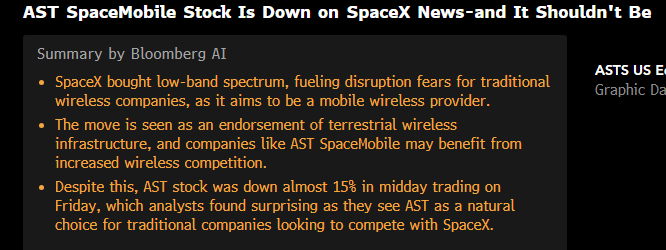
$ASTS: AST SpaceMobile Stock Is Down on SpaceX News-and It Shouldn't Be - Barron's
By Al Root
(Barron's) -- SpaceX shook up the wireless communications industry on Thursday by buying more wireless spectrum, fueling disruption fears for traditional wireless companies.
Make no mistake, SpaceX wants to be a mobile wireless provider (as management has repeatedly said), but the traditional players will fight back as space- and land-based communications technology merge.
That should be good for shares of AST SpaceMobile, which aims to compete with SpaceX's space-based broadband product. AST stock is getting hammered on Friday, though. That's odd.
On Thursday, SpaceX announced the purchase of low-band spectrum for undisclosed terms. Low-band spectrum is good for broad wireless coverage and reaching inside buildings. It's another step on the path toward Starlink Mobile (or whatever Elon Musk decides to name SpaceX's mobile offering).
Shares of Verizon, AT&T, and T-Mobile were down between 10% and 13% in late Friday trading. Shares of wireless tower REITs American Tower and Crown Castle were up about 8% and 13%, respectively.
SpaceX's move is an endorsement of terrestrial wireless infrastructure, says Bernstein analyst Madison Rezaei. She describes the tower companies as apartment buildings. The tower apartments have three tenants -- Verizon, AT&T, and T-Mobile -- and might soon have a fourth.
Similarly, AST seems to be in a good position as wireless competition ramps up. Wireless carriers might be looking to the stars to fight SpaceX on its own turf. A satellite constellation operator that can move data around the globe would be a valuable ally. Still, AST shares were down almost 15% in midday trading on Friday.
That doesn't make sense to Berenberg analyst Michael Filatov. He sees AST as a natural choice for traditional companies looking to compete. Roth Capital also sees AST becoming the direct-to-device satellite partner for the traditional wireless industry.
Still, the stock is down. One reason could be that AST didn't buy the spectrum. It needs spectrum -- the frequencies that carry data -- to build its business. Still, the existing wireless players have a lot of spectrum, multiples of what SpaceX has accumulated.
MoffettNathanson analyst Craig Moffett said he was surprised by Friday's reaction, because everyone expected it. He also doesn't see SpaceX disrupting the three traditional carriers anytime soon. It still needs more infrastructure.
Elon Musk's company will still need to build more infrastructure, buy an existing player for their infrastructure, or partner with an existing player like Mint or Boost Mobile.
The spectrum buy might have been a gentle reminder to the traditional industry that partnering might be the least bad option.
Whatever happens, enablers of wireless communications are seeing their valuations increase. Investors should think about what that means for AST.
Write to Al Root at [email protected].
$ASTS: Roth Capital Buy Rating and $108 Price Target
"ASTS is the preferred D2D partner: The SpaceX actions should push a cozier relationship with tier 1 mobile operators (Verizon, AT&T, T-Mo). ASTS becomes the preferred neutral D2D partner. This has already been underway with 60+ global MNO partnerships comprising over 3B existing mobile subs. We further note that T-Mo has distanced itself from SPCX after its mid-2025 satellite text service launch. Also, SPCX requires next-gen satellites to compete effectively with the ASTS D2D network, which we believe will provide ASTS with a time to market advantage in 2027."
@Defiantclient2 Anyone else relieved/glad ASTS didn't get it? This isn't Ligado; the spectrum is massively valuable and even a revenue share model could require hundreds of millions/billions down. Seems like a waste when the MNOs have all the spectrum they need.
$ASTS Let's talk about Blue Origin, and how future launches might look different than what we've seen so far based on the physics required to meet ASTS's coverage design plans.
@ArturKusiaktbk First stages, we only know about GS1-2. That took 4 months to refurb, slow as it was the first time.
GS1-4 is hopefully ready soon. Assume they half the refurb time (~2mo), and stick landings, that's 12 launches a year soon. If they hit that cadence in 2026, awesome.
@DavidNLefkowitz The cost really isn't an issue when the sats are insured. Their NG3 failure had nothing to do with ASTS, so limiting the number of BBs doesn't really reduce the risk of the launch failing.
Launches can fail. BO will have at least 3x successful ones first, which reduces risk.