I have just published a post on the newsletter website. I would like to point out that, as always, I am merely explaining the reasons behind my own investment decision. This is not investment advice, and everyone should always do their own research. $SEN.AX
I have just published a post on the newsletter website. I would like to point out that I am, as always, merely explaining the reasons behind my own investment decision. This is not investment advice, and everyone should always do their own research.
Radcom $RDCM provides telecommunications network operators with cloud-native software for 5G network intelligence and service assurance.
The company has a great business, but it lacks a shareholder-friendly capital allocation strategy. An activist group wants to change this, and in my view, there is a good chance that they will achieve their goals. Given the moderate valuation, I found the situation very interesting.
Call me out in a few years when all my software investments go to zero:
AI (incl. “vibe coding”) commoditizes code, not systems of record. CSU owns mission‑critical systems of record in niche markets. Those moats are data, workflows, integrations & switching costs – not the difficulty of writing code.
Think about what CSU actually buys: 20‑year‑old billing, practice management, municipal, utility, hospital, etc. systems that are completely entangled with how that vertical runs. Replacing them is a multi‑year capex + career‑risking project. AI doesn’t change that risk calculus.
Vibe coding makes it cheap to stand up “an app”. It does not:
• migrate 15 years of messy production data
• recreate hundreds of integrations (banks, tax authorities, devices)
• rebuild reports auditors & regulators already trust
• retrain an entire workforce on new workflows
Most CSU businesses sit at a control point in the value chain. They are the authoritative ledger for money, people, or regulated data. That’s qualitatively different from a point solution that sends emails or draws dashboards on top of someone else’s data.
AI is great at “systems of action”: generating content, orchestrating tasks, moving data between APIs. Those are the tools that get nuked – thin SaaS wrappers around Gmail, Stripe, HubSpot, QuickBooks, etc. They have shallow data gravity and low switching costs.
But systems of record (ERP/CRM/core VMS) encode:
• strict data models & referential integrity
• audit trails, permissions, compliance
• deterministic workflows that boards, auditors, and regulators understand.
You don’t vibe‑code your general ledger or your clinical records.
We’ve seen a similar wave already: low‑code/no‑code. For a decade you could drag‑and‑drop your own business app. Did enterprises kill SAP, Oracle, or niche ERPs? No – they use low‑code at the edges while keeping standardized core systems. AI just turns that dial further.
The “every company will build their own ERP with AI agents” story underestimates non‑coding costs: product mgmt, domain expertise, change mgmt, security, incident response, integration maintenance. Most CSU end‑markets don’t even have the teams to run that experiment.
On margins: AI is more likely to be margin‑accretive for CSU‑type vendors. It:
• boosts dev productivity (faster features/integrations with same R&D)
• automates support, onboarding, documentation
• improves internal ops (billing, collections, forecasting)
Can buyers use AI to squeeze prices? Some, at the margin. But in most CSU verticals, software is 1–2% of revenue and mission‑critical. The binding constraint is risk, not license cost. As long as the app works and is maintained, there isn’t much appetite to rock the boat.
Meanwhile vendors can repackage AI as upsell: copilots, agents, forecasting, process mining. Core ERP/CRM pricing stays per‑seat/per‑site; AI is a new line item or higher tier. That’s ARPU expansion, not commoditization. The code got cheaper – the outcome got more valuable.
Where AI really hurts is exactly what you flagged: point solutions. Single‑feature SaaS that:
• sits at the UI layer
• talks to a few APIs
• has no proprietary data model or workflow depth.
Those become prompts: “Hey model, do what this $30/month SaaS was doing.”
Net effect:
• Point solutions & generic horizontal tools: heavy pressure.
• Core vertical systems of record: AI is an add‑on + cost reducer, not a replacement.
• CSU’s skill set (buying sticky, boring, regulated, low‑IT‑budget software) is aligned with where AI is least disruptive.
Could AI still reshuffle winners within verticals? Sure. Incumbents that ignore AI may lose to incumbents that embrace it. Some CSU properties will under‑invest and stagnate. But that’s competition at the margin, not “vibe coding obsoletes the whole business model.”
So why doesn’t AI commoditize CSU? Because their moat isn’t lines of code. It’s being the entrenched, audited, regulator‑blessed system that runs payroll, billing, tax, and operations for thousands of tiny niches. AI will sit on top of that stack long before it replaces it.
Oh and I haven't even started talking about the complexity of running a software company and building a team.
$CSU.TO $ACP.WA $SGN.WA $TOI.V $LMN.V
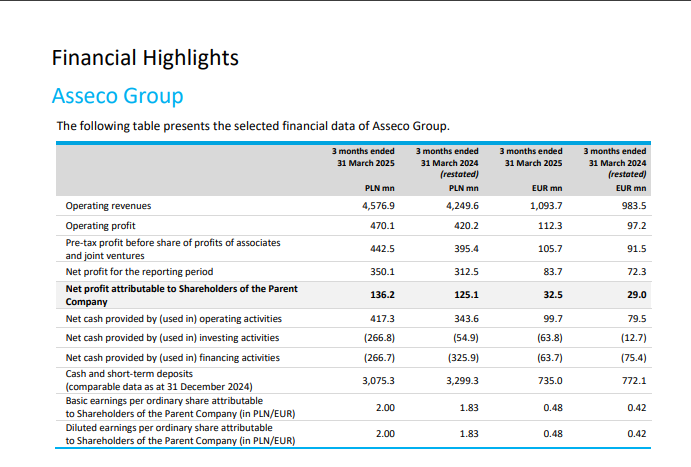
I’ve recently sold some investments and taken a significant position in Asseco Poland $ACP.WA. I believe the downside is limited while the upside is compelling.
Quick Investment Thesis with napkin math (All numbers out of my head. Hence Double-check all details if you find this interesting):
At first glance, Asseco appears expensive, trading at 20x LTM profits (~PLN 500m) with a PLN 10bn equity value. However, I see strong justification for this multiple:
• Market leader: Asseco is Poland’s largest software company, often compared to $CSU.TO (Constellation Software)—though with lower operational profitability (30% EBIT margin vs. CSU’s 30%).
• Strategic investor: Recently, $TOI.V (Topicus), a CSU subsidiary, acquired ~25% of Asseco, purchasing 12M treasury shares at PLN 85/share, plus additional shares from the founder.
• Operational upside: TOI.V secured 3 out of 9 board seats, signaling a clear intent to implement CSU’s best practices and drive efficiency gains.
Why This Matters:
CSU typically targets a 20% cash IRR on investments. Since CSU acquired its stake at PLN 85/share, it likely sees a path to achieving this return purely through future dividends and cash flow growth—even without multiple expansion.
So, how does this add up?
• Post-transaction, Asseco gained ~PLN 1bn in additional cash from selling treasury shares, reducing the cash-adjusted market cap to ~PLN 9bn.
ACP does have some debt, but with CSU as a new major shareholder, it’s unlikely they will prioritize paying it down. CSU tends to focus on maximizing capital efficiency, and given the low IRR on debt repayment compared to reinvesting in the business, it’s reasonable to assume ACP will continue deploying capital elsewhere rather than aggressively reducing debt.
• The business generates PLN 16bn in revenue. If CSU can help Asseco improve margins to 25% FCF, that implies PLN 4bn in annual FCF.
• ACP currently earns PLN 1.2bn in LTM profits, but ~PLN 700m goes to minority interests, meaning it keeps 5/12 of profits.
• At a 25% FCF margin, ACP’s share of profits would rise to ~PLN 1.6bn, meaning the business now trades at just 5.6x earnings (~17% cash IRR).
And that’s before any multiple expansion.
I think people still don't realize how good @sandykik is as a capital allocator. Supreme basically paid nothing for a well-known British consumer brand. The deal includes £7.5 million of stock and trade debt. So they basically paid £2.7 million for the business, which they will probably recoup in under a year, not taking into account all the new improvement opportunities and new sales opportunities under the umbrella of Supreme. #sup $sup.l
@bigpoppastonk I'll see if I can find the time. But there haven't really been any major new developments at Supreme.
It's still my biggest position and preferably I'd rather add to that position than sell
I just posted something on the other platform on NowVertical $NOW.V, which I think is a nice turnaround story that has the potential to become a nice growth story in the future.
As always, do your own work. This is not intended as financial advice and only presents the reasoning behind my own decision!
@bigpoppastonk Roughly half of what it is now. But I'll probably buy a bit more at these prices. The thesis you can find in the substack article above by @FinSkeptic
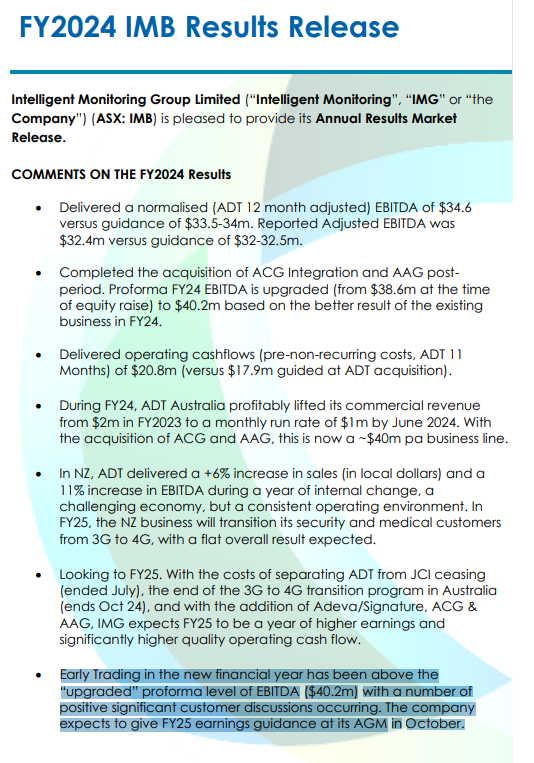
$IMB.AX with results above the original guidance and current trading above the increased guidance of 40.2 million. I was on the call this morning and heard a lot that I liked. I will post a detailed update on the numbers over the weekend.
Supreme plc $sup is my largest investment representing roughly 20% of the portfolio. Sandy recently closed yet another beautiful acquisition at a very attractive price. Awesome business with a really smart capital allocator at the helm for a very low valuation
"...when we came to market we were a £80 million business three years ago with vaping and now we are a £100 million business without vaping..." Sandy Chadha @sandykik CEO of Supreme PLC $sup.l #sup
https://t.co/0c16n0mz5M
@karri_tweets No obvious hair that I know of. Their pod-based vaping systems are actually promoted by the UK government to help smokers of traditional tobacco switch. I expect a healthy future for the vaping business :-)