Investing since 2018 / Berlin / happy to connect / Tweets reflect my personal opinions and are not investment advice. DYODD. $SUP.L $VPR.AX $RDCM $STB.L $MUM.DE
@FriendlyCapMgmt That said, my capital allocation was largely driven by my new role at Symmetry. This meant selling down or not adding to several core positions in my private portfolio...
Portfolio Update Q4FY25
Positions going into 2026:
$NOW.V 45%
$SUP.L 25%
$VPR.AX 23%
Undisclosed 7%
Perfomance
2023: +7%
2024: +25%
2025: -16%
I am not satisfied with the results, given the –16% performance this year. However, the underperformance was not driven ...
I see a lot of discussions on what's going on with $RDCM after the wild ride, so here's my take.
Radcom is a small Israeli software company that most people have never heard of. It quietly runs in the background of phone networks, helping carriers catch and fix problems before your calls ever drop. Boring, sticky, mission-critical. This is exactly the kind of infrastructure business that I like.
A couple of weeks ago, a big account on X mentioned it, the crowd piled in, and the stock shot up to ~$17. Then that same crowd got bored, wandered off, and it slid right back to ~$12. But had anything really broken?
I went digging through the actual SEC filings, and there was nothing there. No bad news, no cut to guidance, no insiders heading for the exits. It was just hype inflating and then deflating. The business itself didn't change at all.
Here's what makes it genuinely interesting once you look past the noise. Radcom is sitting on about $108M of cash with zero debt. That's roughly $6.35 a share — call it half the entire share price, just parked in the bank. Strip that cash out and you're paying almost nothing for a company that's profitable and still growing. For years, that pile sat there doing nothing, which is a big reason the stock stayed so cheap.
What changed is the part that matters: activist investors just took control of the board. These are people who want that cash actually put to work — a buyback, a special dividend, or, most interesting of all, selling the whole company. Businesses like this rarely come up, and the few that have sold went for rich prices. I see a material upside from here, and that giant cash cushion limits the downside while we wait.
It's not free money, of course. The company leans heavily on a handful of big customers (one is about half of sales), and there's always the risk the new board blows the cash on a bad acquisition instead of handing it back.
Net: I own a little, and I'd add on a weakness like this.
Huge credit to @FinSkeptic, whose work on Radcom is the best out there — if this interests you, go read him first.
Not investment advice, just me thinking out loud. I own shares and may buy more or sell the position without any warning. Do your own work.
Buffett ran his first partnership at 26.
Ackman launched Gotham at 26.
At 19, today I get my chance to start.
I have joined Sapphire Capital EAF as Fund Advisor of PEQUITY U&U Global Opportunities, FIL. The strategy I have been writing about on Undervalued and Undercovered for years now has real money behind it.
I have just published a post on the newsletter website. I would like to point out that, as always, I am merely explaining the reasons behind my own investment decision. This is not investment advice, and everyone should always do their own research. $SEN.AX
$NOW.V Headline results are as expected, offering neither a positive nor a negative surprise. However, they generated strong positive cash flow, even when adjusting for changes in working capital.
$RDCM Final confirmation that everything went as planned from an activist perspective. New directors filed their Form 4s. Activists now control the board.
https://t.co/4uPVfJgJHq
$RDCM holders, get your votes in for the proxy fight.
Lynrock will vote its full ~19% record-date stake, even though they've trimmed their economic position.
Record-date holdings, not current holdings, are what count at the meeting.
#SUP@SupremePLC new licensing agreement
With Tonino Lamborghini to develop, manuf & distribute prem energy drink range (6 SKU's) across UK/Euro/ME & China
Will expand SUP beverage category presence & capitalise on Tonino Lamborghini's luxury lifestyle brand appeal
$SUP.L #SUP Supreme plc, solid 48 hours of updates:
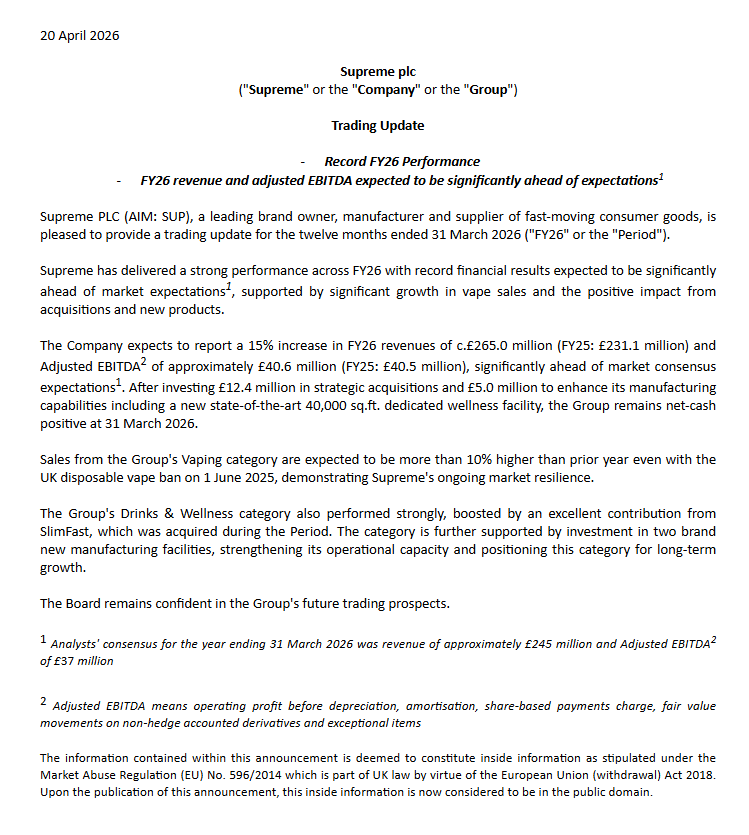
1. FY'26 TU: Revenue +15% (YoY), adj. EBITDA in 40.6m (flat vs 2025), ahead of consensus. Net cash positive, vaping sales +10%
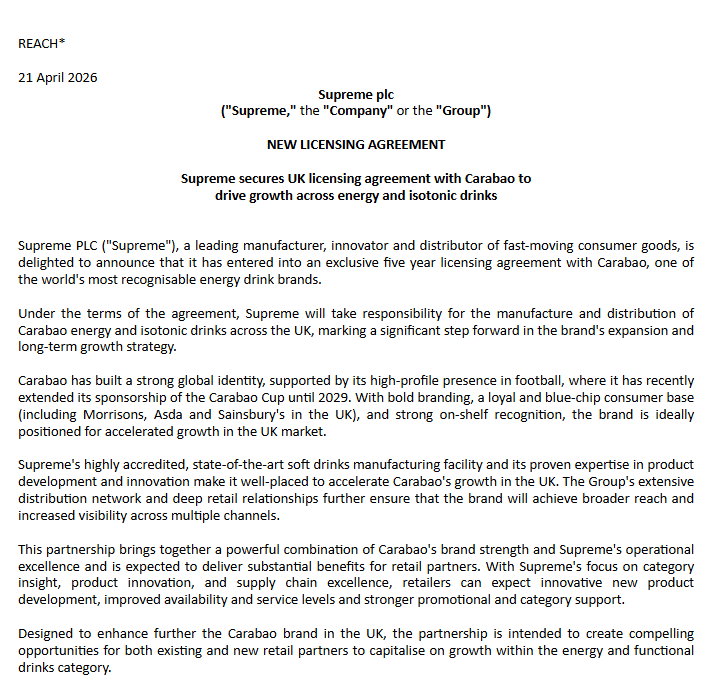
2. Exclusive 5-year licensing deal in UK with Carabao for energy drinks, leveraging soft drinks plant
#SUP
In a crisis riddled world marked by wars from Ukraine to the Middle East – one would expect consumer demand to wobble. Yet across the UK’s FMCG, drinks, wellness and vaping markets, consumption remains remarkably resilient. Why? Because these are everyday, affordable products -small-ticket essentials and “feel-good” purchases that people continue to enjoy.
Enter @SupremePLC , an entrepreneurial group that’s quietly building one of the UK’s most diversified and agile FMCG platforms. By assembling a stable of high-performing brands - ranging from Typhoo Tea and Clearly Drinks to Sci-MX and SlimFast, alongside its heritage vaping arm. Crucially, that pivot towards Drinks & Wellness is not just defensive - it’s tapping into powerful structural growth trends around health, hydration and nutrition.
And today’s FY26 trading update shows that strategy is working.
@SupremePLC delivered a standout performance for the year to March, with revenues jumping 15% to £265m and EBITDA hitting £40.6m, comfortably ahead of expectations . This is no small feat given the well-publicised disruption from the UK’s disposable vape ban. Yet impressively, vaping sales still grew more than 10% year-on-year, underlining management’s successful transition to alternative formats.
Elsewhere, the £20.1m acquisition of SlimFast in Oct’25 has already made an “excellent” contribution, while ongoing investment in manufacturing, including a new 40,000 sq.ft wellness facility, positions the division for sustained expansion. Combined with a vertically integrated model and access to 55,000 retail outlets, Supreme has built a powerful engine for cross-selling and margin enhancement.
CEO @sandykik / Sandy Chadha commenting: the group has delivered “record financial results… significantly ahead of expectations,” supported by acquisitions, new products and strong underlying trading.
Looking forward, @ShoreCapital has upgraded FY26 expectations to £265m revenue and £40.6m EBITDA, with FY27 revenues climbing further to £295m. Moreover, the shares trade on attractive 7.2x FY26 PER and 4.0x EV/EBITDA multiples, alongside offering a 3.4% dividend yield with net cash (est £3.1m). FY27 multiples remain modest too at 7.6x PER and 4.0x EV/EBITDA, suggesting the market is yet to fully price in the group’s diversification and earnings power.
Sure there’s a new UK vaping tax being introduced from Oct’26 onwards. Yet equally Supreme looks like a business leveraging its scale, channel strength, FMCG brands and product diversification to deliver growth in even the toughest of backdrops.
Disclosure: @SupremePLC is a @VOXmarkets client.
Anybody on fintwit looking to hire? Anybody on fintwit looking to be hired? Send me a dm.
About to launch a little project to give back to the community: fintwitjobs.
Would appreciate a RT for visibility!
$NOW.V
Updated again after the stock price fell 15% yesterday. Based on Q4 (~annualized)
Bear ($3.5 Mio. FCF)
Market cap / FCF: ~4.5x
EV / FCF: ~8.3x
Base ($5.0 Mio. FCF)
Market cap / FCF: ~3.2x
EV / FCF: ~5.9x
Bull ($6.5 Mio. FCF)
Market cap / FCF: ~2.4x
EV / FCF: ~4.5x
$NOW.V If I am not mistaken, we have $3m in operating cash flow in Q4 and $1.4m excluding changes in working capital, which confirms what management said about cash outflows. The remainder of the results is mediocre.
Thread on Berkshire’s acquisition record…
I’ve always been fascinated by $BRK acquisitions of entire companies, mostly because it’s a lot harder to judge performance than it is for stock market investments. It’s a lot easier to do a case study on Berkshire’s purchases of Coke, Gillette, Washington Post, AmEx, etc. because most everything you need to determine returns valuations are public.
Some years ago I started trying to analyze Berkshire’s wholly owned acquisitions for lessons learned by doing rough estimates on deal prices, revenue, PTI at acquisition (a lot of this information is actually public), estimating financials today (which by reconciling segment information in the annual report, I think is possible to come out with pretty reasonable estimate) and coming up with some rough number for how much of net income over the years was distributed back up to Berkshire – you can actually come up with some very realistic and fairly precise estimates for modified IRR, essentially the same annualized return they’d get had these been public company investments.
Thought I’d share a few of the things I’ve noticed and collected. This is probably a strange thread, but I really don’t promote anything, don’t have a Substack and thought at least some people would find this fascinating. I’ll just emphasize for the record something that’s obvious – I think these numbers are directionally pretty correct, but they are just my estimates and don’t want to make the mistake of implying any false precision.
I have just published a post on the newsletter website. I would like to point out that I am, as always, merely explaining the reasons behind my own investment decision. This is not investment advice, and everyone should always do their own research.
Radcom $RDCM provides telecommunications network operators with cloud-native software for 5G network intelligence and service assurance.
The company has a great business, but it lacks a shareholder-friendly capital allocation strategy. An activist group wants to change this, and in my view, there is a good chance that they will achieve their goals. Given the moderate valuation, I found the situation very interesting.