Independent investor. Not investment advice. Sometimes sports and other stuff. “A wealth of information creates a poverty of attention.” — Herbert A. Simon
Seen a lot of people be skeptical of $BRK acquisition of $TMHC. A lot of the criticism is around paying a premium for a commodity business and migrating away from Buffett's approach to buy good businesses at a discount rather than buy with expectations of synergy. I don't fully disagree with the shift, but I also think the strategy migration is probably the right direction given one big caveat.
Here's the only caveat and something I wonder about. What kind of conversations happened with Kevin Clayton about the deal and what it means more broadly for Berkshire's CEOs.
Kevin Clayton has run Clayton Homes since before Berkshire bought it. Berkshire paid $1.7B for it and as I mentioned before I think it's worth at least $20B now. Clayton has been a home run. And he built a regional home-building business from scratch through 13 deals that now does $4B in revenue. Now that's presumably being pulled from Clayton and given to Taylor.
How did that come about? Was Clayton offered the chance to manage the combined business and he said "no", it makes more sense as a separate entity? Did Abel go to him and say he found a solution to his homebuilding constraint and get his buy in? Did Taylor's mgmt team say a condition of the deal was managing the Clayton business as a stand-alone sub?
Clayton's 63 and super-rich. He may not care much and genuinely felt it was best for Clayton to focus on the core financing and manufactured housing businesses. But, the shift in incentives and motivations for Berkshire's CEOs could have a big cultural impact over time. Good and bad.
To be honest, they probably believe they don't need the "work for Warren Buffett and be left alone to run your business" selling point and that any other evolutions like this one in the future can be handled with sensitivity one by one as they're needed.
No doubt Kevin Clayton signed off on this and not grudgingly, but it does kind of send a message to the other CEOs.
And, the Buffett strategy more generally of buying assets solely on the basis of who reached out with a good business at a good price at a good size is that the opportunities had dried up because the size requirements kept growing and the competition for deals is way higher than it was 25 years ago and the management breadth to run the disparate operations would need to grow too.
Looking at deals with as much of an engineering mind-set as a finance mind-set is a smart evolution and almost necessary course-correction.
I would unless the amount financed is relatively low percent of park value and/or the LLC has other assets. But, even when the LLC has other assets would want covenants limiting distributions until debt repaid. Often in a closely held LLC they prefer agreeing to PG to the covenants.
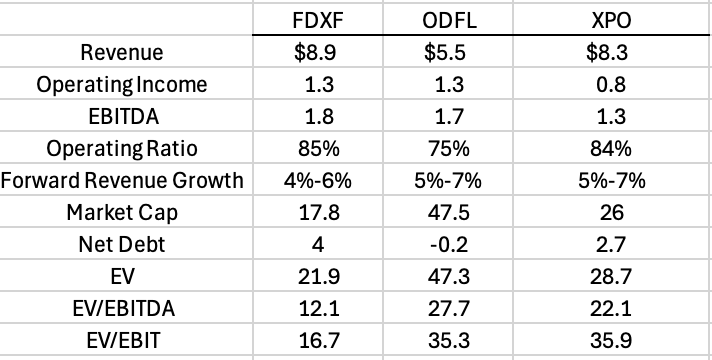
Look, I don't believe that $FDXF is ever going to be as quality as $ODFL, but it does indeed seem cheap on the comps initially.
Of the three biggest publicly traded LTL carriers, $FDXF has 17% market share, $ODFL 11%, and $XPO 9%. $XPO isn't a pure-play and still has a brokerage business and European LTL business, so it's not a perfect comp.
And, it's fair to say I think despite them being very good businesses that $ODFL and $XPO aren't all that attractive right now. But, if $FDX holders start selling the $FDXF shares they've received or there's some economic weakness later this year that sends the stock lower, $FDXF is definitely something to watch. They have a lot of options to create value over the next several years now that they separated.
The upcoming $FDX Freight spin-off is probably one to watch. $ODFL has been the most profitable LTL carrier for a long time and while many of the larger carriers are still private, I imagine FedEx is second. $ODFL trades at 40x earnings, but there's a good chance as a spin-off that the Freight business may initially or sometime soon after the spin have a decent valuation.