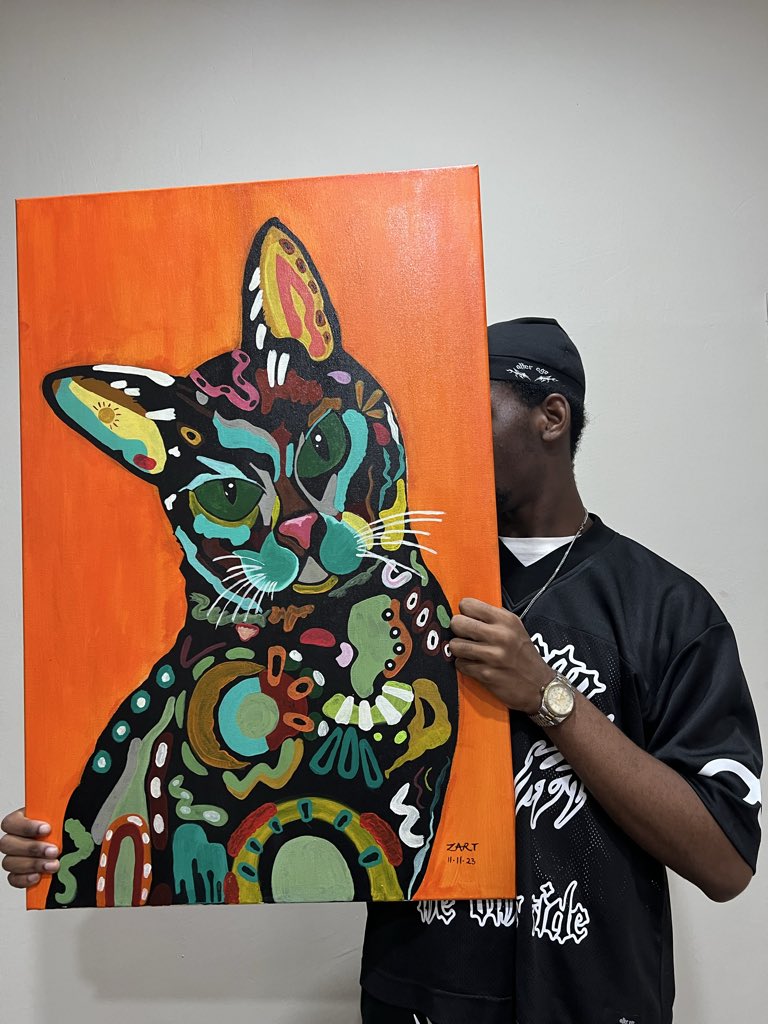
FCDC is Hiring ‼️
🎨 Senior Graphic Designer
📍 Remote
💵 Salary: N600k/month
• The FCDC is a nonprofit organization that provides mentorship, resources, and support for BIPOC marketers, primarily based in developing countries. Our current brand feels good, but we want it to be bolder, more engaging, and more memorable in every space we show up.
• Minimum of 4 years experience
• Proficiency in Adobe Creative Suite (Illustrator, Photoshop, InDesign) and Figma.
• Strong typography, Visual Layout & Color Theory Skills
Responsibilities‼️
• Brand Identity & Evolution
• Cross Functional Collaboration
• Process & Delivery
https://t.co/NQjScDqYQT
I found out my girlfriend cheated on me. Instead of breaking up right away, I made a fake account, sent her the proof anonymously, and told her that if she didn’t send me money, I’d tell her boyfriend everything.
I shared this whole plan with my best friend for advice, but this mf went behind my back and shared everything with my girlfriend.
When confronted, he said
Why does it matter? I thought she deserved to know.
He wasn’t just betraying me. He was behaving like a random variable after you marginalize out all the hidden information.
In probability, to understand what you actually know, you marginalize over hidden variables.
That means you sum over all the possibilities you can’t observe to compute the probability of what you can observe.
Marginal probability is a statistical measure that represents the probability of a single event by aggregating over all possible values of other variables.
Formula
P(A) = Σ P(A, Bi)
Where
P(A) = Marginal probability of event A
P(A, Bi) = Joint probability of A and B
Σ = Summation
Let's take an example and solve step by step
A dating app wants to find the probability of users sending messages, regardless of whether they get a response. The data shows message sent vs response received:
Short forms
- M = Message
- R = Response
Joint Probability Table
- M (Yes), R (Yes) = 0.30
- M (Yes), R (No) = 0.25
- M (No), R (Yes) = 0.10
- M (No), R (No) = 0.35
Step 1 What we want to marginalize
- We want P(M = Yes)
Step 2 Joint probabilities for M = Yes
- P(M = Yes, R = Yes) = 0.30
- P(M = Yes, R = No) = 0.25
Step 3 Apply marginal probability
- P(M = Yes)
- P(M=Yes, R=Yes) + P(M=Yes, R=No)
- 0.30 + 0.25 = 0.55
P(Message = Yes) = 0.55
Final Answer
The marginal probability of a user sending a message is 0.55 or 55%, regardless of whether they receive a response.
Congratulations, you've just learned Marginal Probability.
Bonus: Applications in AI/ML
1. Bayesian Networks:
Computing marginal probabilities by summing out irrelevant variables to make predictions and inferences in graphical models.
2. Latent Variable Models:
In topic modeling (LDA) and hidden Markov models, marginalizing over hidden states to find the probability of observed data.
3. Feature Selection:
Identifying which features independently correlate with target variables by computing marginal distributions, helping reduce dimensionality.
4. Probabilistic Classification:
Naive Bayes classifiers use marginal probabilities of features to classify data, assuming independence between features.
Announcing @terraindustries $11.7M round led by 8VC, the VC by Palantir founder @JTLonsdale
Alex Moore, Board Director at Palantir, also joins Terra’s board
@Max_Sengu & I started Terra to give Africa the technological edge needed for resource protection & counterterrorism
(1/3)