Published in the October 2026 issue of European Urology @EUPlatinum (Impact Factor: 29), this collaborative work was led by Roger Li @UrogerliMD, Can Aydogdu @CanDAydogdu, Laura Bukavina @LauraBukavinaMD A must-read for anyone interested in bladder cancer! Great honor to be part of this work.
@UroDocAsh@AndreaNecchi@apolo_andrea@SpiessPhilippe
This comprehensive review provides an integrated overview of the pathology, molecular characteristics, and clinical management of major bladder cancer subtypes, including squamous, adenocarcinoma/glandular, micropapillary, sarcomatoid, plasmacytoid, nested, and small cell neuroendocrine carcinoma. These tumors are biologically heterogeneous, often clinically aggressive, and frequently understaged on transurethral resection, supporting consideration of early radical cystectomy in selected high-risk patients.
Importantly, treatment response varies substantially by histology. Small cell neuroendocrine carcinoma demonstrates the clearest benefit from platinum/etoposide-based chemotherapy, while other subtypes show variable responses to conventional systemic therapies. Molecular profiling reveals potentially actionable alterations, including ERBB2 in micropapillary carcinoma, CDH1 loss in plasmacytoid carcinoma, FGFR3 alterations in nested carcinoma, and TP53/RB1 alterations in small cell carcinoma. Emerging evidence also supports potential roles for immune checkpoint inhibitors and antibody-drug conjugates.
We emphasizes that variant bladder cancers should not be managed using a uniform approach. Accurate histologic classification, quantification of subtype components, and molecular profiling are increasingly important for personalized treatment and future subtype-specific clinical trials.
Full article available at https://t.co/KLNDkGNVNv
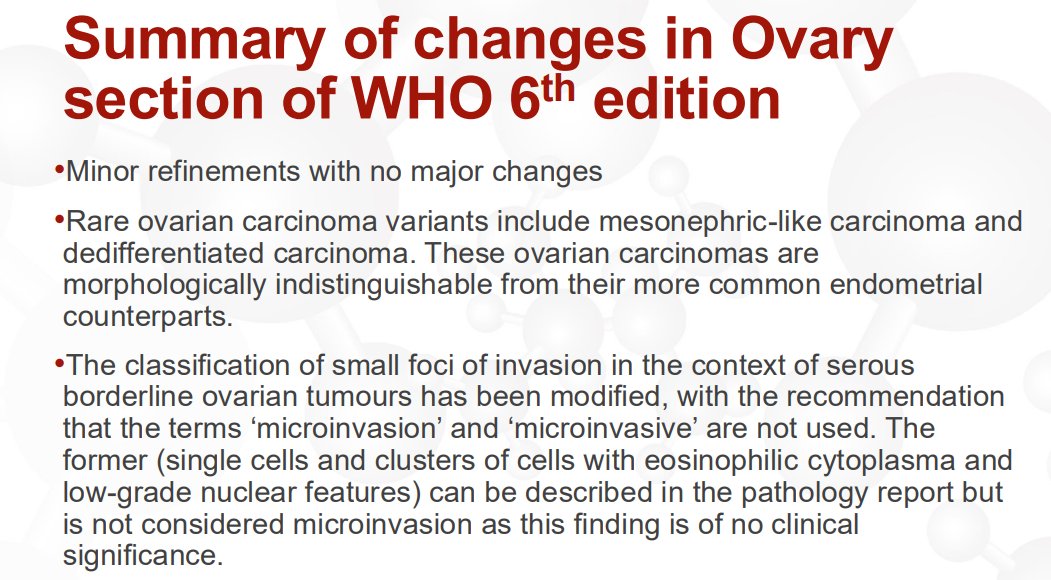
Ovary – Changes to WHO Classification (6th edition, 2026)
Serous borderline ovarian tumors:
The terms “microinvasion” and “microinvasive” are no longer recommended
What was previously called microinvasion (single cells and clusters of cells with eosinophilic cytoplasm and low-grade nuclear features) has no clinical significance (see pic 2). It can be mentioned in a comment if desired; Dr. Gilks previously reported it but no longer does
What was previously called microinvasive carcinoma represents small foci of low-grade serous carcinoma (see pic 3). Report the size and extent of these foci and diagnose them as a small focus of low-grade serous carcinoma arising in a serous borderline tumor
Dr. Gilks. Gynecologic Pathology Masterclass 2026
#USCAP #pathology #pathX
Pathological Diagnostic Criteria for Thrombotic Microangiopathy in the Renal Allograft: Lessons Learned During the Banff Working Group Consensus Process - Kidney Medicine https://t.co/U3wxIUbUxH