@OpenAI(AI only) and @alexdbrw (AI assisted+Lean) both publish Hilbert–Smith proof via signature integrality vs (p)-divisibility (Witt sheaves vs (L_4) tails).
I reverse-read both at:
https://t.co/j6m68J03Mm
Question: Can we use these proofs to discern which Euclidean properties actually block an effective p-adic action?
@alexdbrw@OpenAI Dabrowski proof for Hilbert-Smith published yesterday. I reverse-read both it and OpenAI one, documented in the repo below...intriguing !
Question: which Euclidean properties actually block $\mathbb{Z}_p$?
https://t.co/Ef6WE80WJO
@OpenAI OpenAI and Dabrowski both try Hilbert–Smith via signature integrality vs $p$-divisibility (Witt sheaves vs $L_4$ tails). I reverse-read both. Question: which Euclidean properties actually block $\mathbb{Z}_p$?
https://t.co/Ef6WE80WJO
@OpenAI OpenAI claimed Hilbert–Smith in all finite dimensions. I reverse-audited it, using Cursor(Opus/Grok)
TL;DR: Witt/signature lattice vs (p^k) equal parts — not Yang. No hard FAIL yet; a few WEAK lemmas. Sponges don’t break the writeup.
https://t.co/ndp7nen0Ua
An AI-generated under human guidance proof of Hilbert-Smith, together with complete Lean4 formalization (100k LOC), on which I have worked independently over the last few weeks in my free time. It’s the first Lean4 formalization available afaik, since openai didn’t publish it. Planned on cleaning it up, but had to rush it out after openai’s release. You don’t need the latest biggest models to do research (but it helps).
@OpenAI OpenAI claimed Hilbert–Smith in all finite dimensions. I reverse-audited it, using Cursor(Opus/Grok)
TL;DR: Witt/signature lattice vs (p^k) equal parts — not Yang. No hard FAIL yet; a few WEAK lemmas. Sponges don’t break the writeup.
https://t.co/ndp7nen0Ua
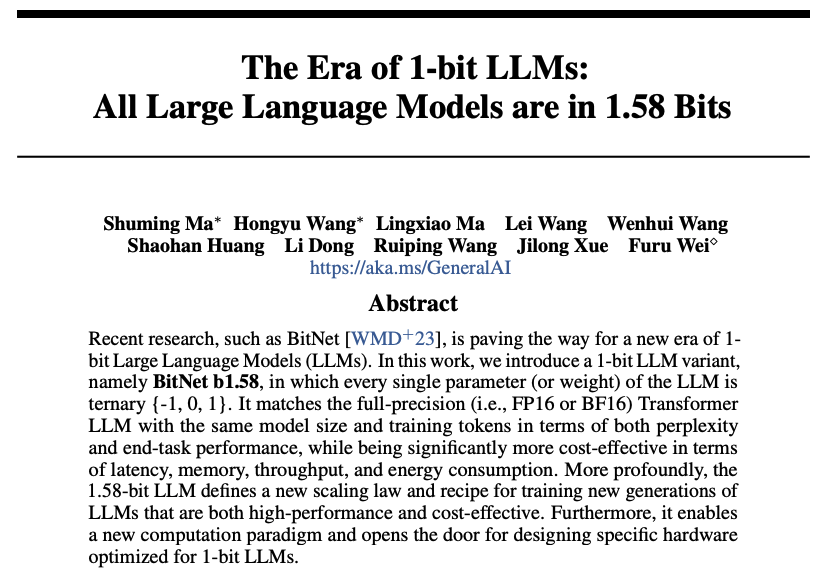
Microsoft presents The Era of 1-bit LLMs
All Large Language Models are in 1.58 Bits
Recent research, such as BitNet, is paving the way for a new era of 1-bit Large Language Models (LLMs). In this work, we introduce a 1-bit LLM variant, namely BitNet b1.58, in which every single parameter (or weight) of the LLM is ternary {-1, 0, 1}. It matches the full-precision (i.e., FP16 or BF16) Transformer LLM with the same model size and training tokens in terms of both perplexity and end-task performance, while being significantly more cost-effective in terms of latency, memory, throughput, and energy consumption. More profoundly, the 1.58-bit LLM defines a new scaling law and recipe for training new generations of LLMs that are both high-performance and cost-effective. Furthermore, it enables a new computation paradigm and opens the door for designing specific hardware optimized for 1-bit LLMs.
# on technical accessibility
One interesting observation I think back to often:
- when I first published the micrograd repo, it got some traction on GitHub but then somewhat stagnated and it didn't seem that people cared much.
- then I made the video building it from scratch, and the repo immediately went through hockey stick growth and became a verty often cited reference for people learning backpropagation.
This was interesting because the micrograd code itself didn't change at all and it was up on GitHub for many months before, stagnating. The code made sense to me (because I wrote it), it was only ~200 lines of code, it was extensively commented in the .py files and in the Readme, so I thought surely it was clear and/or self-explanatory. I was very happy with myself about how minimal the code was for explaining backprop - it strips away a ton of complexity and just gets to the very heart of an autograd engine on one page of code. But others didn't seem to think so, so I just kind of brushed it off and moved on.
Except it turned out that what stood in its way was "just" a matter of accessibility. When I made the video that built it and walked through it, it suddenly almost 100X'd the overall interest and engagement with that exact same piece of code. Not only from beginners in the field who needed the full intro and explanation, but even from more technical/expert friends, who I think could have understood it if they looked at it long enough, but were deterred by a barrier to entry.
I think as technical people we have a strong bias to put up code or papers or the final thing and feel like things are mostly self-explanatory. It's there, and also it's commented, there is a Readme, so all is well, and if people don't engage then it's just because the thing is not good enough. But the reality is that there is still a large barrier to engage with your thing (even for other experts who might not feel like spending time/effort!), and you might be leaving somewhere 10-100X of the potential of that exact same piece of work on the table just because you haven't made it sufficiently accessible.
TLDR: Step 1 build the thing. Step 2 build the ramp. 📈
Some voice in your head will tell you that this is not necessary, but it is wrong.
There's too much happening right now, so here's just a bunch of links
GPT-4 + Medprompt -> SOTA MMLU
https://t.co/Jkp96izfec
Mixtral 8x7B @ MLX nice and clean
https://t.co/75StzY5AHe
Beyond Human Data: Scaling Self-Training for Problem-Solving with Language Models
https://t.co/gOCWjfY7ec
Phi-2 (2.7B), the smallest most impressive model
https://t.co/Fps8tI5QVi
LLM360: Towards Fully Transparent Open-Source LLMs
https://t.co/l6E16GfdIN
Honorable mentions
https://t.co/7GQqiCGHRH
https://t.co/3GZrYPp9KP
https://t.co/Su8iiDksMZ