@ManpreetBola@xjwanglab Great question! Unfortunately, this is tricky to answer as it likely depends on the neuromodulator (you have to consider their signaling pathways). Moreover, you also have to consider possible synergistic effects (as has been reported for adenosine A2A receptors and Grp I mGluRs)
Check out our new preprint with @xjwanglab! Here, we characterize the computational role of metabotropic glutamate receptors (mGluRs) in thalamic circuitry. To do so, we develop models of their dynamics at the molecular, single neuron, and circuit level! https://t.co/QfnaUGUWIx
@ManpreetBola@xjwanglab Classic solutions with iGluRs (Wang, 1999) get long timescales with recurrence, which thalamus lacks, so synaptic mechanisms are key. Neuromodulators in principle can do something similar, but mGluRs are synapse-specific, so the slow signal is tied to the input that generated it.
@ManpreetBola@xjwanglab The timescale gap is a key feature as opposed to a bug. Because mGluRs are so slow, input from seconds ago influence incoming sensory processing to give you the ability to integrate information across trials which is otherwise hard to obtain.
I am excited to share some new results investigating how subcortical signals are channeled via VM to engage specific inhibitory networks in L1 of mPFC. Check out our preprint linked below if you’re interested in reading more! 🥳
Excited to share our latest preprint with @CamilloPadoaSch and @xjwanglab! We present a biologically plausible framework showing how neural circuits compute & compare value to drive flexible economic decision making. https://t.co/ZuVeQvfPVA
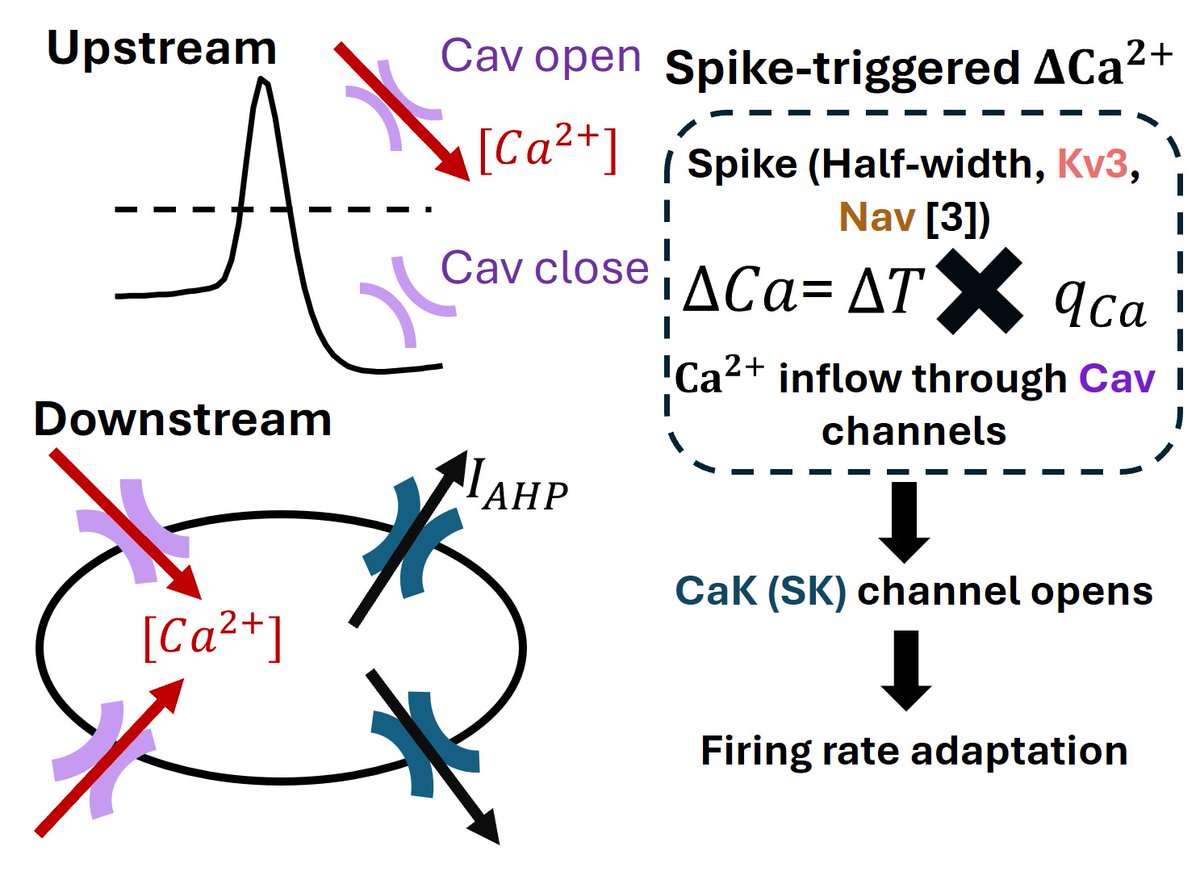
"In Search of Transcriptomic Correlates of Neuronal Firing-Rate Adaptation across Subtypes, Regions, and Species: A Patch-seq Analysis" https://t.co/wiLHRPkzf5
A new paper from our team! This work was completed in Wang's lab in collaboration with Yijie Kang and others.
Continuous-time RNNs are used in neuroscience to model neural dynamics. CNNs are used in vision neuroscience for image processing. So what's the right architecture to model the biological visual system? We propose a hybrid. (#NeurIPS2024 spotlight!)
https://t.co/IJV5H1NVuW