Spatial intelligence for physical retail @ Nightcap // Previously: Barclays, Carlyle Group, ESPN Tennis, US Senate Page // Sometimes: ATP Tour with MG.
I recently found this note to myself:
No sense in thinking small. Don't water down your vision. A remarkable amount can be accomplished if you are willing to think longer term than most and work hard each day.
@bhalligan Put hardware in there too. Distribution, business models & hardware can't be replicated overnight.
If software is going to zero, I think open source / open core as distribution becomes a powerful strategic positioning (rather than a historically ideological one).
Given how easy it is getting to build things, distribution and business models will be keys to victory.
I just don’t see much creative ideas here and I don’t count changing the name professional services to forward deployed engineering.
What amazing stuff is happening here?
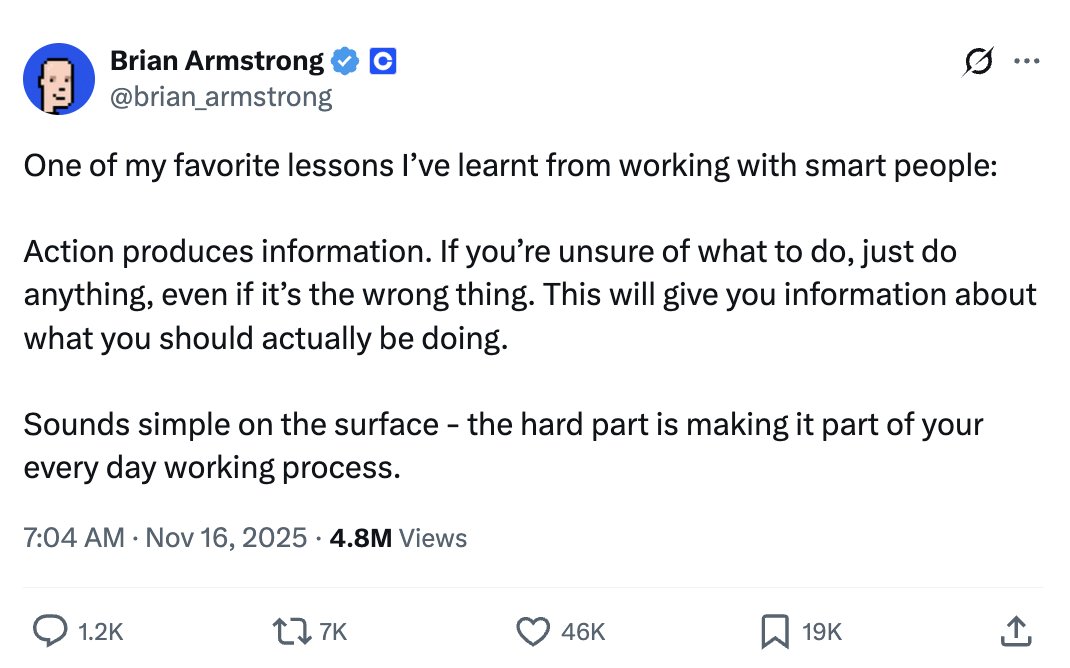
Working on something ambitious is like climbing a mountain that’s covered in fog.
You can't see a clear path to the top. You have to take a few steps into the unknown to be able to see the next few steps in front of you. Inevitably, sometimes you’ll end up a local maximum and have to backtrack. That’s fine, just keep moving.
Had a friend tell me once: "When you're feeling overwhelmed, there are only two things you should do... get organized and get to work. The rest is just noise. Peace is found in progress."
Some of the best advice I've ever received.
A huge, huge part of a founder's job is to simply inject (1) energy / optimism (2) clarity (3) urgency into EVERYTHING they are involved in. Every email, every meeting, every walk & talk, every slack thread, every whatsapp chatter.
“One of the many life skills that you want to learn at a fairly young age is the skill of being an ultra-thrifty, minimal kind of little wisp that’s traveling through time . . . in the sense of learning how little you actually need to live, not just in a survival mode, but in a contented mode. . . . That gives you the confidence to take a risk, because you say, ‘What’s the worst that can happen? Well, the worst that can happen is that I’d have a backpack and a sleeping bag, and I’d be eating oatmeal. And I’d be fine.’”
— Kevin Kelly
- Building a Claude connector doesn’t count.
- Building a beta release doesn’t count.
- Simply enhancing your product with AI so it’s better doesn’t count.
To win in AI + B2B today, you have to have the #1 agent in the market in your space.
And it has to be so good, your customers are happy to pay you even more for it than they pay for your base SaaS pricing.
That counts.
A lot of having taste about something is just caring about it enough to be honest with yourself, so that you can get past "I like what I like" to "Is this actually good?"
If you use any software, you will hit bugs. Only a tiny 5% of your users will ever report bugs.
The speed at which those bugs are fixed is the true measure of a founder in mastery of their craft.
The counterintuitive insight isn't that we should repeat what works - that's obvious. It's that we abandon what works precisely because it's working.
Success makes things boring (for our novelty seeking brains).
4 brutally honest reminders from Seneca:
1. Most suffering is self-inflicted
2. Stop putting things off
3. Stop acting like you’re going to live forever
4. Seek out challenges
Had a mentor tell me once: "When you're feeling overwhelmed, there are only two things you should do... get organized and get to work. The rest is just noise. Peace is found in progress."
The amount of money your company can make is directly related to the amount of incremental revenue your customers believe you help them make. Revenue your customers believe you help them make is therefore a better KPI than your revenue because you can always figure out how to optimize your pricing over time. And your customers will almost never churn as long your product continues to help them make a lot of money. Let me know if you can find an example at scale (companies with over $1b in revenue) where this is not true.