1/5 Excited about our publication in @ScienceAdvances 🤩🥳🍾. With @tpleskac @Kurvers we introduce the social DDM. The model describes and captures the process of how human groups integrate personal and social information dynamically over time. https://t.co/Z4mRZU1Pu3
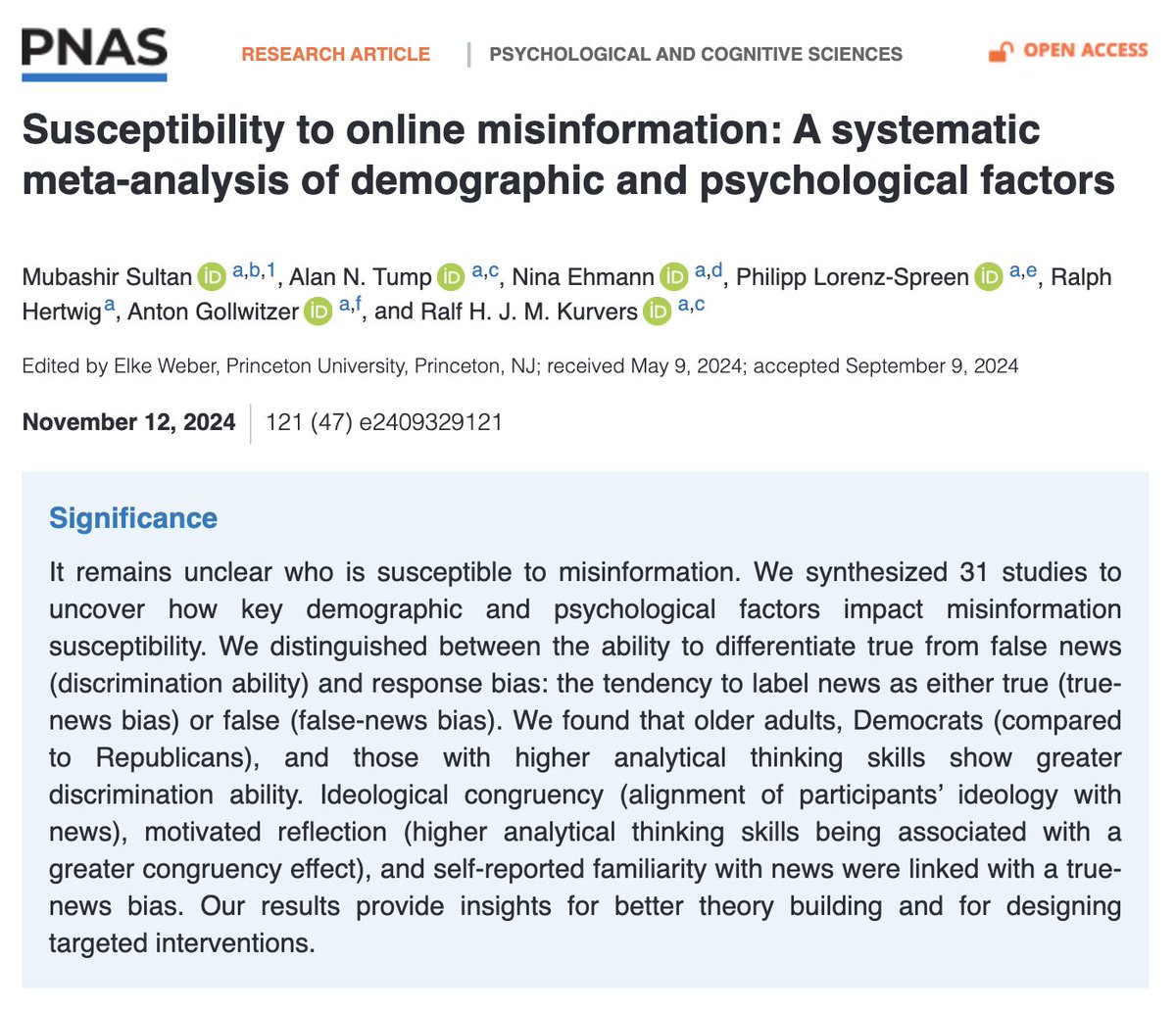
Very happy to share that our work is now published in PNAS (@PNASNews)! 🎉 It's a systematic look into how demographic and psychological factors are associated with misinformation susceptibility. @arc_mpib
Thread below and can be read in full here: https://t.co/lf8GRrhw74
Join our diverse team for a 3-year Post-Doc in Cognitive Psychology at KU Eichstätt! 100% position (Verbeamtung auf Zeit/TV-L), focused on decision science & computational modeling. No denominational requirements. Apply by 2024-03-31.
Details: https://t.co/BvSBOGKDWq
Please RT!
@lukasdaubner @rmanthe1 I 100% agree with your point but why is hydro not categorised as renewable?
They even state below the graphic that hydro is elsewhere categorised as renewable.
🎉New paper in PoPS. Illustrated with DDMs and RL models, we show how cognitive modeling in combination with interactive group experiments, helps understanding complex collective dynamics. With @dominik_deffner , @PRomanczuk, @tpleskac & @RalfKurvers.
https://t.co/wkr9zFctfb
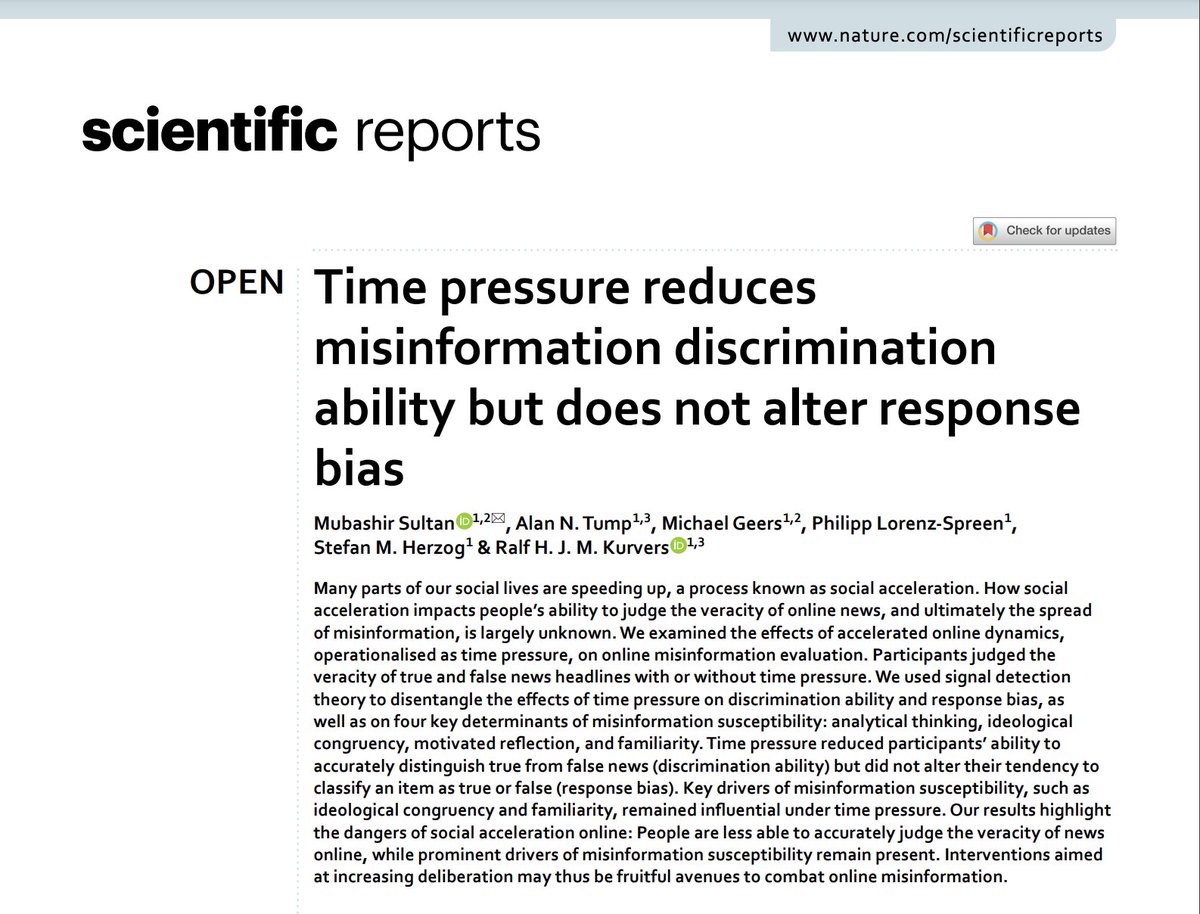
Such a nice way to end the year! Our paper on fast-paced news consumption and false news just got published at @SciReports 🎉 🥳 🎉.
You can read it in full here: https://t.co/1smOj9Qo3k
And see quoted tweet for a thread :)
@arc_mpib@mpib_berlin
Nice to see this work is now published in the new journal Collective Intelligence as of yesterday: https://t.co/xdziOxDneP
The published version is better (less wrong on the effect of non-identical preferences) and Open Access.
How do cognitive processes shape collective dynamics? We illustrate how cognitive modeling can link cognitive processes and collective dynamics, allowing a better understanding of the principles underlying adaptive dynamics and collective intelligence: https://t.co/XvhgKa1RhJ
We‘re excited to announce that @twiecki, CEO of @pymc_labs and co-creator of @pymc_devs, will give a talk on solving business problems with Bayesian modeling on Tuesday, November 15 @ 7PM! Details and RSVP: https://t.co/CwqNR3hiBv
I have an N=1300 data set with 9 variables. All have some missingness. Some are roughly Gaussian, but others are best described as ordinal. If I want to accommodate--but not fret over--their distributions, would *pedictive mean matching* multiple imputation be the way to go?
We show how cooperative and selfish individuals should tune their strategies to different error costs. The results reveal how the implemented strategies of individuals in high-stakes social contexts (e.g., panicking crowds) could jeopardize or boost the collective. (3/3)
New publication out in @PLOSCompBiol with Max Wolf, @PRomanczuk and @RalfKurvers. We show the importance of adjusting individual response biases to the social context. (1/3)
https://t.co/Cfp2n5arsa
When options are associated with different costs, individuals develop a response bias to avoid the more costly error. But they also tend to pick the option with the lower cost faster. In groups, observable fast choices can lead to bias amplification and maladaptive herding. (2/3)
Abkühlung @LNDWBerlin! ❄️😅 Der 1. Vortrag #LNDWMPIB#LNDW22 von @AlexSchakowski@arc_mpib führt uns nach Finnland. Wir lernen was wir von erfolgreichen Eisfischer*innen über soziales Verhalten lernen können!
Very excited to share my first first-author pre-print :) 🎉 🥳 🎉 It’s been a pleasure working with my lovely co-authors (@AlanTump, @michael_geers_, @philipplenz6, @stefanmherzog, @RalfKurvers) on this, more in the 🧵 below. (1/9).
@dominik_deffner @RachKendal @ESLRSociety This reminded me about the social DDM where we can partially distinguish between waiting for social information and using this information by incorporating it into the evidence accumulation process. This simulation paper describes it. https://t.co/ecwJia0zuZ