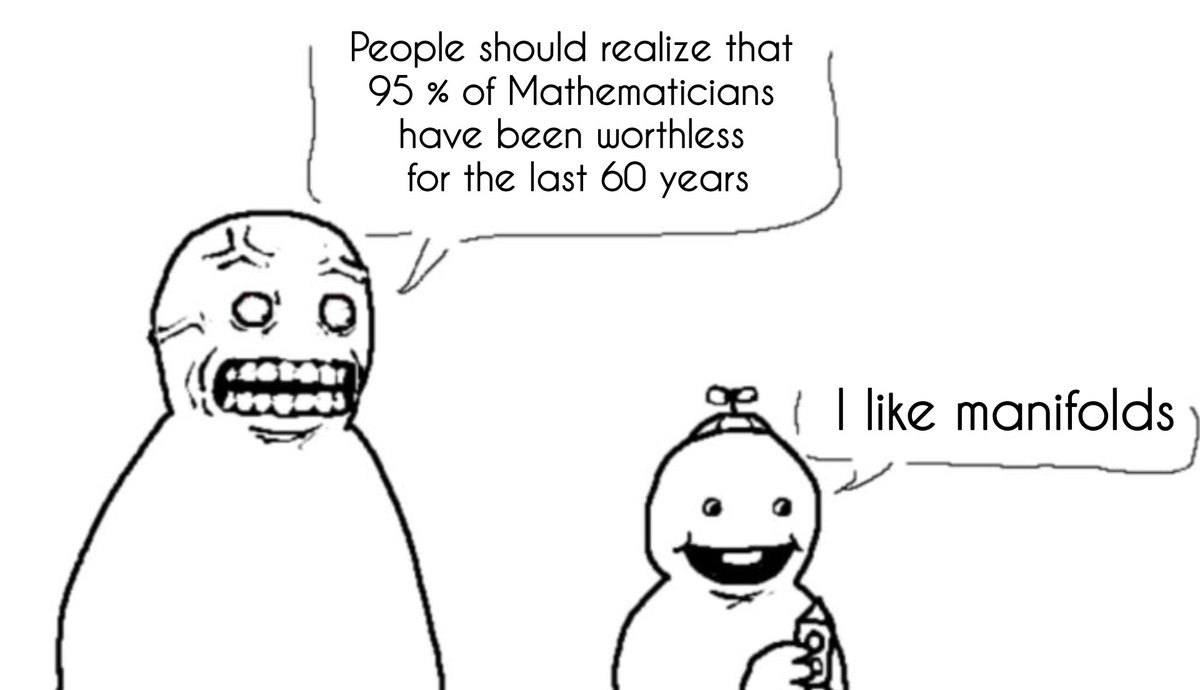
sf is insane
2 guys i know co-founded a company
working 140 hour weeks
both wanted to start dating but didn't have time to meet women
they made the efficient choice and just started dating each other (even though they're not gay)
other founders could learn from this level of commitment
To the best of my respect (I like Keller's Muon Optimizer work a lot), I do not think it's the best action for a person who barely published papers in top venues to trash AI top conferences. In fact, the community should do everything to make those AI conferences better. It's our last hope to get a place to share and open-source AI advancements. Otherwise, we will be living in the dark dominated by close-sourced AI Labs.
me, begging, crying, on my knees: "Please just use plain english, I don't understand what you're saying."
Claude: "The right fix, and the book's lesson applies: the tutorial rotted as a front door because a front door full of claims always rots. So the new root holds only what's timeless — the thesis and three doors — and every claim lives behind it in the thing that goes red when stale."
It's insane that Y Combinator is listed as a signatory on the open letter but rival incubator Denny's is not. Denny's has done far fewer companies but the market cap of their incubator portfolio is approximately 8x the size of Y Combinator's ($5T vs $600B)
So, you (or the model you've prompted) has proved or provided a counterexample to an open conjecture! What's next?
- Check if it's correct!
- Try to understand what new ideas, if any, have been introduced. Do they have any further applications? How are they related to the rest of math?
- Try to understand different PoV's on the argument. Can you digest/illuminate it further?
- Why is it interesting? What does it tell you about the objects in question? Does it raise any new questions?
- Start trying to solve those new questions!
I have no doubt math won’t be what it was yesterday. But I think we might still be in the branching middle of the game, where the endings aren’t clear yet. Three questions:
1. Is there a meaningful distinction between Erdős-style math (brilliant use of existing tools) and Grothendieck-style math (building new theories until the original problem becomes obvious)?
2. If yes, can LLMs’ math ability extrapolate from the former to the latter? The reward for building a framework arrives much more slowly.
3. How fast can humans adapt?