Breaking 🇪🇹✈️
Historic milestone! Ethiopian Airlines becomes the first African carrier to surpass 2 million departing seats in a single month.
According to Business Insider Africa via OAG, 2,004,642 seats are scheduled for December 2025, a new continental record.
@flyethiopian
#EthiopianAirlines #Aviation #AfricaRising
https://t.co/e1aWRBP09o
GERD generates the equivalent of 4 large nuclear units
Come close and look with me. This is a live frame from GERD’s control room.
Total power reads 4,822.85 MW. Reactive power 93.09 MVAr. Flow tag 3,048.64 m³/s. Numbers, yes. But also a heartbeat.
What does that mean in plain words?
GERD’s roof is 5,150 MW. Right now we are just 327.15 MW under it - about 93.6% loaded. That is the plant running strong and steady, voltage tight, almost unity power factor. If you split the moment across all 13 Francis units, you get roughly 371 MW per unit. Some breathe a little lighter, some a little heavier - that is normal with head, efficiency, and grid limits.
About the flow tag on the screen.
If it were the total discharge, the implied head would be around 179 m, which is higher than GERD’s usual band. More likely it is the readout from one powerhouse or it excludes some units. Double it to about 6,100 m³/s and the implied head lands near 90-100 m, right where big Francis machines like to work. Either way, the power number is the truth. We are sitting near the ceiling.
Now, let’s make the size of 4,822.85 MW feel real.
• Picture Addis Ababa lit many times over. Addis peaks around 0.6-0.8 GW. This single reading is like powering 6-8 Addis Ababas at once.
• Think of Nairobi and its neighbors around 2 GW. GERD at this moment is more than double that.
• Think of London at 6-7 GW. We are at about two thirds of London’s peak.
• Think of New York City around 12-13 GW. We are at about one third of NYC’s glow.
• Or count homes. At roughly 1.3 kW per home, this instant lights about 3.7 million homes. At 1.0 kW, it is about 4.8 million homes. Hold this for 24 hours and you deliver around 116 GWh - enough for 3.9 million homes at 30 kWh/day, or 11.6 million at 10 kWh/day.
• Plant for plant, think 4 large nuclear units together, or about 10 big gas turbines.
Now, a question I know I will get: why not 5,150 MW every minute?
Because real operators keep headroom. A few percent of space for frequency control, temperature, vibration, line limits, and safe ramping. That is good practice, not weakness.
Let’s ask a second question: where does this power come from in the rhythm of the year?
From storage. From the Abay’s pulse. Long run, the river brings about 50 bcm each year. GERD’s normal lake band is ~625-640 m. We store during flood months and release steadily later. That is the job. That is why you cannot take one high minute and multiply by 8,760 hours to make an annual number.
Another scene people ask about is the crest spill.
At FSL 640 m the lake is full - roughly 74 bcm. When inflow nudges the top of the band, the ungated crest behaves like any weir and passes the extra gently into a lined, stepped chute and a stilling basin. That is the spillway doing what it was built to do. It is not uncontrolled overtopping. It is control.
Seatbelts are on too.
There is a continuity release so the river does not go dry. There is day-to-day ramp discipline to protect Roseires and the banks. There is monitoring and emergency coordination because this is a flagship plant, not a guessing game.
Let’s look at the national picture for a moment.
Before GERD, Ethiopia’s installed fleet was ~4.7-5.2 GW. Today’s single snapshot at ~4.82 GW is essentially the old entire system, concentrated in one station. If you want to see exactly how much the rest of the country is making right now, open Merkava and subtract 4,822.85 MW from the total. That number is the non-GERD share in that minute.
Machine sense-check for the engineers reading this:
At net head ~100 m and efficiency ~90%, one 400 MW unit needs about 453 m³/s, one 375 MW needs about 425 m³/s, and all 13 at nameplate would want around 5,833 m³/s. That is why we push harder in the wet months and ease in the dry months. That is the music of a storage plant.
Why 13 units?
Because a hub plant must cover peaks, keep n-1 reserve, rotate maintenance, capture seasonal surges, and support exports. A few units alone cannot do all that with resilience.
So what does this image really tell us?
It says the turbines are humming near full song. It says voltage is crisp. It says the lake is being managed inside its band and the spillway is ready to pass what it must. It says a single project now stands shoulder to shoulder with the grid we used to have as a country. For me, as an Ethiopian, that is pride. For readers who love numbers, that is 4,822.85 MW and a story of water turned into light.
#GERD #GrandEthiopianRenaissanceDam #Abay #BlueNile #NileBasin #Hydropower #CleanEnergy #PowerAfrica #Energy #Electricity #Infrastructure #Ethiopia #Egypt #Sudan #SouthSudan #Uganda #Kenya #Tanzania #Rwanda #Burundi #DRC #CongoDRC #Eritrea
Thank you, Ethiopia
I want to thank everyone who carried the Renaissance Dam from an idea to reality.
• Emperor Haile Selassie - for starting and backing the early Blue Nile studies and big-dam planning.
• PM Meles Zenawi - for selecting the site, launching GERD in 2011, and creating a strategy to finance it ourselves when lenders said no.
• PM Hailemariam Desalegn - for keeping the build moving, overseeing river diversion in 2013, and signing the 2015 Declaration of Principles with our neighbors.
• PM Abiy Ahmed - for restructuring stalled contracts, clearing bottlenecks, strengthening the grid and interconnectors, and overseeing the first power in 2022, with more turbines synchronized afterward, and for completing the project successfully.
• Eng. Simegnew Bekele - the face of the project who led tirelessly with courage.
• Eng. Kifle Horo and the current management - for driving the final stretch to delivery.
• The negotiation team - all members, experts, ministers, and diplomats who worked day and night for Ethiopia.
• The builders - 25,000 to 30,000 workers, EEP teams, contractors, security, and everyone on site.
• The people – bond buyers, diaspora, activists, experts, farmers, and citizens who contributed and advocated for GERD and Ethiopia’s national rights.
We did this together. Our grandparents dreamed it. We built it. Our children will carry it forward. 🇪🇹💧⚡️
@AbiyAhmedAli@PMHailemariamD #Ethiopia #GERD #RenaissanceDam #Abay #Hydropower #AfricaRising #EnergySecurity #Unity #ProudEthiopia
You don’t need to be the smartest person in the room. You need to be the one who shows up. Who stays true to their word. Who can figure it out. Who does the boring things well. Who takes pride in their work. Who is reliable. The old fashioned things never go out of style.
Red Sea is a Geopolitical Chessboard
This chessboard represents a multipolar struggle where geopolitical actors try to exploit the Iran-Israel conflict to advance their agendas. The global superpowers like the US and UK struggle to maintain maritime security. The region powers like Ethiopia and Somaliland leverage their strategic locations to gain economic and diplomatic advantages. Others like the UAE and Turkey pursue competing visions of regional dominance.
The Iran-Israel conflict, anyways intersects with the ambitions of other geopolitical actors anxiously staring to the Chessboard. Every actor’s moves has a likelihood of reshaping the power balance in the region. A bill that aim to recognize Somaliland as an independent country is introduced in the US and Ethiopia is here.
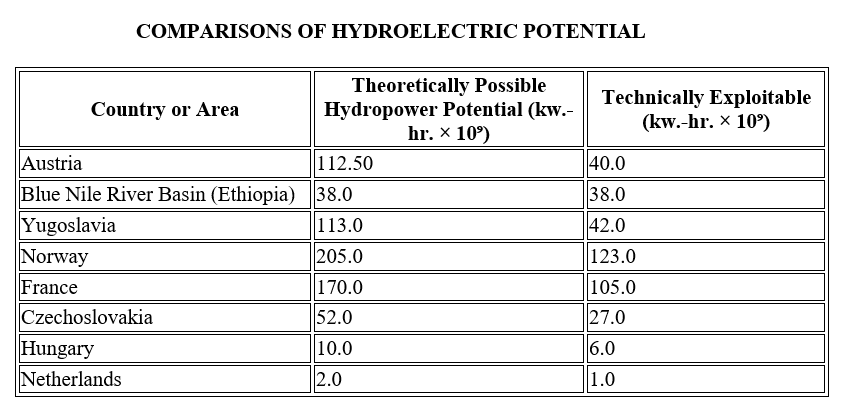
Incredible and Untapped Hydropower Potential!
Did you know Ethiopia's Blue Nile River Basin has a technically exploitable hydropower potential of 38 TWh? Currently, Ethiopia uses only 12.3 TWh (32.4%) of this potential, meaning over two-thirds remains untapped!
Sources:
1. IA002 140, Land and Water Resources of the Blue Nile Basin, Ethiopia, U.S. Department of the Interior, Bureau of Reclamation.
2. United Nations publication (Document Reference: E/ECE/EP/AC.2/1).
#BlueNile #Ethiopia #Hydropower #RenewableEnergy #UntappedPotential #SustainableDevelopment
#Ethiopia's Electric Power (EEP) rakes over $61M from electricity exports in 6 months!
🔹 13,504 GWh generated—exceeding targets
🔹 274.2 GWh to #Djibouti ($17.16M)
🔹 654.9 GWh to #Kenya, 26.6 GWh to Sudan
EEP continues expanding regional energy supply.
https://t.co/KnJw5HvXMl
@RobelYeshitla There is Zarema Dam close to Waldeba Monastery, planned to irrigate to 1 million farmers and USd 1 billion spent by Ethio- govt? It is stuck due to the Ministry of Revenue refuse to recognize double taxation treaty of Ethiopia & Italy. The Dam is 95% complete, but not certified