Albedo is THE VLEO company.
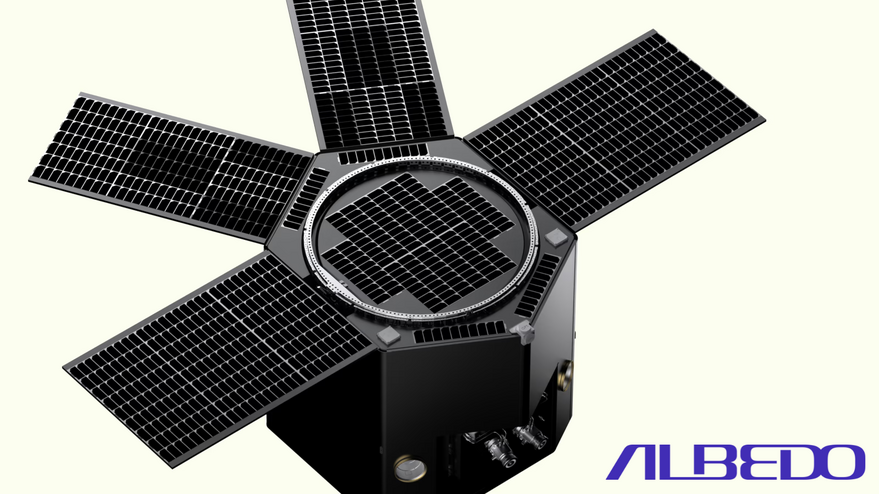
Announcing Vicinity — our next VLEO bus, powered-up to unlock performance from proximity for higher power payloads.
Demo mission launching to VLEO next year.
More details on our new website: https://t.co/YJUjF4UQ73
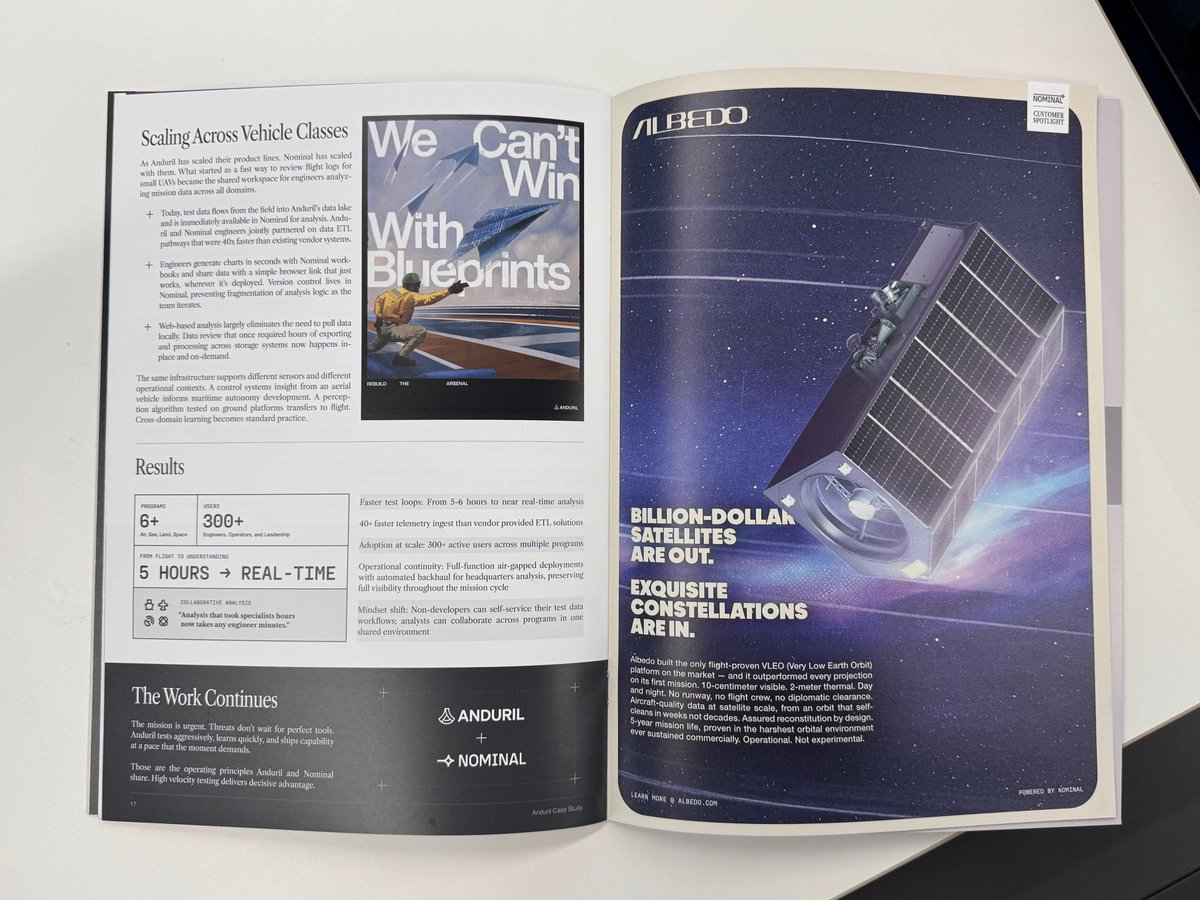
Nominal’s software and the team behind it have created immense leverage for our hardware testing & on-orbit data analysis
And now even more clutch as we’re scaling up future builds with repeatable processes
Big congrats to @Nominal_io & thanks for featuring @Albedo!
We are pleased to announce that Albedo has been awarded a contract for the Missile Defense Agency SHIELD IDIQ with a ceiling of $151B.
This contract encompasses a broad range of work areas that allows for the rapid delivery of innovative capabilities to the warfighter with increased speed and agility.
Proximity Drives Performance
This is what A+ execution in hard tech looks like.
The @Albedo team built the highest resolution commercial imaging satellite ever and flew it so low they had to worry about atomic oxygen + atmospheric drag. They built so many ingenious workarounds for FOAK equipment issues, Andy Weir would blush.
Unlike SaaS, space is unforgiving. 98% functional is not fixable with your CI/CD system. Just as SpaceX took a few explosions on the launchpad to get to orbit, Albedo's first mission ended similarly in what is, in this world, a massive success.
Give this a read and you'll have a new appreciation for how hardcore this team is.
ANNOUNCEMENT: Albedo is going all-in on VLEO systems
For years, the space industry has competed on resolution, altitude, and scale — bigger optics, higher orbits, more satellites. But what if the next advantage doesn’t come from going higher, but from getting closer?
We started @Albedo to build the next generation of Earth-imaging satellites. What we built to take better pictures became something much bigger: a way to operate reliably in Very Low Earth Orbit (VLEO) — 275 km above Earth, where drag and atomic oxygen used to make long-duration missions impossible. This breakthrough changed our focus.
From this point forward, we’re no longer selling commercial imagery. We’re building the infrastructure that makes an entire orbital layer operational and scalable. Our full effort is going into building the systems that make sustained flight in VLEO possible.
The economics of getting closer
Satellites today operate in three established orbit domains:
GEO - Farther
MEO - Middle
LEO - Closer
VLEO is roughly half the altitude of LEO. Getting this close to Earth doesn’t just improve performance; it also changes the economics of space. Satellites in VLEO can:
→ Capture higher-resolution data with smaller, cheaper payloads
→ Maintain stronger downlinks and uplinks at lower power
→ Deliver faster latency for real-time applications
→ Maneuver dynamically to balance endurance, precision, and autonomy
The physics are simple: signal strength ∝ range², and for two-way systems, performance ∝ range⁴. Halving the distance delivers roughly 4× the signal power — or 16× for two-way systems — enabling smaller optics, lower-power transmitters, and lower mass. These efficiencies compound. Smaller spacecraft mean lower build and launch costs, faster iteration, and more frequent refresh cycles — a new economic curve for every market that depends on satellites, with a similar compounding cycle that transformed cloud infrastructure and semiconductors.
Clarity’s proof through Solar Max
Our first spacecraft, Clarity, has been on orbit for seven months through Solar Max, the most demanding period of the solar cycle. Clarity is performing 12% better than design predictions in drag efficiency, has executed 150 km of controlled maneuvers, and has maintained strong power generation while its solar arrays are exposed to atomic oxygen — a reactive element that corrodes conventional spacecraft materials at hypersonic speed. We’ve also uploaded 12 flight-software updates while in orbit, adding novel control modes and solving issues in real time.
Clarity was designed for an average five-year lifespan at ~275 km, proving that long-duration, low-altitude operations are sustainable with the right architecture.
VLEO isn’t experimental anymore. It’s operational.
Our reliance on satellites requires redundancy
LEO is crowded and vulnerable. VLEO offers the opposite: a naturally self-cleaning layer that clears debris in weeks, not years.
Everyday life runs on space: ATMs to national security. As launch costs fall and cadence rises, redundancy shouldn’t mean “more LEO” — it means adding a second layer in VLEO.
In testimony to Congress last year, John F. Plumb (Former Assistant Secretary of Defense for Space Policy) warned that a high-altitude nuclear detonation could render LEO unusable for up to a year. Diversifying architectures ensures continuity of communications, intelligence, and warning missions even under extreme conditions. VLEO sits below the radiation belts and in a naturally debris-clearing regime, making rapid reconstitution assured.
What’s next for Albedo
We’re dedicating our full engineering and operations teams to VLEO systems: buses, integrated satellites, and turnkey missions.
These past few years proved the physics. Now we’re scaling the infrastructure that will make VLEO the next productive, sustainable orbit in space. If you believe the next edge in space isn’t higher but closer, please reach out.
More to come.
ANNOUNCEMENT: Albedo is going all-in on VLEO systems
For years, the space industry has competed on resolution, altitude, and scale — bigger optics, higher orbits, more satellites. But what if the next advantage doesn’t come from going higher, but from getting closer?
We started @Albedo to build the next generation of Earth-imaging satellites. What we built to take better pictures became something much bigger: a way to operate reliably in Very Low Earth Orbit (VLEO) — 275 km above Earth, where drag and atomic oxygen used to make long-duration missions impossible. This breakthrough changed our focus.
From this point forward, we’re no longer selling commercial imagery. We’re building the infrastructure that makes an entire orbital layer operational and scalable. Our full effort is going into building the systems that make sustained flight in VLEO possible.
The economics of getting closer
Satellites today operate in three established orbit domains:
GEO - Farther
MEO - Middle
LEO - Closer
VLEO is roughly half the altitude of LEO. Getting this close to Earth doesn’t just improve performance; it also changes the economics of space. Satellites in VLEO can:
→ Capture higher-resolution data with smaller, cheaper payloads
→ Maintain stronger downlinks and uplinks at lower power
→ Deliver faster latency for real-time applications
→ Maneuver dynamically to balance endurance, precision, and autonomy
The physics are simple: signal strength ∝ range², and for two-way systems, performance ∝ range⁴. Halving the distance delivers roughly 4× the signal power — or 16× for two-way systems — enabling smaller optics, lower-power transmitters, and lower mass. These efficiencies compound. Smaller spacecraft mean lower build and launch costs, faster iteration, and more frequent refresh cycles — a new economic curve for every market that depends on satellites, with a similar compounding cycle that transformed cloud infrastructure and semiconductors.
Clarity’s proof through Solar Max
Our first spacecraft, Clarity, has been on orbit for seven months through Solar Max, the most demanding period of the solar cycle. Clarity is performing 12% better than design predictions in drag efficiency, has executed 150 km of controlled maneuvers, and has maintained strong power generation while its solar arrays are exposed to atomic oxygen — a reactive element that corrodes conventional spacecraft materials at hypersonic speed. We’ve also uploaded 12 flight-software updates while in orbit, adding novel control modes and solving issues in real time.
Clarity was designed for an average five-year lifespan at ~275 km, proving that long-duration, low-altitude operations are sustainable with the right architecture.
VLEO isn’t experimental anymore. It’s operational.
Our reliance on satellites requires redundancy
LEO is crowded and vulnerable. VLEO offers the opposite: a naturally self-cleaning layer that clears debris in weeks, not years.
Everyday life runs on space: ATMs to national security. As launch costs fall and cadence rises, redundancy shouldn’t mean “more LEO” — it means adding a second layer in VLEO.
In testimony to Congress last year, John F. Plumb (Former Assistant Secretary of Defense for Space Policy) warned that a high-altitude nuclear detonation could render LEO unusable for up to a year. Diversifying architectures ensures continuity of communications, intelligence, and warning missions even under extreme conditions. VLEO sits below the radiation belts and in a naturally debris-clearing regime, making rapid reconstitution assured.
What’s next for Albedo
We’re dedicating our full engineering and operations teams to VLEO systems: buses, integrated satellites, and turnkey missions.
These past few years proved the physics. Now we’re scaling the infrastructure that will make VLEO the next productive, sustainable orbit in space. If you believe the next edge in space isn’t higher but closer, please reach out.
More to come.
What does it take to design, build, and launch satellites into one of space’s toughest orbits?
@Albedo cofounder and CTO AyJay Lasater shares how physics-based design, in-house engineering, and unconventional problem-solving are guiding their mission — from rethinking designs to salvaging a shattered mirror in two weeks.