💼 COO at Hotwine, Expert in Information Technology
🌐 Passionate about website editing & automation
🚀 Google Discover Specialist
🏖️ Expatriate in Brazil
SEO is dead (thanks AI Overviews 💀), long live Google Discover.
Does your website meet these criteria?
💎 You're sitting on a goldmine of potential traffic.
Here are the exact requirements you need to meet, plus a surprise at the end if you check at least 6 out of 8 boxes 👇
☐ 📰 Your site is editorial in nature
- You run a media outlet, a blog, or an informational site that primarily publishes editorial content like articles.
- Bonus: your site is listed in Google News (optional).
☐ 🚀 Your site has a solid technical foundation
- Your articles (homepage performance doesn't matter much!) load quickly and score at least in the orange, ideally in the green, on Google's tools (PageSpeed Insights).
- Your articles get indexed quickly (within 24 hours naturally, within 3 hours if on Google News).
- Bonus: your site passes Core Web Vitals (optional).
☐ 👪 You already have an existing audience
- The ideal: at least 10K visitors/month from varied sources, with a majority coming from SEO.
- Google loves Google: a healthy SEO base is the strongest trust signal to unlock Discover.
☐ 💰 Your traffic comes from (or could come from) high-RPM countries
- US, UK, Canada, Australia, Northern Europe…
- Bonus: you already monetize your audience via display ads (optional).
☐ 📈 Your user metrics are strong
- A loyal audience that keeps coming back.
- High time spent on pages.
- Bonus: more than 2 pages per session (optional).
☐ ✅ You are in Google's good graces
- Not recently impacted by a Core Update, HCU, or other Google updates.
- Traffic curve has been stable or growing over the past 3 months.
☐ 🔎 A Discover tab is already visible in your Google Search Console
- Even if performance is low, this means you're potentially eligible.
- Bonus: you already have some impressions/clicks organically, without an active strategy.
☐ ✍️ You pay attention to your E-E-A-T signals
- Articles signed by human authors, providing real added value, with clear legal mentions.
- Bonus: you have UGC content (comments section, user interaction) (optional).
If you check 6 (or more) of these 8 boxes, your site has a high chance of reaching millions of additional visits via Google Discover.
The good news?
We can take care of everything for you, at no cost!
Our experts help you grow on Google Discover with a 100% performance-based model.
🤝 No results, no cost.
Interested? 👉 https://t.co/qBPp6VoVVy
On recrute 2 stagiaires H/F chez WeTrend pour la rentrée 🚀 (6 mois min)
Tu aimes apprendre + vite que la moyenne, dans une petite équipe dynamique où tes idées comptent vraiment ? Lis la suite.
Au menu : sujets à fort potentiel, titres qui claquent, images qui stoppent le scroll, IA, et des médias reconnus dans le monde entier.
Plus que ton CV, c'est ta façon de penser qui nous intéresse.
Pour postuler 👇
https://t.co/gcjLdA4MXb
Le partage est fortement apprécié (et vous protège des Core Updates Google 🙏)
For months, Google was calling this site.
Nobody picked up.
The month someone answered: 2.08M Discover clicks.
The month before: 55.
Your site is probably getting the same call right now. Here's how to tell 👇 🧵
For 5 years I've been saying the same thing to media outlets:
Google Discover is your single biggest traffic source, and you're treating it like luck.
I just spent 1h20 breaking down why, on @edwardeachday's podcast. The key points 🧵
Most publishers are sitting on a goldmine of untapped traffic. They catch the occasional Discover spike, think "nice bonus" and move on.
Big mistake. Here's what that traffic looks like when you actually go after it.
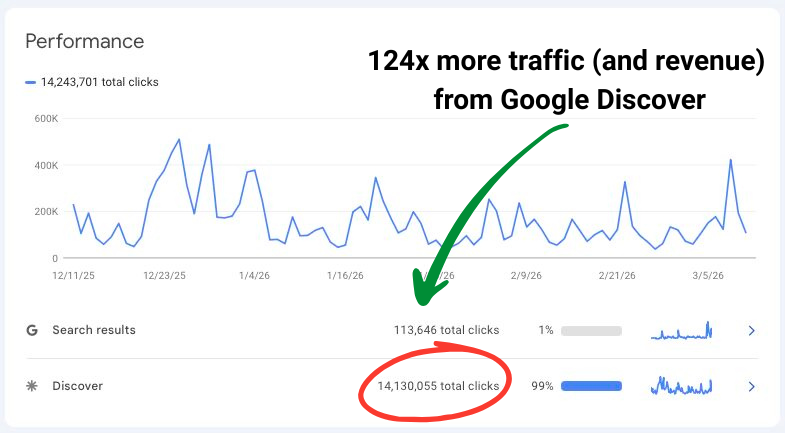
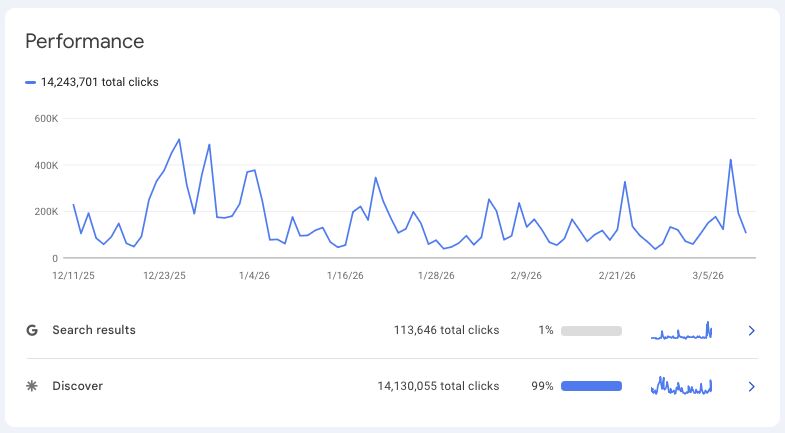
A real publisher's Google Search Console:
Google Search: 113,000 clicks.
Google Discover: 14.1 million.
On SEO alone, this site would have capped at those 113,000. Discover did 124x more.
And the part that matters most: before we ran a Discover strategy on this site, those 14 million clicks did not exist. We didn't capture them from somewhere else. We opened a door that was sitting closed the whole time.
What's your site really sitting on? 👇
I'm French. Talking about money is taboo here.
Tant pis. (French for "f*ck it.")
€13,905 in ad revenue. One day. One site.
(A site we grow on revenue share. Not even our record.)
Three weeks ago, this same site was flat.
Not Facebook. Not SEO. Google Discover.
Curious what yours could do? 👇
Quick test.
Open X, Instagram, TikTok.
Of the last 10 things you saw, how many came from accounts you actually follow?
About half.
The rest? The algorithm decided for you.
We still follow just as much.
But following no longer decides what we see. 🧵
30,000+ readers on one site right now, live, all from Google Discover. 😊
We build this for publishers. 100% on performance: no results, no cost.
Curious whether your site could do the same? There's a 2-minute check that tells you straight. Link in the comments. 👇
(Full how-to coming soon, for those who'd rather learn it themselves.)
5 years, 120+ publishers, 30+ countries, 1B+ clicks on Google Discover taught me this.
If you already get Discover traffic and want to multiply it, one thing moves the needle more than anything else :
Your title.👇
Ce skill Claude trouve tes bons mots-clés en temps réel c'est incroyable!!!
Tu économises 1 600 € et 5 jours de travail
(Je te l'offre gratuitement dans ce post)
Tu colles tes données SEMrush, Haloscan ou ta Search Console. Ou rien du tout.
Le skill marche dans les deux cas grâce à ce qui change tout :
→ avec tes données : il les transforme en carte d'opportunités priorisée
→ sans données : il explore les recherches réelles en direct (SERP, "autres questions posées", autocomplétion)
→ il classe chaque mot-clé par intention : informationnel, commercial, transactionnel
→ il repère les pépites : longue traîne, quick-wins, questions que personne ne couvre
→ Google ET les questions posées à ChatGPT et Perplexity
Je t'offre tout ça GRATUITEMENT
Si tu veux recevoir :
Like + RT
Commente "SKILL ou tag un pote qui serait chaud
Follow pour que je puisse t'envoyer en DM ;)
Most publishers with real Discover traffic are still writing for the wrong audience.
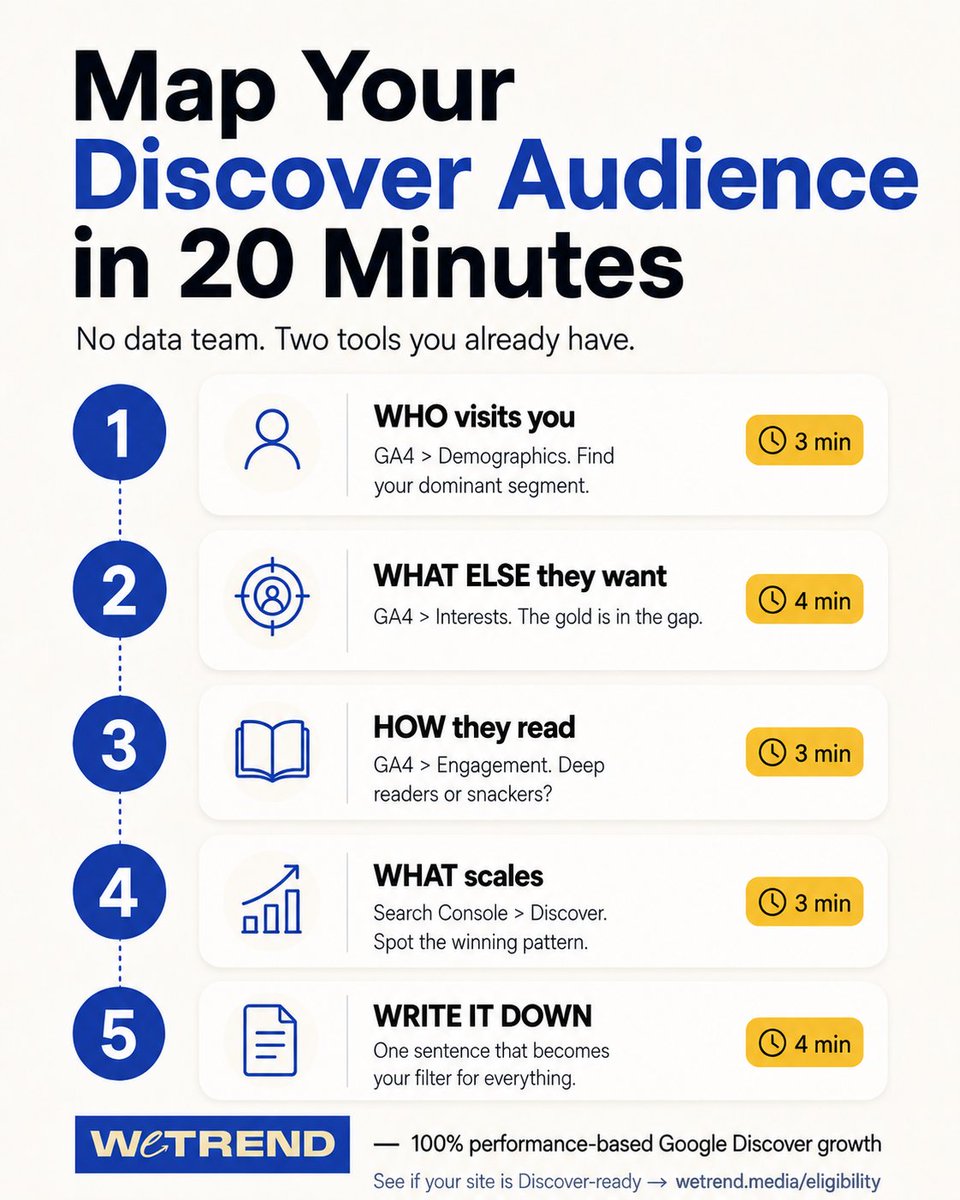
Here's the 20-minute exercise that grew Discover traffic for several clients, doubling or even more it in the best cases.
Two tools you already have. No data team needed.
Here's how to find the audience Google actually sees. Bookmark this, run it on your site.
1. WHO actually visits you (3 min)
GA4 → Reports → User → User attributes → Demographic details.
Age, gender, top countries, language. Don't average. Write down the dominant segment.
If you target women but 60% of readers are men, that's a signal, not a rounding error.
2. WHAT ELSE they care about (4 min)
Same report. At the bottom of the table, click the dimension (e.g. "Country") and switch it to "Interests".
You'll see the interest categories Google assigns your audience. The gold is in the gap between your stated niche and what they're actually into. These are angles you'd never have guessed.
(Report empty? Turn on Google Signals in Admin → Data Collection, then give it 24h.)
3. HOW they read (3 min)
GA4 → Reports → Engagement → Pages and screens.
Over 2 min engagement? Deep-reading audience, long articles work. Under 30 sec? Snackable wins. High returning rate? Discover loves that signal of trust.
4. WHAT actually scales (3 min)
Search Console → Performance → Discover. Last 90 days, sort by clicks.
For your top 20 articles, name the topic, the angle, and the emotion. Find the dominant pattern: that's what works for your audience, not what you assumed.
Then go beyond volume and add the CTR. Above 10%, your audience and the topic are aligned. Below 5%, there's a gap between who Google shows you to and who you write for.
More on CTR next week, it's where titles begin.
5. WRITE IT DOWN (4 min)
Cross it all and you get your core persona, plus 2-3 secondary audiences (the bigger the site, the more you'll find).
Lead with the core: it's your filter for every title, image, topic. The secondary ones are your next growth angles.
Boil the core down to one line:
"Women 35-54 in the US, into lifestyle and home, drawn to stories about how people live."
A real example. A celebrity news site in our network thought it was, well, just that. Then the data showed a strong "Home & Habitat" interest in their audience. So they ran articles on the homes of the stars they covered.
Their Discover traffic doubled in two months. Same celebrities, different angle, because they finally wrote for the audience Google saw, not the niche they assumed.
Do this once, then re-run it every quarter, and right after any Google update. Audiences drift, and updates reshuffle them. Catch the shift before your traffic does.
Knowing your audience isn't a feeling. It's 20 minutes with data you own.
Run it on your site, then tell me what surprised you most. Comments are open.
👉 Tomorrow: once you know who reads you, how to read your own Google ad profile to reverse-engineer the algorithm's logic.
We found 14 million readers this editorial site didn't know it could reach.
Their SEO was already solid.
But a much bigger audience was sitting just out of reach, one they were never going to find through search.
We didn't change who they were. We helped them reach the readers they didn't know they had.
Over the next few weeks, I'm going to break down exactly how we did it, step by step. Not theory, the actual playbook.
It starts with the piece almost everyone gets wrong: audience.
That's the most common reason editorial sites never take off on Discover: they confuse their niche with their audience. They keep optimizing for the readers they already know, and never go looking for the ones Google is ready to send them.
Here's the trap.
You think in terms of your topic, your vertical, your beat. "We're a cinema site." "We're a finance site." So you write for the audience that label implies.
Logical for SEO. Quietly fatal for Discover.
Because Google doesn't push your content based on your stated niche. It pushes it to the people who actually stop scrolling, click, and come back, whoever they are.
And those people are often interested in far more than your niche suggests. Miss that, and you keep writing slightly beside what Google is ready to reward you for.
So instead of guessing, we read Google's own data to see how it reads a site.
Here's the simplest example, a 3-minute move you can run right now. It won't map your whole audience, that comes later this week, but it proves one thing:
1. Open Chrome on desktop. In the URL bar, type:
chrome://topics-internals/
2. Click the "Classifier" tab.
3. Enter your own domain (hostname only, no https). Google shows you the topics it associates with your site.
Don't be surprised if the tags and clusters Google has assigned to you are nothing like what you expected.
That surprise is the point: it's the gap between the niche you claim and the one Google actually files you under.
This little tool isn't the destination. It's the proof of concept: in 30 seconds, it shows that Google has its own read of your site, one you don't control and probably can't guess.
Once you accept that, the real work begins.
Then try three more domains: your closest competitor, the biggest publisher in your space, and a site you'd love the algorithm to confuse you with. The differences are where your next moves hide.
Consider this a warm-up. The Classifier is the smallest example of a bigger habit: using Google's own data to understand how it sees you.
All week, I'm going deeper, with the tools that map your real Discover audience:
- The little-known ways to make Google's data reveal who actually reads you
- How to read your own Google ad profile to reverse-engineer the algorithm's logic
- Pulling your true audience from GA4: affinity categories, in-market segments, and the adjacent interests that become your next content angles
Stop thinking in niches. Start thinking in audiences.
On Discover, that shift is the difference between a flat line and a takeoff.
👉 Tomorrow: the full 20-minute version that builds your complete Discover audience profile. Stay tuned.
Google Discover is the most powerful free traffic source for publishers. By far.
Nothing else delivers 5M+ daily visits from a single article.
I've spent 5 years cracking it. 120+ publishers. 30+ countries. Over 1 billion clicks.
Here are the 8 secrets I wish someone had told me from day one 🧵
7/7 We've helped 120+ publishers unlock Discover.
Zero upfront cost. You only pay when it works.
15 min to find out if your site qualifies 👉 https://t.co/SHutgw6wPy
#GoogleDiscover#GoogleNews
1/7 👇 Google Discover sent 1 billion visits to our clients' sites.
Most publishers still treat it like a black box.
Here's exactly how it works and what actually moves the needle 🧵
On fait monter les enchères: si ce tweet a 200 RT je vous enregistre une vidéo claude code maintenant et je la poste ce soir-même. Sinon tranquille d'ici 1 semaine ou 2.
Je vais faire ma pickme. Si j'ai 100 RT sur ce tweet je crée une chaîne youtube claude code & AI pour détailler concrètement et en vidéo ce dont je parle sur ce compte X, dédiée aux noobs et aux + avancés. Du même acabit que ça, mais avec tous les détails:
https://t.co/4Qmsqsj7Z4