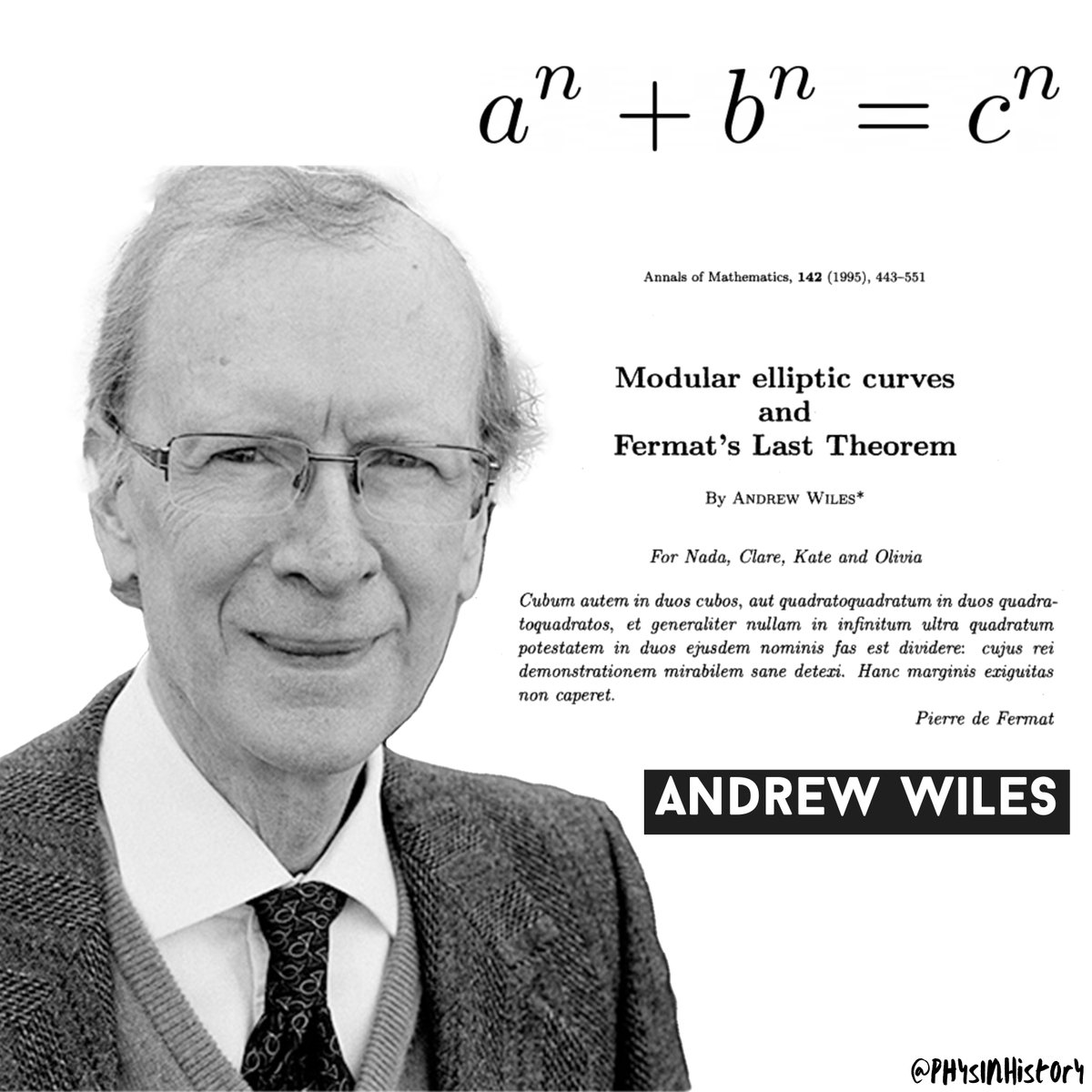
Fermat's Last Theorem is a statement in the field of number theory that was first proposed by Pierre de Fermat in 1637. Fermat was a French lawyer and amateur mathematician who is given credit for early developments that led to the development of infinitesimal calculus.
The theorem states that there are no three positive integers a, b, and c that satisfy the equation
aⁿ + bⁿ = cⁿ
for any integer value of n greater than 2.
Fermat famously wrote in the margin of his copy of the book "Arithmetica" that he had a "truly marvelous proof" for this proposition, but it was too large to fit in the margin. However, he never wrote down this proof, and his claim tantalized mathematicians for centuries.
The theorem was finally proven by British mathematician Andrew Wiles in 1994. Wiles' proof was not simple or elementary; instead, it used many areas of mathematics that were developed long after Fermat's lifetime. This has led to speculation about whether Fermat truly had a proof or whether he was mistaken. Regardless, the theorem that carries his name is a central result in number theory, and the story of the search for its proof is one of the most famous in the history of mathematics.
La XXXIV Asamblea de AIMFA fue una de las más concurridas de los 50 años de historia de la agrupación, con más de 140 asistentes. Aquí tenéis el vídeo-resumen de las jornadas: https://t.co/NcsWqObneR
#50añosAIMFA#comparteAIMFA#somosAIMFA