Simple Life Optimization Heuristic - Identify intersection of:
1/ What you see as the worlds most critical inefficiencies or injustice; 2/ Where you can create the most value and/or learn the most; 3/ Get to do stuff that gives you the most joy - then aim for the middle everyday.
If you leader in a company and you're not "writing code" with AI 10% of your time to:
1/ Learn what's coming
2/ Build what's next
3/ Refactor what's rotting
You might as well be dead.
@garrytan If you are a leader/exec/CEO, or anyone in tech -- and you aren't building & "writing code" with AI.
WTF are you doing?
If you aren't spending at LEAST 10%-20% of your time building/"coding" w/ AI -- the stuff that's taking you away from that time IS the distraction.
If you are a leader/exec/CEO, or anyone in tech -- and you aren't building & "writing code" with AI.
WTF are you doing?
If you aren't spending at LEAST 10%-20% of your time building/"coding" w/ AI -- the stuff that's taking you away from that time IS the distraction.
I came back to code because AI made it possible for me to build at a level I couldn't before.
I'm not coding despite being CEO of YC. I'm coding because this is the most important technological shift since the internet and I'd be an idiot to experience it from the bleachers.
I'm 45, running the most important startup institution in the world, and I can ship production software at 2am. That's not a distraction from the job.
That is the job understood correctly.
No matter which side you’re on, the clip choices are unintentionally hilarious. In the darkest way possible.
I’m not very a political person - But using my favourite movies and games to promote war from the @WhiteHouse just feels wrong.
lol interesting movie choices
Braveheart: The entire movie is about resisting imperial occupation by a more powerful nation. Using it to celebrate American military power is exactly backwards -- we are the empire.
Saul Goodman: A corrupt, morally bankrupt lawyer who helps a meth dealer and ends up in witness protection. His entire arc is about the rot inside the American dream.
Keanu Reeves: Canadian. Born in Beirut. Raised partly in Australia. Using him as an avatar of American might is weird.
Christopher Reeve: Died paralyzed after a horse riding accident. His legacy is disability advocacy and stem cell research... causes the right largely opposed.
Walter White: Poisons children, murders people, destroys his family, and dies alone in a meth lab. Cranston himself is openly liberal.
R&D firm Merkle, which sold Farcaster, says it plans to repay VCs the $180M they invested in the social media project, and says Farcaster is not shutting down (@suvajourno / Bloomberg)
https://t.co/WgUpM8f0Vr
https://t.co/pWDxMKljr1
📥 Send tips! https://t.co/wlNZvXuhJs
https://t.co/QP3BcgHLGz
Google’s Genie3 is not getting enough attention.
Gangster move for Google to drop on same day as OpenAI open source model.
Genie3 is even more impressive. By far.
Kudos to both teams for making it a magical time to be alive.
@cccccleveland @im_roy_lee@edchucation@cluely@im_roy_lee i appreciate the fact that you would take the time to answer a question like this…. 🤦♂️
I always wanted something like this - esp during COVID. Congrats on the launch and excited to test it!
We’re hiring a Founding Product Designer @ Parallelz (Toronto, hybrid).
Moving from deep tech → productization. Defining a new category of web, mobile & AI experiences.
Looking for a true creative partner. A few thoughts 👇
You’d be working directly with me — shaping how this new category comes to life, and building the design foundation for the company.
This is one of the most important hires I’ll make this year.
@garrytan This is an alternative view of the data.
I think it’s nuts to get rid of gifted programs.
And this is coming from someone that was in a school that had a gifted program that I wasn’t a part of.
Then again, school was boring and I didn’t attend much to make time to build. :)
Across all the LLMs I've used... the default tone in which Grok speaks seems to resonate with me the most and feels the most human, albeit sometimes not as well structured (vs. my ChatGPT w/ my personalized system prompts). Thoughts?
Twelve days ago, I had dinner with President Trump, a dinner that my friend @KidRock set up because we share the belief that there has to be something better than hurling insults from 3000 miles away.
I think the Deepseek moment is not really the Sputnik moment, but more like the Google moment.
If anyone was around in ~2004, you'll know what I mean, but more on that later.
I think everyone is over-rotated on this because Deepseek came out of China. Let me try to un-rotate you.
Deepseek could have come out of some lab in the US Midwest. Like say some CS lab couldn't afford the latest nVidia chips and had to use older hardware, but they had a great algo and systems department, and they found a bunch of optimizations and trained a model for a few million dollars and lo, the model is roughly on par with o1. Look everyone, we found a new training method and we optimized a bunch of algorithms!
Everyone is like OH WOW and starts trying the same thing. Great week for AI advancement! No need for US markets to lose a trillion in market cap.
The tech world (and apparently Wall Street) is massively over-rotated on this because it came out of CHINA.
I get it. After everyone has been sensitized over the H1BLM uproar, we are conditioned to think of OMG Immigrants China as some kind of Alien Other. As though the Alien-Other Chinese Researchers are doing something special that's out of reach and now China The Empire is somehow uniquely in possession of Super Efficient AI Power and the US companies can't compete. The subtext of "A New Fearsome Power Now Under The Command of the CCP" is what's driving the current sentiment, and it's not really valid.
Like, no. These are guys basically working on the same problems we are in the US, and not only that, they wrote a paper about it and open-sourced their model! It is not actually some sort of tectonic geopolitical shift, it is just Some Nerds Over There saying "Hey we figured out some cool shit, here's how we did it, maybe you would like to check it out?"
Sputnik showed that the Soviets could do something the US couldn't ("a new fearsome power"). They didn't subsequently publish all the technical details and half the blueprints. They only showed that it could be done.
With Deepseek, if I recall correctly, a lab in Berkeley read their paper and duplicated the claimed results on a small scale within a day.
That's why I say it's like the Google moment in 2004. Google filed its S-1 in 2004, and revealed to the world that they had built the largest supercomputer cluster by using distributed algorithms to network together commodity computers at the best performance-per-dollar point on the cost curve.
This was in contrast to every other tech company, who at that time just bought what were essentially larger and larger mainframes, always at the most expensive leading edge of the cost curve. (To the young people reading this, this will sound incredible to you)
I worked at PayPal at the time, and in order to keep pace with the rising transaction volume, the company was forced to buy bigger and bigger database servers from Oracle. We were totally Oracle's bitch. At one point when we ran into scalability issues, the Oracle reps told us we were their biggest installation so they had no other reference point on how to help us overcome our scalability issues. We literally resorted to flipping random config switches and rebooting it.
(This heavily influenced me when I was a young manager later at Facebook. I deliberately torpedoed an Oracle salesman's pitch to try and get us to switch from open source MySQL databases to an Oracle contract: of course we had scalability problems, but at least when we had them, we could open up the hood and figure out how to fix it ... assuming we had good enough engineers, and we did. When it's closed-source infra, you're at the mercy of the vendor's support engineers)
Back to Google - in their S-1, they described how they were able to leapfrog the scalability limits of mainframes and had been (for years!) running a far more massive networked supercomputer comprised of thousands of commodity machines at the optimal performance-per-dollar price point - i.e. not the more expensive leading edge - all knit together by fault-tolerant distributed algorithms written in-house.
Some time later, Google published their MapReduce and BigTable papers, describing the algorithms they'd used to manage and control this massively more cost-effective and powerful supercomputer.
Deepseek is MUCH more like the Google moment, because Google essentially described what it did and told everyone else how they could do it too. In Google's case, a fair bit of time elapsed between when they revealed to the world what they were doing and when they published a papers showing everyone how to do it. Deepseek, in contrast, published their paper alongside the model release.
Now, I've also written about how I think this is also a demonstration of Deepseek's trajectory, but that's also no different from Google in ~2004 revealing what it was capable of. Competitors will still need to gear up and DO the thing, but they've moved the field forward. But it's not like Sputnik where the Soviets have developed technology unreachable to the US, it's more like Google saying, "Hey, we did this cool thing, here's how we did it."
There is no reason to think nVidia and OAI and Meta and Microsoft and Google et al are dead. Sure, Deepseek is a new and formidable upstart, but doesn't that happen every week in the world of AI? I am sure that Sam and Zuck, backed by the power of Satya, can figure something out. Everyone is going to duplicate this feat in a few months and everything just got cheaper. The only real consequence is that AI utopia/doom is now closer than ever.
====
Bonus: This is also a little similar the Ethereum PoS moment, when AI finally has a counterpoint to the environmentalists who say AI uses so much electricity. We just brought down the cost of inference by 97%!
@sama the deepseek team made some incredible advancements with their research. i’m excited to see how the team at openAI applies these approaches.
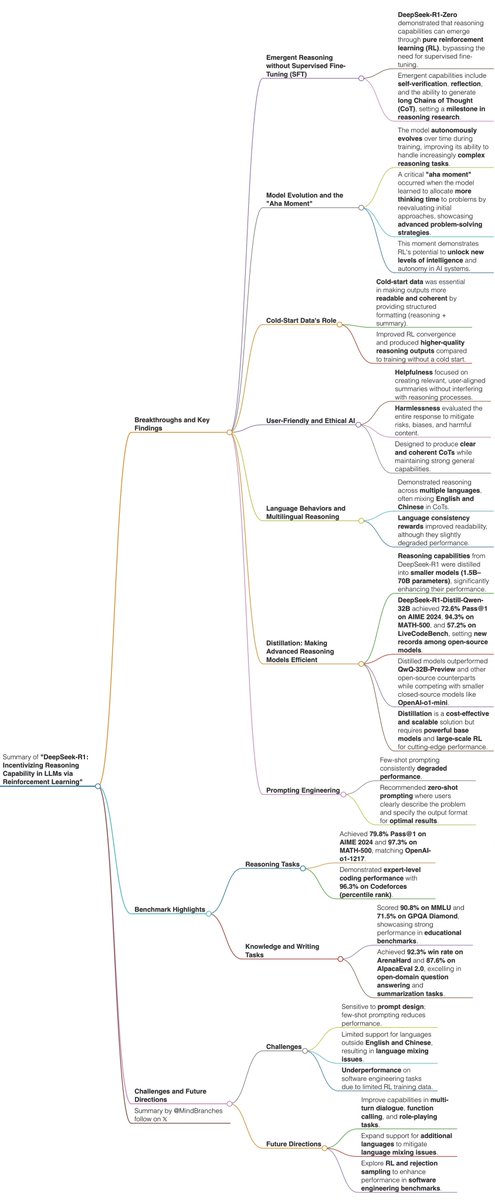
here’s a summary of their paper: "DeepSeek-R1: Incentivizing Reasoning Capability in LLMs via Reinforcement Learning"
DeepSeek just released the first Open Source Reasoning Model that matched o1!
But how did an unknown, 100 person startup with $0 VC funding produce a frontier open source model that rivaled OpenAI and Anthropic at 1/10th of the training cost and is 20-50x cheaper during inference?
After doing extensive research into the company's history, here’s the untold founding story of the rise, fall and rebirth behind DeepSeek and it’s parent company High-Flyer 🧵
How did deepseek ramp up their infra/inferencing so quickly to support being #1 in the appstore w/ very fast response times - even with the est. 30x+ efficiency gain over say 01 - this requires some insane infra?
Something that I can't imagine they could have turned on a week?
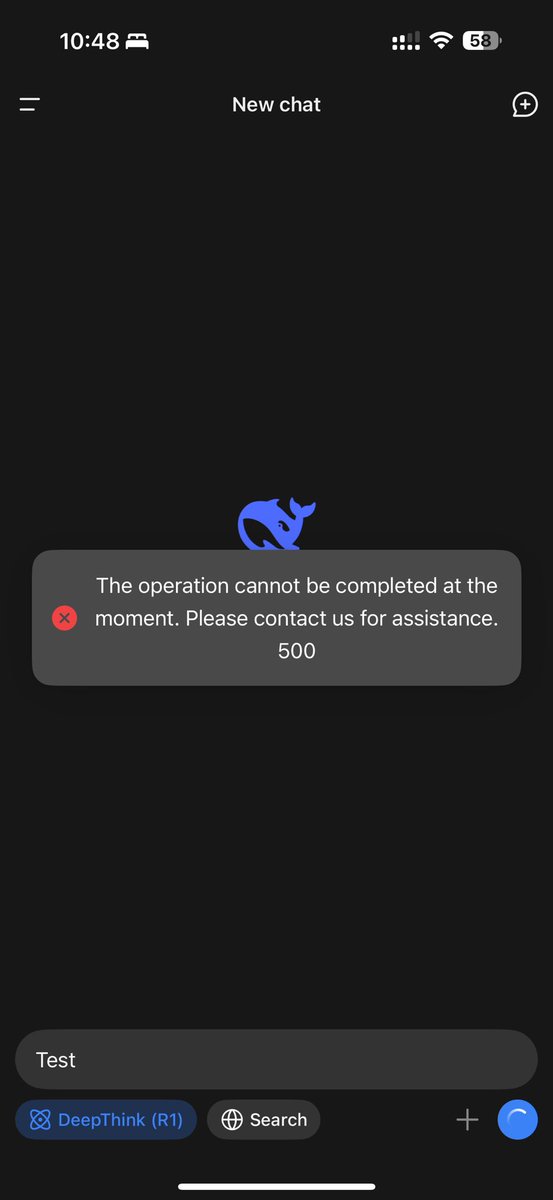
@trelayne Yep. Def read all of that from a very good deep profile from @henrythe9ths - but can’t imagine that they’d have enough for inference demand even with 30x efficiency over alts. That said I just ran into a capacity error on DeepSeek app. So perhaps i just got lucky before.