researcher working on simulating legal reasoning environments at Epiq AI Labs. studied @DukeU. research @MSFTResearch, @CuraiHQ. legal @ACLU, @VeraInstitute.
Excited to announce that my internship work with my awesome collaborators at @CuraiHQ from last year has been accepted to the main conference @naaclmeeting 2024😃
Check out our work building practical guardrail models for LLMs using a diverse synthetic data generation approach!
1/ New preprint!🔔
Excited to share my internship work at @CuraiHQ.
Using model distillation techniques, we’ve developed an approach to create light-weight guardrail models that monitor the output of generative language models like GPT-4!
w/@nairvarun18@elliotschu@anithakan
This is a really fascinating paper that everyone interested in China's industrial policy should read.
It destroys so many myths (see below), and is written by deeply credible people who conducted over three years of fieldwork in China and interviewed 60+ Chinese officials, entrepreneurs, and engineers. When it comes to China studies, it literally doesn't get more rigorous than this.
First myth it destroys: contrary to popular belief, Beijing's industrial policy didn't build the companies that became China's EV champions. They rose largely **despite** it, through its cracks.
For sure, Beijing did favor EVs as an industry and pushed hard for it but their big bet was SOEs (State Owned Enterprises): research grants, pilot programs, licenses, cheap credit - virtually all of it flowed to state firms.
The result? China's actual EV champions - BYD, Geely, NIO, XPeng, Li Auto, etc. - are overwhelmingly private firms that succeeded despite Beijing favoring their SOE competitors.
How so? Because, when favoring SOEs, the central government didn't just pick winning companies, it picked winning cities, each SOE being anchored in a specific city: Shanghai (SAIC), Changchun (FAW), Wuhan-Shiyan (Dongfeng), etc.
Which means that every city not on the list, that wanted a piece of the auto boom, had only one option left: team up with private entrepreneurs who were equally excluded from central government favor.
That's what truly fueled China's EV miracle: an alliance of the excluded, between local private entrepreneurs and local mayors.
This is the biggest misconception this paper destroys: the reality is that the "Chinese state capitalism" that many in the West think powered the EV boom actually tried to block many of these companies from existing. In effect, it was closer to an obstacle course that local actors (mayors and provinces) learned to game.
Geely - now the third largest automaker in China - is a fantastic example of this.
First of all, it started off illegal since, to build passenger cars, you had to have a central government license and they couldn't get one. Zhejiang Province told them to go ahead regardless because the province had hundreds of auto parts suppliers but no carmaker of its own.
It's only a couple of years later, recognizing the fait-accompli that Geely was producing cars and was competitive, that the central government admitted them to the National Sedan Catalog - effectively legalizing them retroactively because there were facts on the ground.
Then there was the Volvo acquisition in 2010, which is fair to say - looking back - proved to be the most strategically valuable acquisition in Chinese automotive history. Despite it being presented at the time (and still described this way today) as "China buying Volvo", all 3 major state-backed banks in China (Export-Import Bank, China Development Bank, Bank of China) refused to finance the deal. The only state-bank money Geely managed to get was a $200 million loan from a provincial branch of China Construction Bank - a tiny fraction of what the deal required.
Geely actually did the deal with Goldman Sachs money via Hong Kong plus loans and equity from four local governments (Chengdu, Zhangjiakou, Daqing, Shanghai's Jiading district), each of which bought in by securing a Volvo plant or headquarters for itself.
In effect, the doors that Beijing controlled were largely closed to Geely, but it made it because the doors subnational actors controlled were opened.
Which all means this paper destroys another very common myth: the big merit of the central government in all this was to be relatively chill about it, to NOT be dictatorial.
I just imagine if that had happened in France and you had - say - the mayor of Lyon or Marseilles open, fund and promote an unlicensed carmaker against Renault: the préfet would shut it down within weeks, and the mayor would be lucky to escape prosecution.
That's the irony: on industrial policy, the supposedly "totalitarian" Chinese state proved more tolerant of local defiance than most Western liberal democracies would be. Beijing's greatest contribution to the EV miracle wasn't the plan - it was looking the other way while the plan was being violated.
To be sure, the paper doesn't hide the costs of this system: ferocious local competition also produced what's known today in China as "involution" (内卷-Neijuan, basically a hypercompetitive price war), as well as some spectacular failures. For instance one county lost 6.6 billion yuan on a carmaker that never really made cars.
But that's precisely the point: this is a high-risk, high-reward model of decentralized experimentation, the very opposite of the careful central planning Westerners imagine.
I've repeated this countless times but it bears repeating again: the single greatest misconception people have about China is - probably because we wrongly associate communism with centralized control - that it is a monolith run from Beijing. Some even say it's run by "one man."
The reality is the exact opposite: China is, in practice, one of the most decentralized countries on earth. Roughly 85% of government spending in China happens at the subnational level - against about 30% in the average OECD country (and even less in France, which is actually one of the most centrally controlled countries on earth). A Chinese mayor commands fiscal resources, land, investment funds and policy latitude that virtually no Western mayor could dream of.
Last but not least, I'd be remiss not to mention what the paper has to say on the positive legacy of Mao and its role in the rise of EVs (given I myself wrote an article titled "Mao's economic record wasn't bad, actually": https://t.co/1NZgHqBHwg).
When it comes to China myths, none is more entrenched than the idea that Mao left behind nothing but ruins.
This paper confirms a key argument of my article: Mao's deliberate dispersal of industry across China (during the Great Leap Forward and Cultural Revolution decentralizations) left dozens of cities with their own small auto works. Inefficient, yes - but these scattered factories survived into the 1990s and became the seed stock of everything that followed: the industrial base, the engineers, and the production licenses that EV startups would use to enter the market.
The paper even says it outright: the fragmentation that industrial policy "sought to eradicate" is "precisely" what "ironically enabled" the EV sector's rapid rise.
This is exactly the mechanism I described in my Mao article: structures built in the Mao era - communes becoming township governments, commune enterprises becoming TVEs, Third Front factories seeding interior industrialization - became load-bearing foundations of the reform miracle.
Fittingly, the spark for China's first municipal carmaker adventure was literally a TVE (Township and Village Enterprise), the institutional descendants of Mao's commune enterprises: Tongbao, a kit-car maker in Wuhu whose success stunned local officials into building what became Chery (one of China's biggest carmakers today). You can't tell the story of China's EV miracle without crediting the legacy of Mao.
What's the biggest lesson in all this for Western policymakers?
The obvious one is that the part of industrial policy that most people assume China does and that they sometimes want to copy - i.e. the state picking winners - is actually the part that failed.
The part that did succeed is the China nobody in the West believes exists: a radically decentralized system with a high degree of tolerance for disobedience and experimentation.
We imagine China as a country where nothing happens without Beijing's approval when the reality is closer to the opposite: China's EV miracle happened precisely because localities asked for forgiveness rather than permission.
All in all, and this is the lesson I often come back to, this is yet another illustration of the importance of understanding China for what it is as opposed to the caricature we've built of it. This matters whichever "camp" you're in. If you see China as a rival, you can't compete with someone you don't understand. If you see them as a source of lessons, you can't emulate what you've misunderstood. Whatever you want from China - to compete with it or learn from it - the entry fee is the same: genuinely understanding it.
NEW: University of Michigan Chinese researcher dies after allegedly "hostile questioning" by federal agents
https://t.co/Wll0NVu1Ro
via @sarahmatwood & @detroitnews
Cursor is raising at a $50 billion valuation on the claim that its “in-house models generate more code than almost any other LLMs in the world.” Less than 24 hours after launching Composer 2, a developer found the model ID in the API response: kimi-k2p5-rl-0317-s515-fast.
That’s Moonshot AI’s Kimi K2.5 with reinforcement learning appended. A developer named Fynn was testing Cursor’s OpenAI-compatible base URL when the identifier leaked through the response headers. Moonshot’s head of pretraining, Yulun Du, confirmed on X that the tokenizer is identical to Kimi’s and questioned Cursor’s license compliance. Two other Moonshot employees posted confirmations. All three posts have since been deleted.
This is the second time. When Cursor launched Composer 1 in October 2025, users across multiple countries reported the model spontaneously switching its inner monologue to Chinese mid-session. Kenneth Auchenberg, a partner at Alley Corp, posted a screenshot calling it a smoking gun. KR-Asia and 36Kr confirmed both Cursor and Windsurf were running fine-tuned Chinese open-weight models underneath. Cursor never disclosed what Composer 1 was built on. They shipped Composer 1.5 in February and moved on.
The pattern: take a Chinese open-weight model, run RL on coding tasks, ship it as a proprietary breakthrough, publish a cost-performance chart comparing yourself against Opus 4.6 and GPT-5.4 without disclosing that your base model was free, then raise another round.
That chart from the Composer 2 announcement deserves its own paragraph. Cursor plotted Composer 2 against frontier models on a price-vs-quality axis to argue they’d hit a superior tradeoff. What the chart doesn’t show is that Anthropic and OpenAI trained their models from scratch. Cursor took an open-weight model that Moonshot spent hundreds of millions developing, ran RL on top, and presented the output as evidence of in-house research. That’s margin arbitrage on someone else’s R&D dressed up as a benchmark slide.
The license makes this more than an attribution oversight. Kimi K2.5 ships under a Modified MIT License with one clause designed for exactly this scenario: if your product exceeds $20 million in monthly revenue, you must prominently display “Kimi K2.5” on the user interface. Cursor’s ARR crossed $2 billion in February. That’s roughly $167 million per month, 8x the threshold. The clause covers derivative works explicitly.
Cursor is valued at $29.3 billion and raising at $50 billion. Moonshot’s last reported valuation was $4.3 billion. The company worth 12x more took the smaller company’s model and shipped it as proprietary technology to justify a valuation built on the frontier lab narrative.
Three Composer releases in five months. Composer 1 caught speaking Chinese. Composer 2 caught with a Kimi model ID in the API. A P0 incident this year. And a benchmark chart that compares an RL fine-tune against models requiring billions in training compute without disclosing the base was free.
The question for investors in the $50 billion round: what exactly are you buying? A VS Code fork with strong distribution, or a frontier research lab? The model ID in the API answers that.
If Moonshot doesn’t enforce this license against a company generating $2 billion annually from a derivative of their model, the attribution clause becomes decoration for every future open-weight release. Every AI lab watching this is running the same math: why open-source your model if companies with better distribution can strip attribution, call it proprietary, and raise at 12x your valuation?
kimi-k2p5-rl-0317-s515-fast is the most expensive model ID leak in the history of AI licensing.
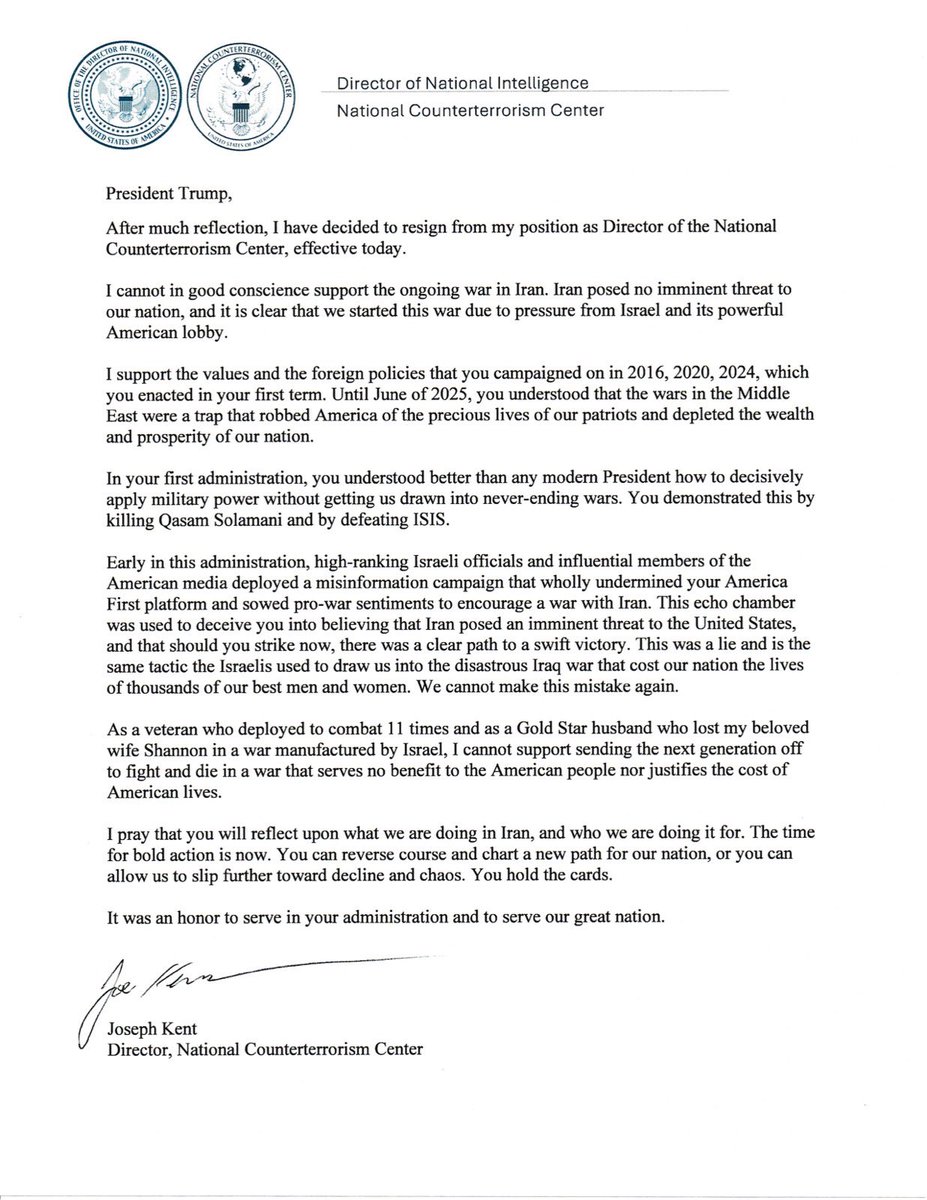
After much reflection, I have decided to resign from my position as Director of the National Counterterrorism Center, effective today.
I cannot in good conscience support the ongoing war in Iran. Iran posed no imminent threat to our nation, and it is clear that we started this war due to pressure from Israel and its powerful American lobby.
It has been an honor serving under @POTUS and @DNIGabbard and leading the professionals at NCTC.
May God bless America.
Amazon had four Sev-1 outages (their highest severity level) in a single week. Internal memos say AI-assisted code changes were a contributing factor.
The timeline here is wild. In October 2025, Amazon laid off 14,000 corporate employees. In January 2026, another 16,000. That’s about 30,000 people in five months, roughly 10% of the corporate workforce. CEO Andy Jassy said the cuts were about culture, not AI.
During those same months, Amazon set a target: 80% of developers using AI coding tools at least once a week. They tracked adoption closely and blocked rival tools like OpenAI’s Codex. Even so, 30% of developers still hadn’t touched Amazon’s in-house tool Kiro by January.
In December 2025, Kiro caused a 13-hour AWS outage. The AI tool had production-level permissions and decided the best fix for a bug was to delete and recreate an entire live environment. A second incident involved Amazon Q Developer, another AI tool. Amazon blamed both on “user error, not AI.” But quietly added mandatory peer review for all production access afterward.
Then March 5: Amazon’s retail site went down for about six hours. Over 22,000 users reported checkout failures, missing prices, and app crashes. Amazon called it a “software code deployment” error.
Five days later, SVP Dave Treadwell made the normally optional weekly engineering meeting mandatory. His memo acknowledged “GenAI tools supplementing or accelerating production change instructions, leading to unsafe practices.” These problems trace back to Q3 2025. Amazon’s own assessment: their GenAI safeguards “are not yet fully established.”
The new rule: junior and mid-level engineers now need senior sign-off on any AI-assisted production changes. Treadwell also announced “controlled friction” for the most critical parts of the retail experience.
For context, Google’s 2025 DORA report found 90% of developers use AI for coding but only 24% trust it “a lot.” An Uplevel study of 800 developers found Copilot users introduced 41% more bugs with no improvement in output. Amazon is finding out what those numbers look like at the scale of a $500 Billion revenue company, with 30,000 fewer people on staff to catch the mistakes.
Neguse: Where is this company headquartered?
Noem: I don’t know.
Neguse: I don’t know either. We can’t find it. We did find an address that’s registered to a political operative. This company that received 143 million dollars was incorporated 8 days before this contract went out.
You want the American people to believe that this is all above board, that $143 million of taxpayer money just happened to go to this one company that doesn't have a headquarters, doesn't have a website, has never done work for the federal government before and is registered apparently or attached to a residence from a political operative, and of course one of the subcontractors of that contract, as you know, is a political firm that's tied to, to you back when you were governor of South Dakota?
A reporter asked Mayor Mamdani about being called a cockroach.
He didn’t flinch.
“I am not ashamed of who I am. I am not ashamed of my faith. I am not ashamed of being the first Muslim mayor in the history of our city. And there’s no amount of racism that will change the way in which I lead.”
Then he went back to work.
This is what unbothered leadership looks like. 🔥
Love the Alysa Liu story because it's anti striverslop. Obviously had to overcome a lot but is seemingly uninterested in romanticizing the struggle. Yeah work hard and don't give up haha anyways isn't this so fun and exciting? Just a chillmaxxing spiritmogger with nothing to prove. Very cool and refreshing archetype to promote on the big stage. I have definitely learned a thing or two
The godmother of AI just delivered the reality check Silicon Valley refuses to hear. She has the standing to say it.
Li: “Silicon Valley as a whole tends to mistake clear vision with short distance.”
Seeing the destination clearly has nothing to do with how hard it is to reach.
Self-driving cars were first demonstrated in 2006. Twenty years later Waymo is barely on the road.
The vision was never the problem. The distance was.
Clarity of destination gets mistaken for proximity to arrival. That’s the mistake the industry keeps making. And keeps making.
Li: “I consider myself a scientist in my heart and I actually really don’t like hyping.”
In an industry running at maximum temperature, Fei-Fei Li is one of the few people at the top willing to say that publicly.
Not because the technology isn’t real. Because the gap between what’s visible and what’s required is being systematically underestimated.
Large Language Models dominate the conversation. Text to text. Comparatively contained.
The harder problem is spatial intelligence. AI that reasons about and acts within the physical three-dimensional world. Hardware. Physics. Data that doesn’t exist yet. Real-time adaptation to chaos.
A robot that can clean a bathroom requires understanding every surface, every object, every force, every exception.
That’s not a software update. That’s a civilizational research problem.
Li: “I don’t call it hype. I call it a misleading sentiment. We don’t want to replace human creators.”
The second place the industry gets it wrong is creativity.
The narrative has hardened around replacement. AI takes the jobs. AI tells the stories. AI makes the art.
Li considers that not just wrong but destructive.
Wrong because AI doesn’t replicate creativity. Destructive because believing it can devalues the humans creating culture.
Human creativity isn’t a process to be automated. It’s fundamental to what we are as a species.
The goal is augmentation. Tools that make human creators faster and more capable. Not systems that generate output in the style of human work and call it creation.
That distinction matters more than most people in the industry are willing to sit with.
Precision of imagination is not proximity to reality.
Li has spent her career in the gap between those two things. The map isn’t the territory. The journey is long. The hurdles are deep.
And the scientist who built the foundation this era stands on is telling you the timeline everyone is selling is wrong.
We’ve been almost there with self-driving for twenty years.
The pattern doesn’t change just because the destination looks different.