Dennis Small/EIR - VIDEO/INVITACION
¡Únete a la Mesa Redonda de Emergencia de EIR!
https://t.co/25RR5orDRD
Viernes 15 de mayo; 11:00 am (H/Este de EU)
Mira la Mesa Redonda de EIR en español por Youtube: https://t.co/OVT2blAFYh
LEE Invitación/ponentes: https://t.co/ACLcwMVly2
https://t.co/n6fsaiUODg
To the Governments of the United Nations: A Policy to Bring Peace and Development to Southwest Asia
--Help us get our Peace Plan on the agenda of the May 26 UN Security Council!
EIR Emergency Roundtable May 15, 11am Eastern Goto https://t.co/rqhXwwS5DW to watch Stop the insane Iran War before the Malthusian oligarchs get their wish: a global plunge into a Dark Age.
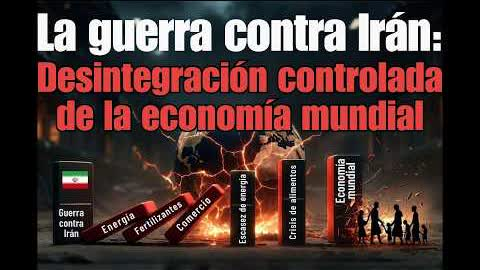
Mesa redonda de EIR, 15 de mayo:
“La guerra contra Irán y la ‘desintegración controlada’ de la economía mundial”
Hora: 11:00 am (H/Este de EU)
Interpretación al español
Zoom: https://t.co/1afVZFxRip
Youtube: https://t.co/OVT2blAFYh
Invitaci��n/ponentes: https://t.co/9uQDqgdXxY
Resumen Ejecutivo de EIR
"¡Abandonemos la geopolítica! Debemos tener la sabiduría para cambiar nuestros axiomas". Elijamos un nuevo camino basado en la sabiduría y el desarrollo.
LEE en este enlace el artículo completo:
https://t.co/ya5uPAy6l4
“Dump geopolitics!” It’s time to change the failed axioms driving conflict and choose a new path based on wisdom and development. Click this link to read the full article: https://t.co/hN7gpFRdRP
An Iranian-American activist confronted Reza Pahlavi during the POLITICO Security Summit for calling on the US and "Israel" to bomb Iran.
The activist called out Pahlavi, saying, "Where were you when our people were pulling their children out from under the rubble of the bombs you invited into our country?"
This is not the first incident where activists have confronted the son of the deposed Shah of Iran. Earlier in April, a protester in Berlin, Germany, threw paint at Pahlavi.
#US #IranWar #Iran #Germany
https://t.co/tPUOu8MNHz
The Lead
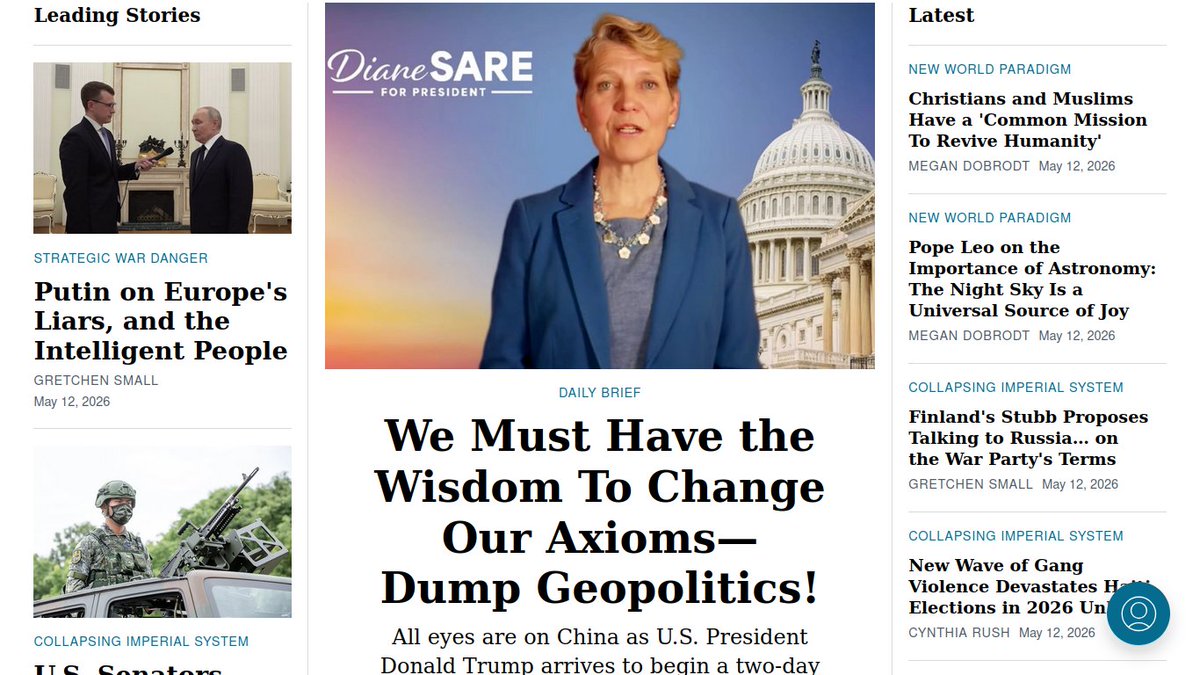
We Must Have the Wisdom To Change Our Axioms—Dump Geopolitics!
by Megan Dobrodt (EIRNS) — May. 12, 2026
All eyes are on China as U.S. President Donald Trump arrives to begin a two-day state visit which many are hoping will provide some stability in a world situation that grows more chaotic and dangerous by the day. With topics high on the agenda such as bilateral trade (Trump arrives with a high-level business delegation) and the conflict in Iran ("I think we’re going to have a long talk about it,” the U.S. President said), and with Trump continuing to praise Xi Jinping as “an amazing man” with whom he has an excellent relationship, there is reason to hope that head-of-state diplomacy can introduce something new into the global dynamic—and not a moment too soon.
As EIR has estimated, the real financial cost for the world of the unprovoked U.S.-Israeli aggression against Iran is a staggering $4 trillion in just the first 60 days, as seen in total military expenditures, physical damage to the region, and lost global output due largely to the ongoing closure of the Strait of Hormuz. The real physical economic cost is orders of magnitude more, when one takes into account the devastation that is about to hit, given the shortage of fuels, fertilizers, chemical feedstock, and pharmaceutical supplies.
This is not an unintended consequence of the war policy, but rather an intentional, Malthusian (un)controlled disintegration of the global economy on the part of the international financial establishment centered in the City of London and Wall Street, which is rapidly losing its grip over world affairs. Better to reign in Hell, than serve in Heav’n?
“The world is moving in many different directions simultaneously,” Helga Zepp-LaRouche observed in a discussion with colleagues on May 11, “and that reflects a real lack of clarity on the side of several segments of the establishment in different parts of the world, of how to assess the failure of their policies, how to readjust, how to develop new options. And since most of these establishment figures have not become smarter since they initiated the policies which just failed, one cannot assume that the outcome of such running around will be any better.”
That view is only reinforced by the seeming shift in attitude of several European leaders who are coming to accept the necessity of talking with Russian President Vladimir Putin—a change in tactic rather than strategic goal. “They … started cranking up the confrontation with Russia,” Putin recounted at a May 9 press conference, “which is continuing to this day. I believe that this business is coming to an end, but nonetheless, it is a serious thing. The question is, why they are doing this? First, they expected a ‘crushing defeat’ of Russia…. It did not work out. And then they got stuck in that groove, and now they cannot get out of it.”
Einstein famously said that the definition of insanity is “doing the same thing over and over and expecting different results”; we have reached a moment in human history when it is only a profound change in the behavior of society, a fundamental shift in the axioms underlying the world system, that can prevent a collapse. Many nations in the Global Majority are shifting in that direction in their rejection of geopolitics. An editorial in Global Times on the eve of Trump’s visit to Beijing looks toward U.S.-China cooperation as a keystone in such progress for humanity: “True wisdom between major powers lies not in treating the other as an adversary that must be defeated, but in placing differences within the broader framework of coexistence among civilizations, keeping competition rational and manageable, and turning cooperation into outcomes that benefit the world.”
The urgent next step in stabilizing both the economic and security situations in the world is for a new security and development architecture for the world, one which rejects the axioms of geopolitics and takes into account the interests of all countries, to be put on the agenda of nations, as Helga Zepp-LaRouche proposed in 2022.
The West must come onboard, and this will not be led by the failures currently occupying elected (and non-elected) office in those nations. A movement of citizens must decide to lead and demand that their nations join the rest of humanity.
In the United States, LaRouche Independent candidates Diane Sare and Jose Vega are rallying those potential leaders around the needed solutions, as are collaborators around the world. The next opportunity to join them will be Friday, May 15, at 11:00 a.m. ET, as Helga Zepp-LaRouche convenes an EIR Emergency Roundtable, “The Iran War and the ‘Controlled Disintegration’ of the World Economy.” Join them, and organize everyone you know to be there.
https://t.co/fFPMtEziWe
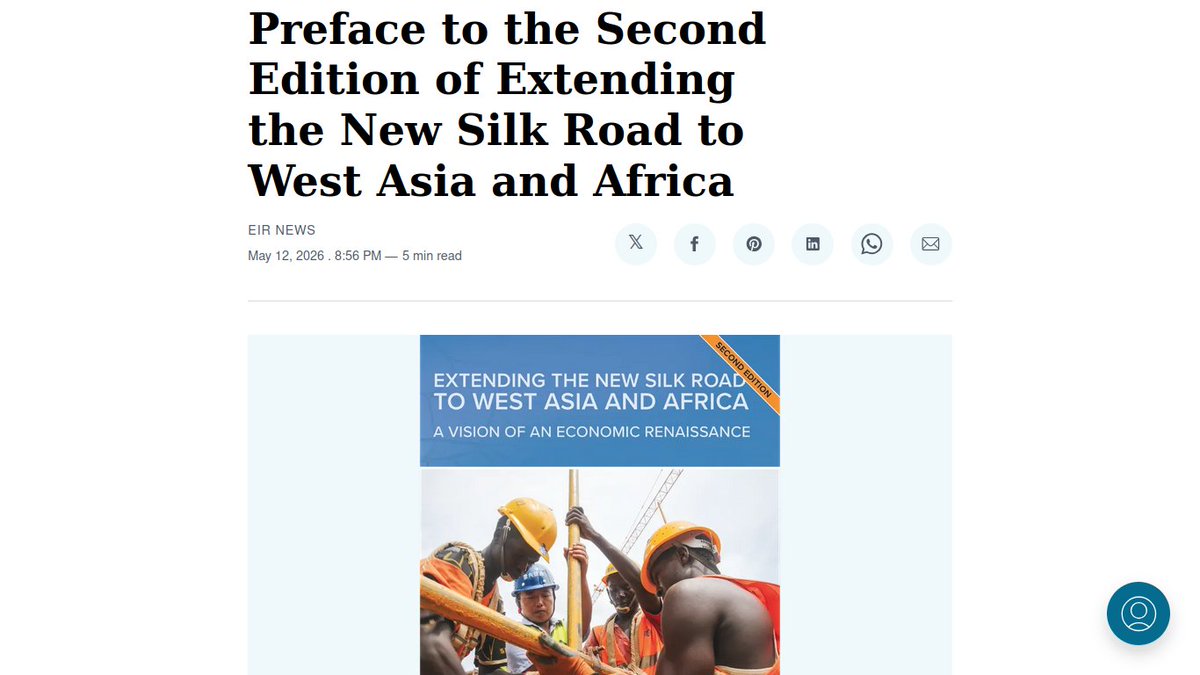
The following preface to the 2026 second edition of Hussein Askary and Jason Ross’s report “Extending the New Silk Road to West Asia and Africa” was written in November 2025 by Li Xing, who serves as Yunshan Leading Scholar, Guangdong Institute for International Strategies, Director of the European Research Center, Guangdong University of Foreign Studies and as an Adjunct Professor at Aalborg University in Denmark.
The report is available in English in paperback and kindle formats, and also in paperback in Chinese.
Extending the New Silk Road to West Asia and Africa: A Vision of an Economic Renaissance, co-authored by Hussein Askary and Jason Ross, is a wide-ranging and ambitious study of global politics and economics that seeks to rethink the path of development in the Global South. Originally published in 2017 as a special report by the Schiller Institute and comprehensively revised in its 2025–2026 edition, the report argues that lasting peace and stability in West Asia and Africa cannot be achieved through diplomacy or aid alone. True progress, the authors contend, must rest on a material-economic transformation driven by infrastructure, science, and industrialization. The Belt and Road Initiative (BRI), launched by China in 2013, is presented as the most inclusive framework for realizing such a grand transformation. At the same time, the authors urge Europe and the United States to abandon zero-sum geopolitical thinking and to participate as equal partners in building this new “win-win” paradigm.
The introduction situates the work within what President Xi Jinping has described as “a great change unseen in a century.” The authors believe that the world is undergoing a transition from a unipolar order characterized by financial speculation and conflict to a multipolar system based on real economic development. They identify two key forces driving this shift: the expansion of the BRICS mechanism into “BRICS Plus,” incorporating Egypt, Ethiopia, Iran, the UAE, and Indonesia; and the consolidation of the BRI, which by 2025 has attracted 152 participating countries. These developments, they argue, mark the emergence of a new model of multilateral cooperation centered on connectivity, industrial capacity, and mutual benefit. In contrast, the debt-ridden and deindustrialized transatlantic system, trapped in perpetual conflict, has lost its moral and economic authority to lead. The authors therefore call for a new global architecture for security and development—one that achieves East–West integration through shared growth rather than confrontation.
Askary and Ross emphasize that the special report serves as a methodological guide for creating a new economic order. Drawing on the “physical economy” theory of the late economist Lyndon LaRouche, they argue that genuine progress cannot be measured by financial gains alone but by the capacity to apply science and technology to enhance labor productivity and creative potential. Within this framework, infrastructure is not a market commodity but the physical platform upon which civilization rests. The authors criticize neoliberal dependence on private financing and public–private partnerships, asserting that nations must reclaim the sovereign power to create credit and direct it toward productive, long-term investment. Only by reconnecting economics with moral purpose—placing human creativity and dignity at its core—can the world break free from its current cycle of crisis.
A major portion of the report dismantles what the authors call the “myth of small and beautiful.” They criticize the ideology, promoted by Western economists such as E. F. Schumacher and institutionalized through aid agencies, that developing nations should limit themselves to “small projects” and “appropriate technologies.” They trace this doctrine to Cold War–era population control policies promoted by figures like Henry Kissinger, which sought to constrain industrialization in the Global South under the banner of sustainability. In their view, such ideas condemned entire continents to underdevelopment. By contrast, they argue that only large-scale, technology-intensive projects—such as dams, railways, nuclear power plants, and transcontinental water systems—can achieve the productivity leap necessary to eradicate poverty. Projects like the Grand Inga hydroelectric plants, the Transaqua water-transfer scheme, and the Pan-African high-speed rail network are presented as examples matching Africa’s true scale and aspirations.
The 2025 edition devotes much attention to Africa’s recent economic breakthroughs. Ethiopia’s industrial parks and the nearly completed 6,000-megawatt Grand Ethiopian Renaissance Dam demonstrate how infrastructure can drive industrialization. Egypt’s massive highway and high-speed rail systems, its new administrative capital, and Africa’s first major nuclear power plant at Dabaa provide another model of modernization. Tanzania’s Julius Nyerere Hydropower Project on the Rufiji River—built by Egyptian companies using Chinese technology—has doubled the nation’s energy capacity and symbolizes the rise of South–South cooperation independent of Western oversight. Collectively, these examples reveal an Africa no longer content to remain a supplier of raw materials but determined to build integrated value chains and manufacturing capacities in partnership with China and other BRICS nations.
In discussing West Asia, the authors describe the region as caught between two competing paradigms: the divisive logic of “divide and rule,” perpetuated by Western intervention and endless wars, and the cooperative vision of “unite and prosper” embodied in the BRI. They highlight the 2023 China-brokered rapprochement between Saudi Arabia and Iran, the China–Arab States Summit in Riyadh in 2022, and the growing number of renminbi-based trade, technology, and energy projects across the Gulf, as evidence that economic interdependence can succeed where political coercion fails. In contrast, Western initiatives such as the India–Middle East–Europe Corridor are portrayed as geopolitical maneuvers aimed at isolating China and obstructing regional integration.
The special report’s core analytical chapters propose a new approach to financing development. The authors call for establishing regional infrastructure banks in West Asia and Africa, supported by sovereign credit creation rather than private markets. Inspired by Alexander Hamilton’s national banking model and the 2019 China–Iraq “oil-for-reconstruction” agreement, they argue that resource-backed, long-term credit mechanisms are more sustainable. They reject the “debt-trap” narrative as a politically motivated myth and assert that properly structured financing fosters real productive capacity and self-sustaining growth.
The latter part of the report translates these ideas into sectoral strategies—continental railway integration linking ports, resource belts, and industrial zones; comprehensive water management through river-basin cooperation and the Transaqua corridor; universal electrification powered by nuclear energy; and agricultural modernization to turn Africa into a net food exporter. The authors even extend their vision into outer space, suggesting that participation in space technology and exploration can catalyze scientific education and innovation, representing the highest expression of human creativity.
Throughout the work runs a strong moral and philosophical undercurrent aimed at fostering dialogue and coexistence among civilizations. The authors argue that the BRI’s principle of “consultation, co-construction, and sharing” aligns with the ethical teachings of Judaism, Christianity, and Islam, and that the concept of “win-win cooperation,” although part of Confucian teaching, is not a Chinese invention but a universal moral ideal. They endorse the Schiller Institute’s proposal for “triangular cooperation,” encouraging the United States and Europe to work with China and Russia on development projects in third countries, thereby overcoming ideological divisions and reviving the humanist spirit of the Renaissance and the American Revolution.
In sum, Extending the New Silk Road to West Asia and Africa serves as both a grand blueprint and a moral declaration for a post-imperial world order. Its core message is that economic development is the most effective path to peace, and that infrastructure is the foundation of human progress. By linking the deserts of the Middle East and the savannas of Africa through railways, energy grids, and knowledge networks, the authors envision a future that transcends geography and ideology. While the work bears an idealistic tone and reflects the influence of LaRouchean economic thought, it nevertheless articulates an ambitious vision of intercontinental economic revival grounded in science, culture, and cooperation.
Placed within the growing body of BRI and Global South literature, this special report stands out for its intellectual ambition and unconventional analytical framework. Unlike most studies that assess the BRI through economic metrics, geopolitical competition, or debt sustainability, it advances a holistic “physical economy” perspective that measures real progress through productivity, technological advancement, and energy density rather than financial indicators. This approach redefines development as a fusion of science and moral purpose, emphasizing infrastructure as the physical foundation of civilization.
As of today, the Vega For Congress campaign will complete its petitioning to secure my appearance on the ballot as an independent candidate for Congress in November. This means that I, Jose Vega, am now on the ballot as a candidate for the June 23rd Democratic Party primary nomination, and that, regardless of that outcome, I will continue my campaign against the Epstein Class and its replacement of the Democratic and Republican Parties with the War Party.
In order to out-flank an Epstein apparatus that is backed by millions of dollars from the War Party, we need to fight back by being as visible as possible in the streets.
Immediately, our campaign intends to produce 500 shirts, as well as hats, buttons, and stickers. That’s at least a $10,000 cost just among all those items! We don’t have Ritchie Torres’ AIPAC money, so our people need to become “living billboards,” walking through the district. On top of that, we will produce our first in-depth campaign pamphlet that will detail not our policy proposals and programs, but the method of thinking by means of which any thinking citizen can organize around these ideas to make them come to life!
In order to transition from this final phase of our petitioning and qualifying for ballot status to the final six weeks now left in the primary campaign, we need a total of $25,000 over this next week:
—$7,500 for the mass printing of these pamphlets to get into the hands of every Bronx resident we can
—$5,000 for our first 500 shirts to give to our supporters in the district and start to increase our visibility!
—$12,000 for final petition collection and preparation, related security and legal expenses, and day-to-day operations (we still use a printer, ok?)
Can you help us today?
Join the EIR Emergency Roundtable this Friday May 15 at 11am US Eastern. Goto https://t.co/oviTSm5BW6 to join. The intention of the Iran War is the controlled disintegration of the world economy, to drag us into a Dark Age. It's time for solutions. #GlobalEconomy
https://t.co/Iv4xUZBsbE
Join Helga Zepp-LaRouche in her live dialogue and discuss the issues and solutions that move the world and its people. Send your questions & comments to [email protected].
Mesa Redonda de EIR
2 de marzo - 8:am (H/Este de Estados Unidos)
Movimiento de Ciudadanos del Mundo:
Epstein y la depravación sin límites de las “élites”. Necesitamos con urgencia un Renacimiento Cultural!
Por Zoom en español y otros idiomas: https://t.co/XEICAORjBR
This is what "Dollarization" is--Under the rhetoric of Trump's America 1st, the City of London-Wall Street Offshore $ Bubble is being imposed on the world in a desperate attempt to disrupt alternatives for the benefit of all.