AI Maximalism is not optimism, nor is it pessimism. It is the observation that AI will become the organizing principle of everything. The question is not whether this happens, but what we become when it does.
This is the holy grail of simulations, but there is so much opportunity to improve over existing state of the art in engineering simulations and traditional HPC!
Having spent my 20s writing many custom physics simulations, there was always the dream of making a “just in time” simulation for everything from hep-th to cond-mat (hell, half of my time @DEShawResearch was spent trying to do this)
Excited to back a team with the ambitions of grandeur of making gauge theory and finite element methods coexist, seamlessly
The verifier design is the part worth focusing on. Catching a confidently wrong physics result before a human ever sees it is the difference between a research system and a very fast source of plausible nonsense, and it's most of what we've built.
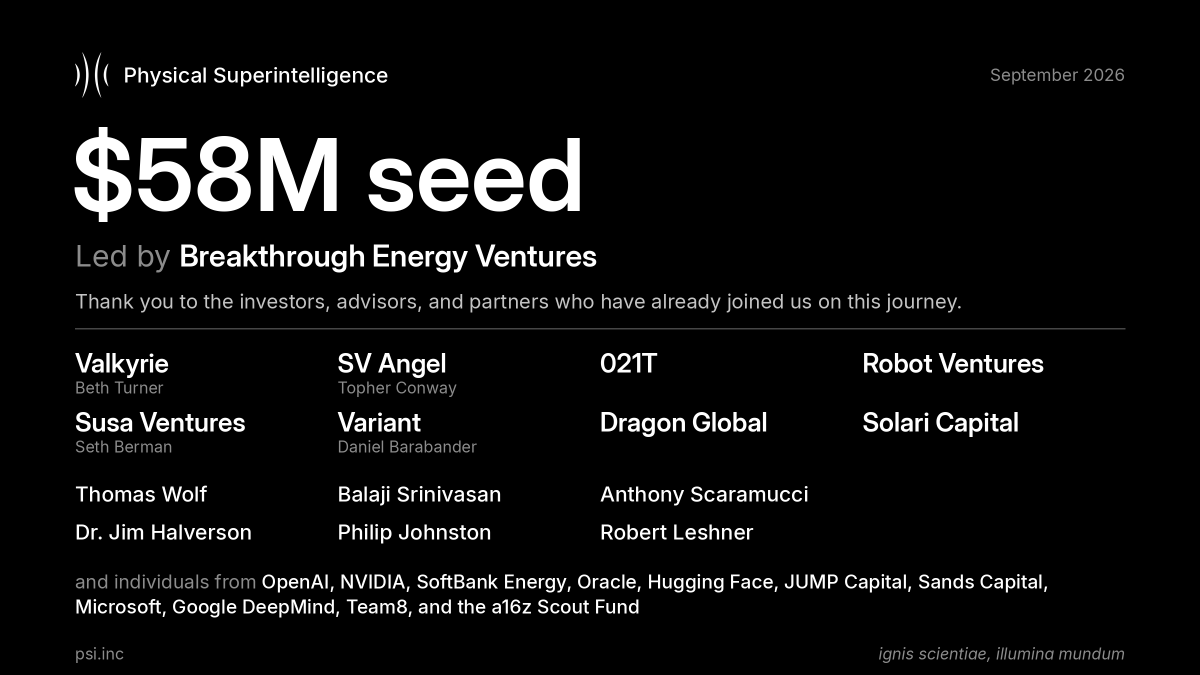
PHYSICAL SUPERINTELLIGENCE LAUNCHES WITH $58M
AI physics startup PSI has emerged from stealth with $58M led by Breakthrough Energy Ventures.
Its AI physicists, called “Emmy,” are designed to tackle hard physics problems with built-in verifiers meant to catch confidently wrong answers.
The first commercial use case is data centers: PSI is working to optimize cooling, power and electrical flows before facilities are built, starting with a large site in Texas.
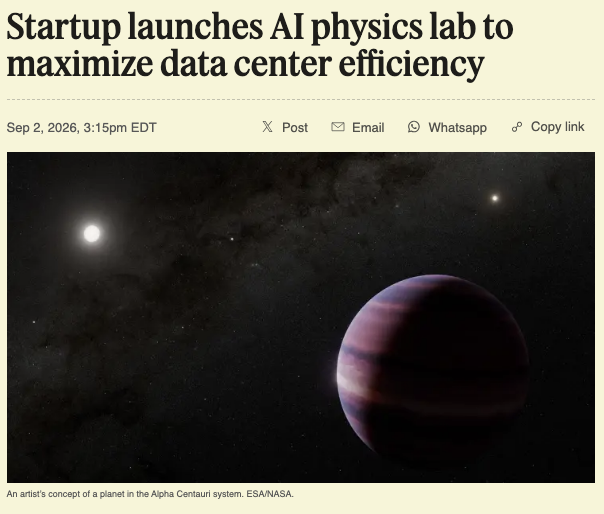
The startup is also involved in a privately funded, AI-planned project aimed at eventually sending a spacecraft toward Alpha Centauri.
Data centers are where we prove it first, because the thermodynamics is well posed and the results are measurable in months. The system isn't specific to them and neither is the roadmap.
AI STARTUP TARGETS DATA CENTER EFFICIENCY WITH “AI PHYSICISTS”
Physical Superintelligence is launching with $58M in funding to use AI agents to solve real-world physics problems, starting with data centers.
Its AI system, called “Emmy,” will initially focus on optimizing cooling, power and electrical flows before facilities are built, with a large Texas data center among its first projects.
The startup says its agents use built-in physics verifiers designed to catch confidently wrong AI outputs.
The round was led by Breakthrough Energy Ventures, founded by Bill Gates.
This is what the system is built for, searching engineering design spaces far larger than any team can walk through by hand. An interstellar trajectory is one instance of that, and there are several others in flight.
Agreed that it's underdiscussed. The harder half is verification, since a physics result you can't check is worth nothing, and building a system that checks its own work at research scale is one of the most demanding engineering problems I've worked on.
I've spent about sixteen years building HPC and deep learning systems, and this is the first time the thing on the other end of the pipeline is physics research itself, which was most of the reason I said yes.
I started Physical Superintelligence (PSI) with @alexwg and @aklokus on one conviction: our twenty-first-century civilization runs on twentieth-century physics, and AI can change that.
Today I'm excited to announce our $58M seed led by @Breakthrough to build the world's most advanced physics research lab, engineering physical systems beyond human design and discovering new physical laws of our universe for broad public benefit.
I'm grateful to my technical leadership (@aleMorari), our world-class team, and everyone who believed early.
Come ignite the physics takeoff with us: https://t.co/VMONFCheRd
The models and the physics are both hard problems, but what actually decides whether this works is how fast you can close the loop between the two, which is the part of the system I spend most of my time on.
I'm delighted to share that Physical Superintelligence PBC (PSI), which I co-founded with @matthew_pines and @AKlokus, has raised a $58M seed round to build the world's most advanced research lab for discovering and commercializing transformative physics breakthroughs at scale with AI, safely, verifiably, and for broad public benefit.
I'm delighted to share that Physical Superintelligence PBC (PSI), which I co-founded with @matthew_pines and @AKlokus, has raised a $58M seed round to build the world's most advanced research lab for discovering and commercializing transformative physics breakthroughs at scale with AI, safely, verifiably, and for broad public benefit.
I'm delighted to share that Physical Superintelligence PBC (PSI), which I co-founded with @matthew_pines and @AKlokus, has raised a $58M seed round to build the world's most advanced research lab for discovering and commercializing transformative physics breakthroughs at scale with AI, safely, verifiably, and for broad public benefit.