the homebrew cybernetics club of nyc™️ is convening for dinner Nov 4th
will be discussing the Ant S-1, future of the labs as public co's, economics of AGI, and more!
lineup includes an amazing set of folks from the labs, leading ai startups, simulation / prediction co's, ai rollups, and more
we've saved a few spots for the timeline - dm if interested
cc: @hypersoren@PossibltyResult@dbarabander@ishaans22
Claude Science looks to me like a bid to own the economic version control system for life sciences. The logical endgame is Anthropic financing hundreds of drug programs in parallel for the biopharmas that leverage its harness. In return, Anthropic will ask for clinical data rights and use the data generated to 1) improve their ability to finance the next program and 2) eventually feed a God Model that allows them to create the holy grail: an “AI drug factory”.
You can think of a drug program as an exercise in making a sequence of complex decisions under uncertainty: specifically, decisions around how to allocate incremental experimental capital to maximize expected value across safety, efficacy, commercialization, etc.
A growing share of that experimental capital will be compute-mediated over time (e.g, Claude generated roughly 35,000 antibody designs in a month for Divergence Labs). But the most consequential increments will still go toward compiling therapeutic candidates in (very scarce and slow) human biological computers, which is where both the cost per bit and the consequentiality per bit of information are highest.
Whoever owns the system that originates and integrates the most information upstream and downstream of those allocation decisions (in this case Anthropic) becomes the best suited to start making them (or at least gains a differentiated understanding of the relevant signals necessary to make those decisions well).
Some examples of the experimental capital allocation decisions they are starting to help generate / facilitate and version:
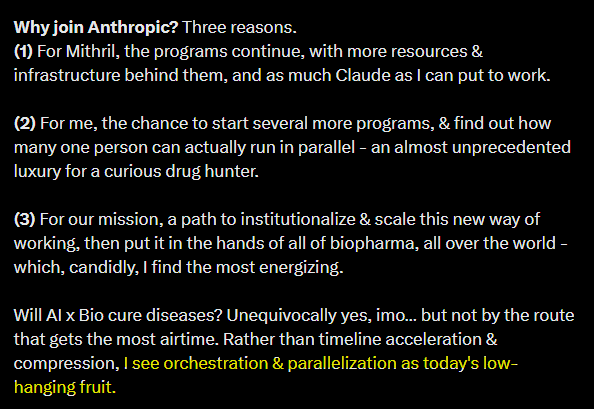
1) Most importantly: Acquiring Mithril, where Cody Tranbarger (@prof_oak_) is massively levered by a swarm of agents that help him identify, evaluate, and ultimately select a much larger # of drug programs to run in parallel than is typically possible for a single drug hunter. He calls this a “Pipeline-in-a-Person”
2) Bristol Myers using Claude Science to analyze their proprietary data (guessing preclinical and clinical) to create optimal clinical study plans and weigh the study’s chance of success. If that program is actually executed, they should be able to calibrate how well those predictions turned out and in what sense they were right or wrong.
3) The Column Group spinning up Pleiades: a biopharma company with a mandate to “run many more—and more complex—drug programs than is usual for a small team.” Similar to the Formation Bio’s of the world. They are using Claude to evaluate target-disease pairs and find non-obvious, potentially valuable combinations.
I believe Anthropic is running their own drug programs not to compete with pharma directly (yet), but instead to generate the learning signals that would allow them to become the single largest (and potentially best calibrated) underwriter / financier of drug programs. These financed programs would eventually create the data distributions necessary for them to create an AI drug factory (and start competing with pharma).
Specifically, I could see Anthropic creating the first real instantiation of @AndrewWLo’s elegant Megafund model. TLDR on Megafund (proposed in Nature Biotechnology 14 years ago): any single drug program is a terrible bet on its own, but if one entity funds a large enough portfolio of them, the odds that a few hit become predictable enough to finance the whole thing with debt. Lo et al. proposed doing this by issuing “research-backed obligations” (bonds collateralized by the portfolio and its IP) alongside an equity tranche. Ofc, the pool of available capital that buys debt is far larger than the pool that buys biotech equity, therefore this would unlock capital from pensions, insurers, endowments, etc. Their simulations of $5–15 billion oncology portfolios estimated average annual returns of 8.9–11.4% for the equity and IMPORTANTLY 5–8% for the RBOs. This would be a fixed-income-like return that many new sources of capital would get excited about.
For some reason this strategy never took off, and part of the reason is that it’s pretty hard to find a large basket of drug programs that’s sufficiently uncorrelated. But I also think it’s because there wasn’t really an incentive for any well capitalized player to push through all the schleps and actually unlock the capital sources to this end. I think Anthropic has that incentive.
They have a structurally higher willingness to finance a drug program / make this structure real, because, by doing so, they would capture two return streams: 1) the potential economics of a blockbuster drug and 2) the widely amortizable value of what the associated series of experimental capital allocation decisions teach its models!
In return for providing biopharmas cheap financing, Anthropic will ask for clinical data rights (including rights to learn from decision histories, negative results, protocols, etc.). Just selling tokens / the harness doesn’t give them the right to learn all of these things, but providing financing likely would.
This would allow them to make more well-calibrated experimental capital allocation decisions over time and eventually feed the God Model that “cures all disease.”
This would all also be quite charismatic: your retirement money funds the experiments that might let you enjoy a much longer retirement!
The sky is the limit.... well... LET ME CHALLENGE THAT!
@LATAMAirlines & @TakenosApp
We have made history. The stablecoin industry is taking the places it deserves and we have been working for. This is not a win for @TakenosApp, it is for the stablecoin industry that is changing the way the world works.
Now, more than 5.000 crew members of LATAM Airlines will be using our app to recieve, send and move their money around the region.
Thanks to our team, but also for the people that invested a lot of money to make this posible. @reganbozman@dbarabander@lsukernik@TravisScher@NorthIslandVC@variantfund@lattice_fund@hi_Reverie and every investor that has been with us from scratch.
Today Physical Superintelligence PBC is announcing solutions to five long-standing problems in quantum information theory.
https://t.co/LjmLz0mCtF
Thread 👇
a cold comment on the @usv blog got me a reply, a meeting, a seed investment, and an incredible thought partnership thats lasted over a decade.
so grateful to capture that in this talk with @nickgrossmanon, on the long arc of a single idea, and why we're still investing in it @variantfund
It's feeling like we're starting to overfit to this loss target - but at the same time we're now seeing techniques surface here that none of us in Pluralis had thought of. Latest record is a >30x speedup over vanilla Subspace networks.
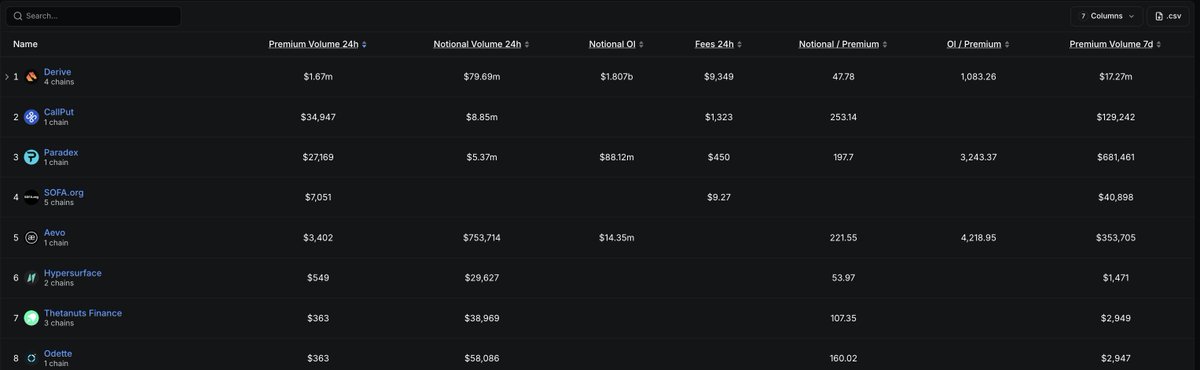
Over the last 30 days, Derive has remained over 90% of the onchain options market. In that same time frame, we’ve done about 5% of Deribit’s options volumes, up from 0.1% a year ago.
It’s difficult to build momentum in this category because of the uniquely strong network effects around options markets. Users and market makers hold positions and collateral on exchange for the duration of an option, often many months. The difficulty and cost of integration are a liquidity provider is an order of magnitude higher than perps. Options markets are also the last vertical to mature in any asset class.
Onchain has finally broken the dam - and Derive, alongside all of our builders and partners, has a chance to redefine the options category, first in crypto, and then beyond.
The tailwinds are enormous, and still underappreciated by most people I speak with.
1. Bringing options liquidity onchain unlocks more functionality than any other vertical: programmable, composable building blocks for precise, tailored yield generation, hedging, and speculative trades. One click hedges embedded in every brokerage and fintech, yield generation strategies with verifiable backtests and transparent risk, on any asset, new social trading experiences built using the kinds of trades only options can support.
2. AI for UX: the biggest barrier to entry to trading options is understanding. 2026 has seen a step function change in how models reason about options. This has yet to filter through to UX, but is coming. People shouldn’t trade options if they don’t understand them. But - given they want to express an opinion about the market - they should be able to find the best way to translate that into a trade. Options are often the best way to do so.
3. AI for agentic trading: options give you thousands of ways to express a view across strikes, expiries and structures. For many traders this is overwhelming, but for agents, it’s a much more useful set of choices. My wager is that agents will prefer specificity and precision when executing trades: not just whether an asset goes up or down, but how far, by when, and with how much risk. Options are the answer.
These tailwinds are strengthening just as our liquidity hits an inflection point. Big integrations take time to come to fruition, but we’re seeing the results month by month, with many more in the pipeline. At the same time, we’ve completed our biggest infrastructure upgrade in 3 years, taking what was already a leading onchain product into what I believe is the best options infrastructure anywhere.
We have so much more work to do, and will be constantly taking feedback, iterating on the product, and ensuring that every dollar of liquidity that onboards to Derive is earned. But we really are only at the dawn of the last major trading vertical to move onchain, and in my opinion, it will be the largest.
Every company is becoming a Network Effect company
The model "software factory" looks like end-to-end agentic development directed autonomously by user feedback. Your ability to compound is determined by the number and frequency of users communicating product feedback (via email, x, fax...)
As AI makes execution cheaper, we believe that a company’s edge will come from human judgment (which makes hiring the right humans more consequential than ever.)
Proud to be backing the https://t.co/F37h3ayL4H team, which is putting a dedicated talent team within reach of every founder.
Delighted to (somewhat belatedly) announce our $3.3 million raise to help companies find, engage and hire better candidates faster.
Thanks @ycombinator for the start and @variantfund for accelerating the journey ahead!
In my initial, very amateur foray into robotics, one thing that’s helped me make sense of the space is grouping by types of data used for training. Here’s how I’ve been thinking about them:
1. Video footage is cheap, but its value to robots plateaus quickly, since (1) human hands don’t map onto robot hands and (2) it doesn’t capture metrics that are invisible to cameras, like grip force. Generating data synthetically is also ineffective, since the sim2real gap means it’s incredibly challenging to reproduce real-world physics closely enough.
2. Teleoperation is probably the quickest way to bootstrap and get robots in the field for data collection, but it’s also incredibly expensive, as you’re constrained by the number of robots you have, skilled operators that can control them, and site partnerships you have to deploy them.
3. This leaves tactile methods of data collection (like handheld rigs and wuji gloves). Attempts here are interesting but have thus far mainly involved companies paying someone to wear these specifically for data collection rather than incorporating these devices into everyday worker routines (either because they’re going after household deployment or because the devices used are too obstructive to deploy in everyday work.)
Ep. 210: The Law of AI Distillation
What it is, why Anthropic considers it illicit and how the decision in a web scraping case (involving @X) could guide what comes next.
Featuring @dbarabander, @sabina_beleuz and @PossibltyResult.