Senior Lecturer in Economics at Hertfordshire Business School, UK. Interested in political economy, especially of water utilities in developing countries.
How to engineer a $1.25 Trillion Mirage
More often than not, share prices are rigged, which is why they are a dreadful predictor of profitability even on average, and why they have become the primary instrument for transferring wealth upwards. The recent SpaceX-xAI merger tells much of this sorry tale.
A financial spectacle greeted with celebratory yelps from the usual quarters, the SpaceX-xAI merger is a sight for sore eyes. More accurately, it is a sight for eyes still sore from what they witnessed 25 or so years ago, when Wall Street’s perfection of the dark art of corporate mergers sent phoney valuations into the stratosphere, before they crashed back to Earth. As Elon Musk cashes in, we are left staring at a perennial flaw of modern capitalism: a market forever eager to buy its own illusions.
Like all large-scale swindles, this one comes complete with a pseudo-scientific cloak: the touching faith that a company’s share price is the best indicator of its underlying value – a rational predictor of its future wealth, health, and profitability. The fact that the creative calculus behind the $1.25 trillion valuation of SpaceX-xAI went unchallenged can be explained in two words: motivated irrationality.
There is little doubt about motivation, given the millions to be made by the many financiers going along with it. As for the valuation’s irrationality, it becomes transparent after a closer look at the similarities with the fraudulent arithmetic which once propelled the AOL-Time Warner and Daimler-Chrysler mergers.
But first the broader point needs to be emphasized: more often than not, share prices are rigged. That is why they are a dreadful predictor of profitability even on average, and why they have become the primary instrument for transferring wealth upwards, while disguising systemic rot as the miracle of the market. The SpaceX-xAI merger tells much of this sorry tale. The practice of share buybacks tells the rest.
Let’s begin with the logic behind Musk’s stupendous merger, an echo of its precursors in the late 1990s and early 2000s. To see how the thinly disguised fraud works, consider two widget producers: Goodwidget, an old, boring firm, with a solid track record, and AIwidget, a trendy upstart. Goodwidget, a 30-year-old company with annual earnings (E) of $5 billion and an annual growth rate of 10%, has a $50 billion capitalization (K), implying a prudent 10:1 capitalization-to-earnings (K/E) ratio. AIwidget, by contrast, has been around for about a year, during which it earned $2 billion. Yet, based on frothy projections of its capacity to tap into an AI-empowered future, its capitalization is $100 billion, yielding a dizzying 50:1 K/E ratio.
A rational person might see Goodwidget as the safer bet. But Wall Street sees things differently. A reasonable valuation of the merged entity would simply add together the two capitalizations: $50 billion + $100 billion = $150 billion. Too timid! For Wall Street, the name of the game is multiplication, not simple addition. So, instead, they add up the two companies’ earnings ($5 billion + $2 billion = $7 billion) and then multiply the total by the higher K/E ratio – that of the frothy AIwidget.
The new company’s capitalization soars by a cool $200 billion to $350 billion (50:1 x $7 billion). The merged company, visited by the financial tooth fairy, rides the tsunami of hype that catapulted AIwidget’s market value just before the merger.
Why Wall Street’s moneymen engineer this is obvious: their fees and commissions are derived from the final fabulous figure. But why do investors turn a blind eye? The reason is always the same: what matters is not whether they believe the phoney arithmetic, but that they believe enough investors believe that many investors believe that enough investors will turn a blind eye to specious math.
The fact that these mergers eventually crash and burn (the fate of Time Warner and Chrysler) offers no evidence that the market “gets it right on average.” It proves that prices can be wrong for a very long time, until the music stops and a great many people lose a great deal of money – before the rigging begins anew.
And then there are the share buybacks that support rigged prices between booms and busts. Legalized in 1982, after being wisely banned by US President Franklin Roosevelt’s New Dealers in 1934, buybacks are dressed in the benign language of “returning value to shareholders.” The official story – that they are just like dividends – is an intellectual fraud. Yes, both enrich shareholders – and there the similarity ends.
Think of a company as an eight-slice pizza. A dividend is an extra sliver of pizza for every slice-holder; you get a tangible benefit, but your ownership stake (your slice) remains the same. You also pay tax on the new sliver immediately. A buyback, by contrast, is the equivalent of the company buying and destroying two of the eight slices, so that now you own one-sixth of the pie. You don’t have to pay taxes until you sell, but you can benefit from the type of fraudulent merger discussed above, based on artificially boosted valuations.
That is the crucial difference. A rising dividend signals management’s confidence in future profits from real growth, and it comes with a rational constraint: if the dividend is too high, investors may fear the company is starving its future, and the share price may fall. A buyback signals no such thing. It is a financial engineering trick to inflate the share price. It ransacks the company’s cash pile not to build, but to create a tax-deferred, compounding illusion of value.
The New Dealers outlawed buybacks because they knew a tool for manipulation and looting when they saw one. And that is why the kleptocracy that rose on the coattails of Margaret Thatcher and Ronald Reagan pressed to allow the practice. Between the alchemy of mega-mergers, the price-pumping of buybacks, and the ocean of cheap central-bank money that lubricated it all after the 2008 financial crisis, the notion that share prices reflect true value has become a trick played on everyone with no stake in mirages like Musk’s $1.25 trillion fantasy.
https://t.co/s66Lqnf0O0
Proactive landscape resilience => reactive urban upgrades
Kigali’s wetland parks: how cities work with nature to manage floods and create economic opportunities.
https://t.co/rhV1Y9WEzq
@REMA_Rwanda with @theGEF@GreenFundRw@KfW_FZ_int@Denmarkdotdk
BREAKING:
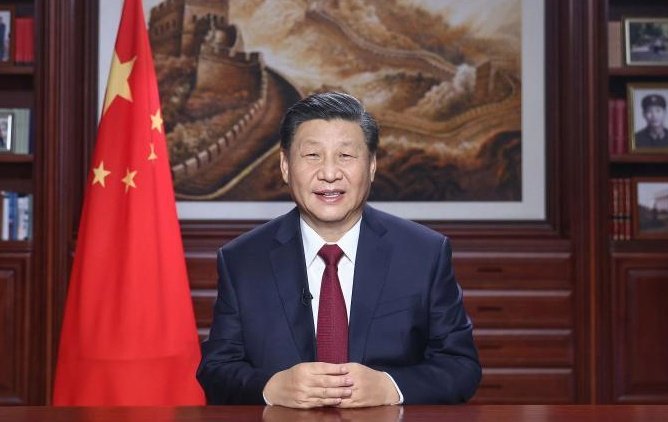
China has announced it will remove all tariffs on goods imported from the 53 African countries it has diplomatic relations with, allowing those products to enter China without import taxes, and the policy will take effect on May 2026.
“Capitalism also locks us into never-ending cycles of imperialist violence. Capital accumulation in advanced economies relies on massive inputs of cheap labour and nature from the global south. To maintain this arrangement, capital uses every tool at its disposal – debt, sanctions, coups and even outright military invasion to keep southern economies subordinate.” https://t.co/Rw55fLsund
Capitalism cares about our species’ prospects as much as a wolf cares about a lamb’s. But democratise our economy and a better world is within our grasp | Jason Hickel and Yanis Varoufakis https://t.co/NWtpEWNRsn
The idea that developing countries can skip industrialization — and instead develop based on services — is fundamentally misguided.
Except for very small countries, *every* country that has transformed its economy from low- to high-income has done so via manufacturing.
🧵Attention UK #Creators!
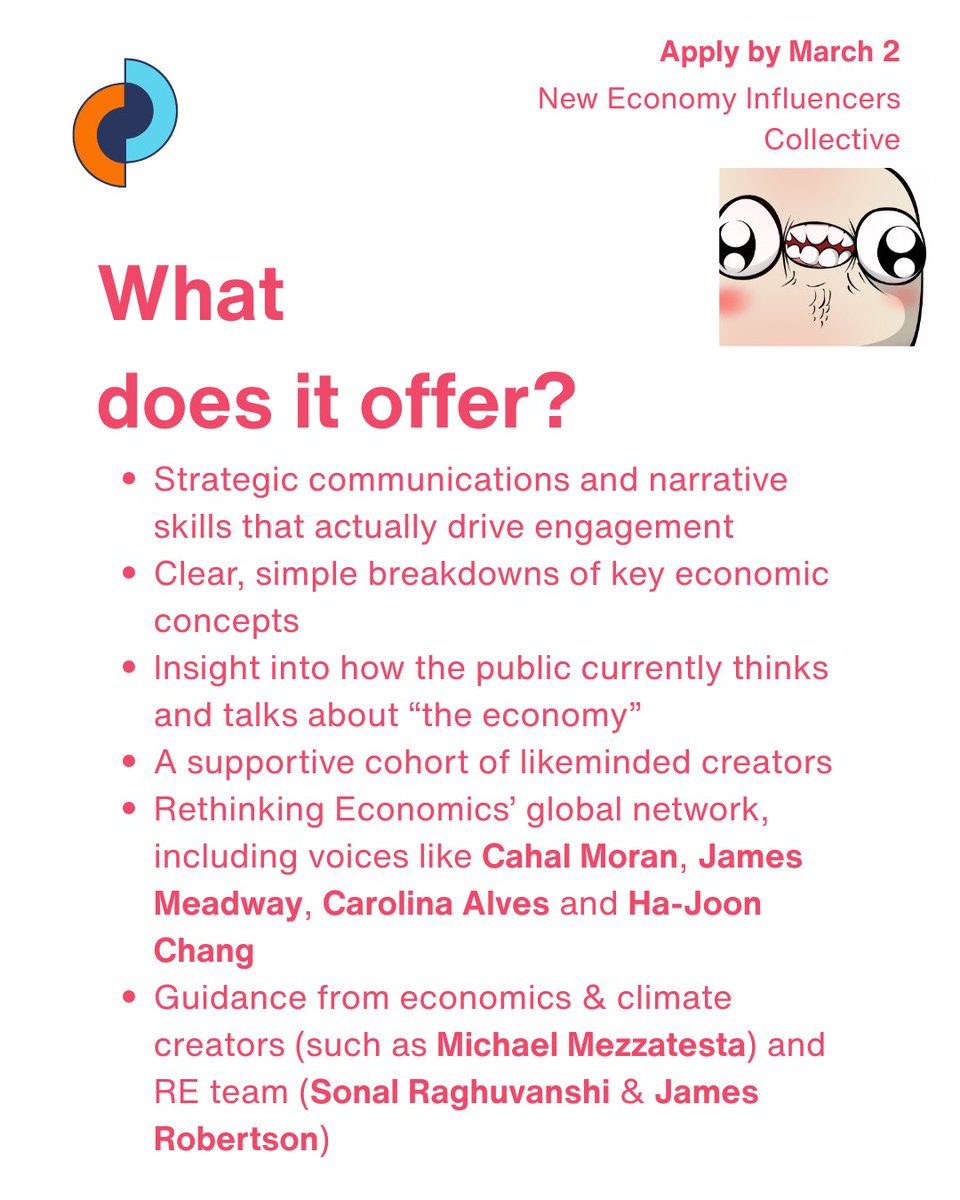
Most of the stories people hear about the economy are narrow, confusing, or just plain wrong. That’s why we're launching the ✨ New Economy Influencers Collective✨Applications open now, apply by March 2! https://t.co/dro6tq77eX
Almost a decade and a half since I was one of its founders, I’m glad to see @rethinkecon play a huge role in educating young economists across the world. Great to speak to @mrmatthewtaylor in his new piece in @Guardian about Rethinking Economics:
https://t.co/kK5b4AyVeh
📤 Submit abstracts (300-750 words) by 1 March 2026
👉https://t.co/NAqhAA4Ybm
Select: “The Social Production of Green Discontent”
🤝 Organisers:
Aleksandra Peeroo & Christina Wolf
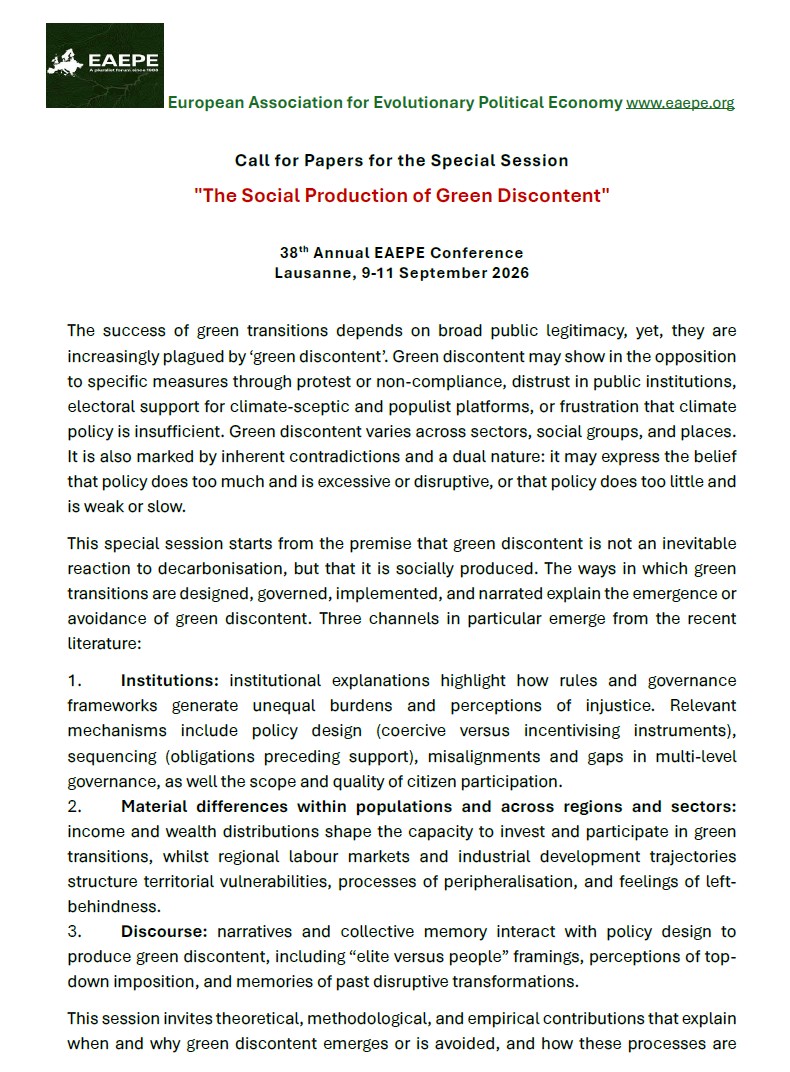
📢 Call for Papers – EAEPE 2026 Special Session
“The Social Production of Green Discontent”
📍Lausanne, 9-11 Sept 2026
Green transitions increasingly face green discontent. This session examines how it is socially produced through institutions, material differences, & discourse
📝 We welcome contributions on:
• Theories or case studies of green discontent
• Cross‑country or sectoral comparisons
• Policy successes & failures
• Conditions that avoid or transform discontent
We are looking for contributions from different approaches & perspectives exploring analytical & policy challenges in shaping fair & just transitions. New abstract submission deadline: 1 March. EAEPE2025. @eaepe
📆 EXTENDED DEADLINE for abstract submission to @eaepe's 2025 conference in Athens now 1 March 📝. Our special session on "Institutional Perspectives on the Social Costs of Economic, Social, and Ecological Transitions" can be found here: https://t.co/h48oYNKoFp
📢❗️Special session @eaepe conference Sep 2025 in Athens.📝 "Institutional Perspectives on the Social Costs of Economic, Social, and Ecological Transitions". 📅 Abstract submission deadline: 15 Feb❗️Feel free to share.
CfP: ➡️ https://t.co/h48oYNJQPR
⬇️
I need to set the story straight about China's 'technology theft' and 'industrial espionage'.
To those now upset that China is using tools to transfer technology from richer countries: don't forget that US and EU firms deliberately offshored production to China to take advantage of productive capabilities and cheap labour there. Consumers and large multinationals in the global North have benefitted massively from integrating China into global value chains.
It's also odd that we've come to accept that technology isn't a common global good. The world would be a much better and more prosperous place if intellectual property was more widely shared. And, honestly, a lot of intellectual property should be owed to the South due to years of labour exploitation.
It's shocking to see widespread accusations that China is stealing foreign technology. Not only do these accusations fail to acknowledge how China's integration into the world economy allowed multinationals in the North to thrive, it's also anti-developmental.
NEW 🧵: Why do we need state intervention?
State intervention has come back into fashion, and for good reason. In this thread, I’ll explain why the state is crucial for economic prosperity, development, and innovation.