small but important nuance: AI isn’t what breaks modern cryptography. quantum is
shor’s algorithm on a big enough quantum computer breaks the curves behind almost every wallet today, ed25519 on solana, secp256k1 on bitcoin
what AI breaks is implementations: buggy contracts, bad randomness, leaked keys. that’s happening right now, not in 10 years
two threats, two timelines. the chains that migrate to post-quantum signatures first win the next decade
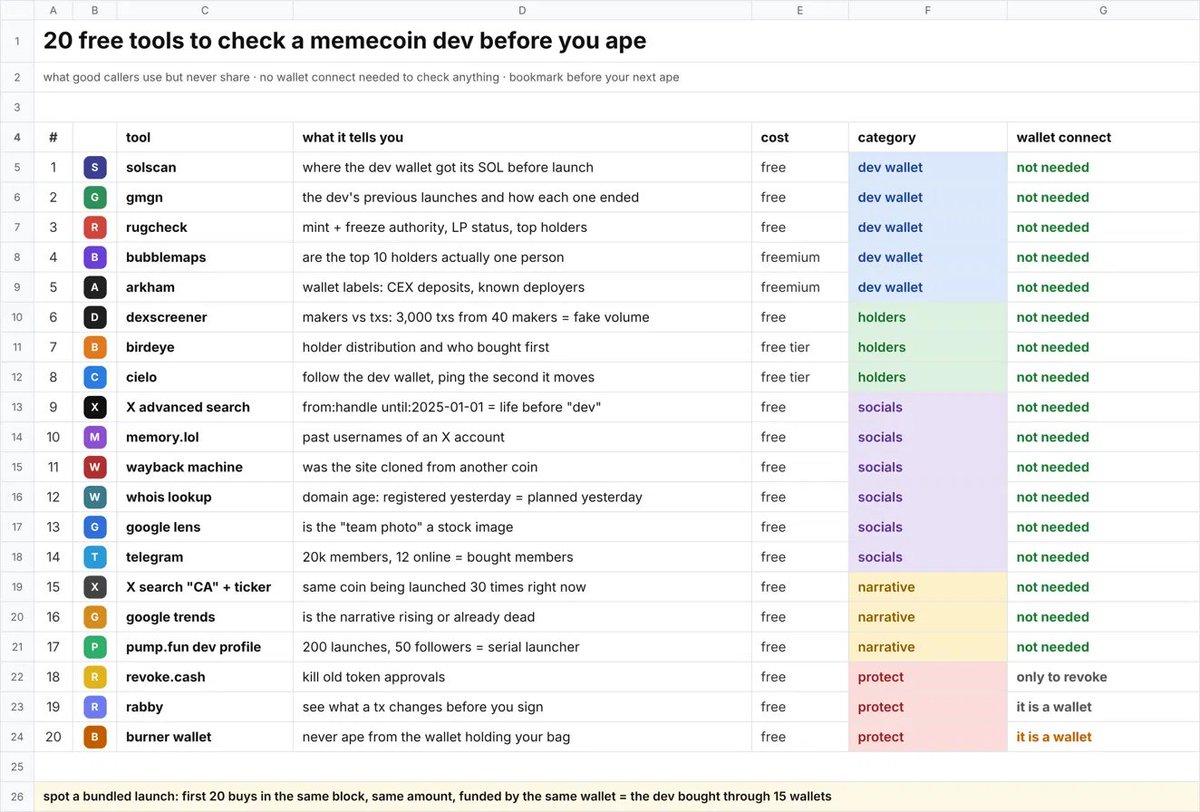
20 free tools to check a memecoin dev before you ape
the stuff good callers use but never share. no wallet connect needed for any of them
check the dev wallet
1.) solscan → full history of the dev wallet: where the SOL came from before launch
2.) gmgn → the dev’s previous launches and how each one ended
3.) rugcheck → mint authority, freeze authority, LP status, top holders in one view
4.) bubblemaps → see if the “top 10 holders” are actually one person
5.) arkham → labels on wallets: CEX deposits, known deployers, linked entities
check the holders
6.) dexscreener → makers vs transactions. 3,000 txs from 40 makers = fake volume
7.) birdeye → holder distribution and who bought first
8.) cielo → follow the dev wallet, get pinged the second it moves
check the socials
9.) X advanced search → “from:handle until:2025-01-01” shows what the account posted before it became a “dev”
10.) https://t.co/r6a0CpQEcz → past usernames of an X account. renamed 4 times = red flag
11.) wayback machine → was the site cloned from another coin
12.) whois lookup → domain age. registered yesterday = planned yesterday
13.) google lens → is the “team photo” a stock image
14.) telegram → 20k members, 12 online = bought members
check the narrative
15.) X search “CA” + ticker → is the same coin being launched 30 times right now
16.) google trends → is the narrative rising or already dead
17.) https://t.co/Q7S9O5QXZD dev profile → follower count vs launch count. 200 launches, 50 followers = serial launcher
protect yourself
18.) https://t.co/uiI3vT4j5s → kill old approvals
19.) rabby → see what a transaction changes before you sign
20.) burner wallet → never ape from the wallet that holds your real bag
how to spot a bundled launch :
open the first 20 buys on solscan. same block, same amount, wallets all funded by the same source = the dev bought through 15 wallets.
you’re their exit liquidity
@pbi_trade bonding software to its promises is a great primitive for agents. the whole thing lives or dies on one question tho: who measures the break? if uptime is reported by the operator or a single oracle, nobody ever gets slashed. who runs the probes?
cool design, but one thing:
the vault is a solana program, and programs have an upgrade authority, which is an ed25519 key.
if it isn’t revoked, a quantum attacker doesn’t need to break winternitz, he just takes the upgrade key and rewrites the vault.
is the authority burned?
love that it’s real heron hardware. but real qubits aren’t fair coins:
|1⟩ relaxes toward |0⟩, and readout error differs per qubit.
So some slots on the chip read 1 less often than others, by design of physics. do you correct for per-qubit bias, or does your coin’s qubit decide your odds?
i’ll be honest, when i first saw $QUBIT i roasted it. “quantum memecoin” sounded like the most 2026 narrative possible.
then i actually looked at how it works.
the mint address came out of a real IBM quantum computer, at $96 a minute of machine time. but the part that got me isn’t the quantum, it’s the order of operations: the rule was published before the job ran. you can’t cherry-pick a result when the rule is public first. and you can check the whole thing yourself in plain python.
that’s rare in the trenches. most coins ask you to trust a narrative. this one hands you the receipts.
it’s also not a one-off. the QUBIT launchpad gives every new coin its own quantum-born address ending in qbit. that’s a product, not just a ticker.
and the timing is perfect. solana CT spent the whole week on quantum: wallets, agents, whitepapers. $QUBIT is the one that can actually prove its origin.
full transparency: i’m holding. my plan is to keep holding through the noise and start taking profits above 1.5M mcap. not financial advice, size accordingly, and verify it yourself before you buy.
Launchpads with a real acronym need to be studied.
whether it’s Higgspad or even Jupiter in this case, there’s too much at stake for the project to fail.
This kind of project very often ends up taking off simply because of its name; either the team behind it drives the hype, or people will just buy it without even knowing if it’s ingenious or not.
@spoofpad X accounts out of stock” is a wild sentence to post on X lol.
bulk-made accounts usually get linked and suspended together.
if one ban wave hits, every spoof and its token loses its account at once. how are the accounts sourced?
sending fees to telegram usernames is smart for onboarding, but a username isn’t an identity. people change them, drop them, and some trade on Fragment. if a coin routes fees to @someone and that handle changes hands, the next owner claims everything. are fees bound to the user ID or the handle?
@qolonyfun love the “facts not ratings” approach. one thing tho: the worst devs deploy from fresh wallets, so “creator’s other coins: none” looks clean when it’s actually the biggest red flag. the ants should trace who funded the deployer, that’s where the real history lives
good devs can finally see good project in trenches.
- Qchan x6 (16k -> 75K)
- PetPad x4 (7.3K -> 26.6K)
- qLab x3 (68.2K -> 212K)
No one is mine, no one is bundled.
All proof on my pumpfun.
3 facts about pumpfun callout rewards:
- multiplier is measured to ATH
- the ATH is made by the followers buying
- algo changes lag weeks and payouts can’t be reversed
so the meta isn’t “make good calls”. it’s “farm the window before the next patch”. every update just tells you when the window closes
@usestripes ZEC rewards on a Solana launchpad is a fun twist.
but “claim on our website” is doing a lot of heavy lifting here.
onchain claims or it’s just a points system with extra steps
winternitz on solana is a fun choice. real edge case tho: offline signing + blockhash expiring in ~60s means a lot of txs will die before broadcast. if you re-sign with the same vault key for a different amount, WOTS reuse leaks enough to forge. durable nonces or hard block on re-sign?
@namiPF@aixbt_agent@virattt@typesafeai Trading volume floods with agents is a real edge if it works. Drop the agent wallets and this goes from narrative to case study overnight. How do they tell an organic flood from a wash-traded one?
I asked Claude to give me 3 ideas to launch on Quantum.
Here's what it told me.
1/ $QBIT: "Q-Day is coming" 🚨 Your private keys are sandcastles facing the tsunami. $QBIT = the ark. I'll be back. You'll already be liquidated. 🤖
2/ $SCHRODINGER: "Neither alive nor dead" 🐱📦 My token is both 100x and zero until you look at the chart. I advise you not to look. I advise you not to not look
3/ $QuantumLaunch: the launchpad 🦾 Allocation in superposition, bots in collision. A qubit-style random draw decides who gets in. Snipers won the launchpad war. I came from 2029 to end it.
3 Teams dev already ask him ahahah.