The case for private stablecoins has never been stronger.
Today, we're thrilled to release a landmark white paper that explains how privacy is the missing layer that makes blockchain payment rails viable for mainstream institutional use.
The GENIUS Act presents the opportunity for widespread stablecoin adoption. But public blockchains expose every transaction, permanently, hindering adoption.
Payroll. Treasury. Vendor payments. All of it broadcast to the world.
Existing solutions fall short and carry too much risk for institutions to engage.
The industry has been stuck.
But today that changes.
This paper presents a new path forward: permissionless, private stablecoin architecture built on Aleo, using zero-knowledge technology and programmable smart contracts.
Financial privacy and institutional risk management are not in tension. They're built from the same foundation, with programmable risk mitigation that lets institutions transact privately without compromise.
Behind this paper is a team that has spent careers at the intersection of cryptography, policy, and financial systems.
Aleo's Global Head of Policy @SignCurve, Valerie-Leila Jaber of the @crypto_council for Innovation and former Global Head of Financial Crime Compliance at Coinbase, and @matthew_d_green, cryptographer and Johns Hopkins University computer science professor, bring a rare combination of hands-on experience in private payments, financial regulation, and zero-knowledge cryptography.
This is a big deal. Not just for Aleo, but for institutional finance as a whole.
Read More 👇
https://t.co/ngx5fgN5yy
The case for private stablecoins has never been stronger.
Today, we're thrilled to release a landmark white paper that explains how privacy is the missing layer that makes blockchain payment rails viable for mainstream institutional use.
The GENIUS Act presents the opportunity for widespread stablecoin adoption. But public blockchains expose every transaction, permanently, hindering adoption.
Payroll. Treasury. Vendor payments. All of it broadcast to the world.
Existing solutions fall short and carry too much risk for institutions to engage.
The industry has been stuck.
But today that changes.
This paper presents a new path forward: permissionless, private stablecoin architecture built on Aleo, using zero-knowledge technology and programmable smart contracts.
Financial privacy and institutional risk management are not in tension. They're built from the same foundation, with programmable risk mitigation that lets institutions transact privately without compromise.
Behind this paper is a team that has spent careers at the intersection of cryptography, policy, and financial systems.
Aleo's Global Head of Policy @SignCurve, Valerie-Leila Jaber of the @crypto_council for Innovation and former Global Head of Financial Crime Compliance at Coinbase, and @matthew_d_green, cryptographer and Johns Hopkins University computer science professor, bring a rare combination of hands-on experience in private payments, financial regulation, and zero-knowledge cryptography.
This is a big deal. Not just for Aleo, but for institutional finance as a whole.
Read More 👇
https://t.co/ngx5fgN5yy
Recently, we released a landmark white paper on private stablecoins 📝
Tomorrow, we're joined by co-authors @SignCurve, Aleo's Global Head of Policy, & Valerie-Leila Jaber of @crypto_council to dive deeper 💬
📆 June 16 at 2pm ET
🔔Set a reminder 👇
https://t.co/j4gy0ZrUaa
Last week we released a landmark white paper making the case for privacy as the missing layer in onchain institutional finance.
Co-authored by @SignCurve, Valerie-Leila Jaber, and @matthew_d_green, it presents a new path forward for private stablecoin infrastructure.
Learn More 👇
The case for private stablecoins has never been stronger.
Today, we're thrilled to release a landmark white paper that explains how privacy is the missing layer that makes blockchain payment rails viable for mainstream institutional use.
The GENIUS Act presents the opportunity for widespread stablecoin adoption. But public blockchains expose every transaction, permanently, hindering adoption.
Payroll. Treasury. Vendor payments. All of it broadcast to the world.
Existing solutions fall short and carry too much risk for institutions to engage.
The industry has been stuck.
But today that changes.
This paper presents a new path forward: permissionless, private stablecoin architecture built on Aleo, using zero-knowledge technology and programmable smart contracts.
Financial privacy and institutional risk management are not in tension. They're built from the same foundation, with programmable risk mitigation that lets institutions transact privately without compromise.
Behind this paper is a team that has spent careers at the intersection of cryptography, policy, and financial systems.
Aleo's Global Head of Policy @SignCurve, Valerie-Leila Jaber of the @crypto_council for Innovation and former Global Head of Financial Crime Compliance at Coinbase, and @matthew_d_green, cryptographer and Johns Hopkins University computer science professor, bring a rare combination of hands-on experience in private payments, financial regulation, and zero-knowledge cryptography.
This is a big deal. Not just for Aleo, but for institutional finance as a whole.
Read More 👇
https://t.co/ngx5fgN5yy
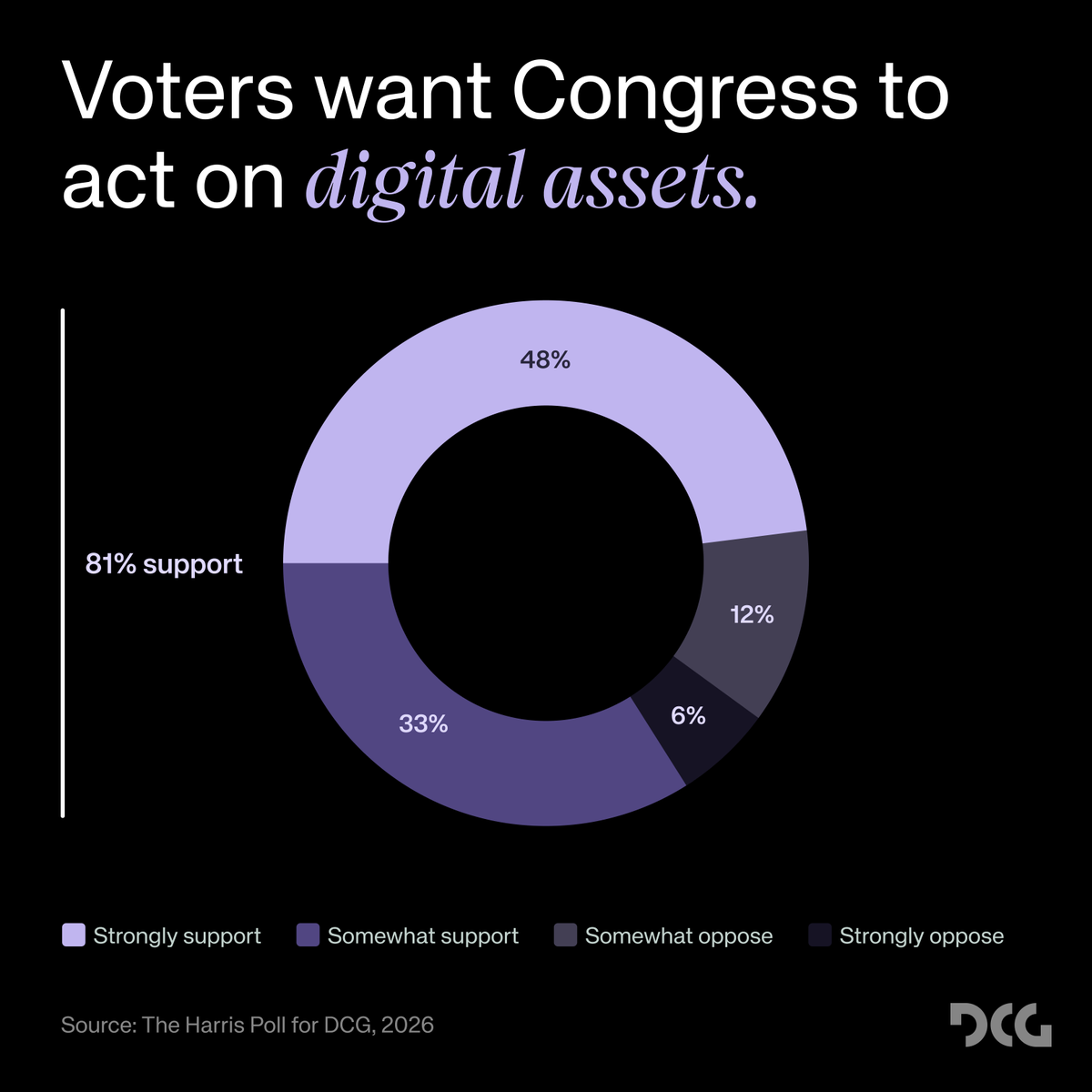
Americans want action on digital asset policy
New poll from DCG and @HarrisPoll found that 81% support legislation creating a clear regulatory framework for digital assets and 60% want Congress to act now even if the rules evolve over time
Full report available: https://t.co/FVIosnYLAv
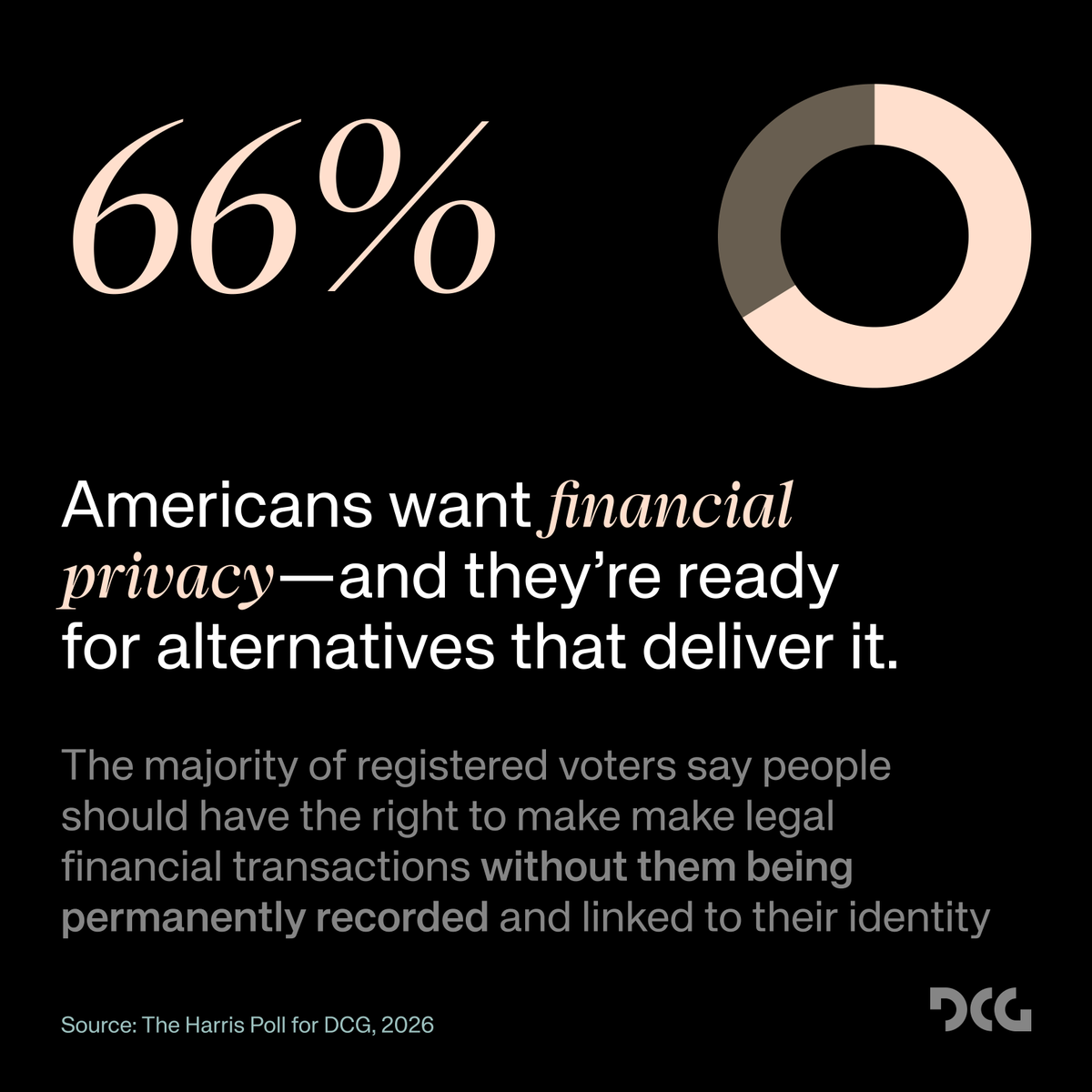
The demand for financial privacy is clear.
2-in-3 Americans want the right to transact without their financial data being permanently recorded.
Private stablecoins will play a critical role in making this a reality.
Dive deeper into the data 👇
Today, sharing new voter data with @HarrisPoll that shows increased public demand for financial privacy
2/3 say people should have the right to make legal financial transactions without those transactions being permanently recorded and linked to their identity
@DCGco@HarrisPoll@BlockchainAssn A fantastic resource on what real world users actually want. This is exactly the problem private stablecoins were built to solve.
We're excited to be in Washington, D.C. this week for the 2026 DCG Fly-In ✈️
As policymakers shape the future of digital asset regulation, we're ensuring private stablecoins are a central part of the conversation 💬
This week, we're in Washington, D.C. for the 2026 DCG Fly-In, where we bring together our founders with lawmakers on the Hill to discuss moving digital asset policy and financial privacy forward
Stay tuned, new voter data from @HarrisPoll out tomorrow
#DCGFlyIn
Most blockchains are transparent by default, so every salary, balance, and trading strategy you put onchain is permanently public.
@AleoHQ is a Layer 1 that flips that, making privacy the foundation and enforcing it with math instead of trust.
Private onchain infrastructure just got stronger 🛡
@BlockdaemonHQ has implemented support for Aleo's signature requirements across Builder Vault and its SDKs, enabling stablecoin issuers to support private payments and other use cases on Aleo.
Builder Vault is a self-hosted MPC key management system that gives institutions direct control over their key infrastructure.
Learn more about what this means for builders 👇
Blockdaemon has added @AleoHQ signature support across Builder Vault and its SDKs, enabling regulated stablecoin issuers to support Aleo stablecoin use cases.
Available now across Go, iOS, Android, C, Java, NodeJS, and WASM.
More in the latest blog: https://t.co/mVXilUBbcR
The case for private stablecoins has never been stronger.
Today, we're thrilled to release a landmark white paper that explains how privacy is the missing layer that makes blockchain payment rails viable for mainstream institutional use.
The GENIUS Act presents the opportunity for widespread stablecoin adoption. But public blockchains expose every transaction, permanently, hindering adoption.
Payroll. Treasury. Vendor payments. All of it broadcast to the world.
Existing solutions fall short and carry too much risk for institutions to engage.
The industry has been stuck.
But today that changes.
This paper presents a new path forward: permissionless, private stablecoin architecture built on Aleo, using zero-knowledge technology and programmable smart contracts.
Financial privacy and institutional risk management are not in tension. They're built from the same foundation, with programmable risk mitigation that lets institutions transact privately without compromise.
Behind this paper is a team that has spent careers at the intersection of cryptography, policy, and financial systems.
Aleo's Global Head of Policy @SignCurve, Valerie-Leila Jaber of the @crypto_council for Innovation and former Global Head of Financial Crime Compliance at Coinbase, and @matthew_d_green, cryptographer and Johns Hopkins University computer science professor, bring a rare combination of hands-on experience in private payments, financial regulation, and zero-knowledge cryptography.
This is a big deal. Not just for Aleo, but for institutional finance as a whole.
Read More 👇
https://t.co/ngx5fgN5yy
The Oslo Freedom Forum is wrapping up today.
It's been a powerful few days with conversations around privacy, onchain finance, and what this means for humanitarian coordination around the world.
The work being done at @OsloFF is a reminder of why this infrastructure matters.
We're attending Stablecoin 2.0 at @money2020, hosted by @utila_io, @raincards, and @yellowcard_app.
Looking forward to conversations around the intersection of stablecoins and privacy 💬
Tomorrow, months of planning come together as we host Stablecoin 2.0: Own the Stack at @money2020 Europe, co-hosted with @raincards and @yellowcard_app.
The focus: how institutions build and operate stablecoin infrastructure at scale.