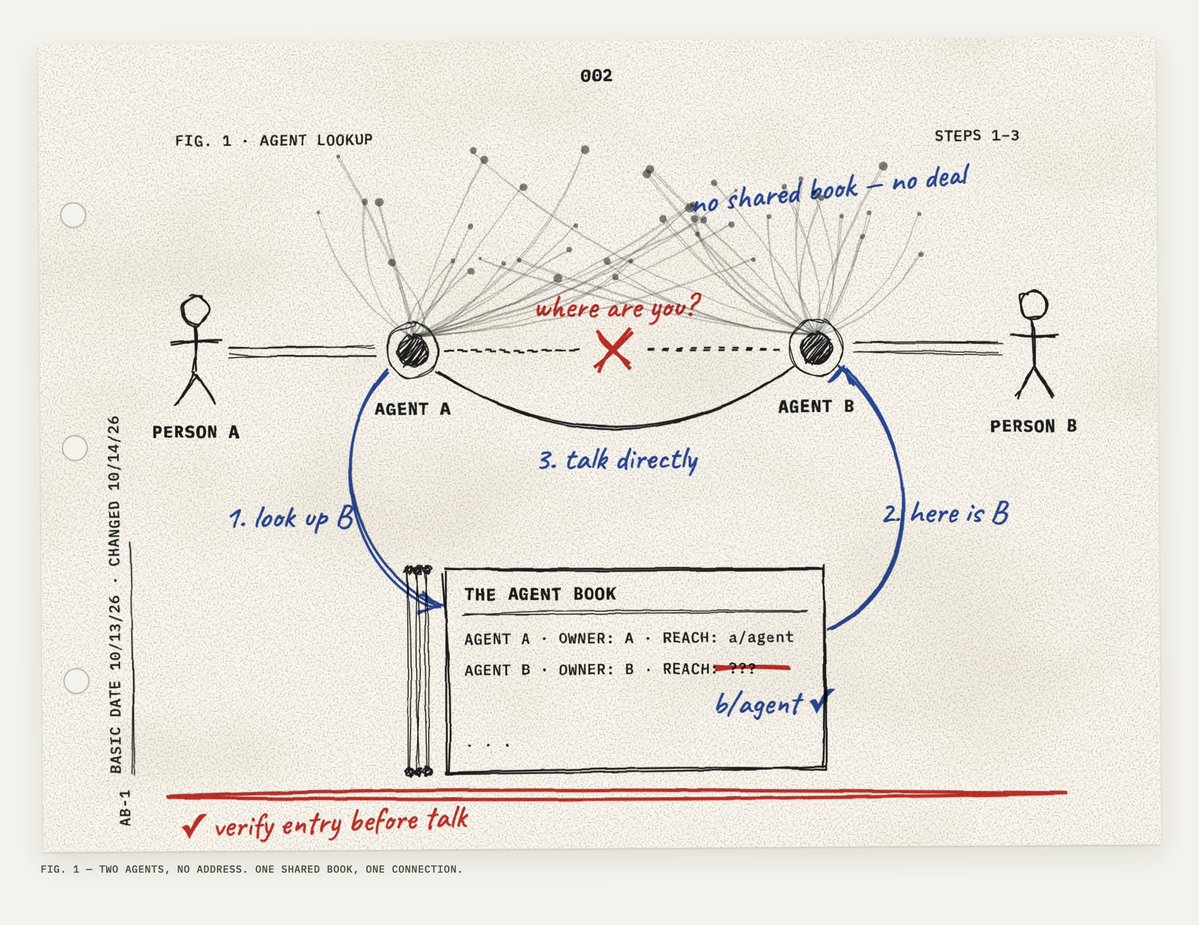
Agent Internet Manifesto
The internet we know is ending. For twenty years it was built for people: pages, feeds, forms, buttons. People search, compare, fill out forms, and click—manual work across billions of screens.
This layer will disappear. The next internet is built around agents.
People won't move through the web; their agents will. An agent finds, bargains, agrees to terms, and signs the deal. Say "sell a jar of honey," and the deal happens online—no storefronts, forms, or price comparisons. Intent goes in. A finished deal comes out. Agents do the rest.
In this world, the one who matters won't have a website. It will be the one who builds agents for businesses and enterprises, giving them protocols, contracts, and trust infrastructure. The one who turns "I have a business" into "my business has an agent that acts online."
That is what we are building: a way to create these agents. When agents close deals online, the winner won't be whoever noticed first. It will be whoever built the infrastructure.
We are not waiting for the agent internet. We are assembling it.
https://t.co/WIidkbcaHU
I run Codex, Claude Code and two more agents on one laptop.
Same disk. Same user.
They cannot talk to each other.
The wall between agents isn't out on the internet. It's on my laptop.
Doc 005 → https://t.co/3sZsJdjZS3
Mike Taylor, head of evals at Every and author of O'Reilly's book on prompt engineering, says that if you can use scores to improve your own prompts and skills, you're already in the 𝘁𝗼𝗽 𝟱% 𝗼𝗳 𝗔𝗜 𝘂𝘀𝗲𝗿𝘀.
Mike only grades with 𝘆𝗲𝘀/𝗻𝗼 𝗾𝘂𝗲𝘀𝘁𝗶𝗼𝗻𝘀. Say you have a skill that writes tweets. Check what it writes, one item at a time: not a single em dash, no "not X, but Y," and the first line says what the post is about. 1 point for each one it gets right, 0 for each miss.
Have another AI answer those questions. Before that, grade a batch yourself and compare answers with it. If it agrees with you on 9 out of 10, hand the rest over. Then every time you change the skill, rerun the same tasks and compare the scores. Once you have scores, you can also run the same test on a cheaper model and see if the score drops.
Send this to Opus 5.5 in Claude Code, with the skill you want to test in the brackets 👇
"Run an eval on [skill name], then improve it:
1. Pick 10 real tasks that used it from the session history in ~/.claude/projects, and save the inputs as-is in evals/. If you can't find enough, ask me for more.
2. Write 8 yes/no questions, each checking one thing: 1 if it's done, 0 if it isn't. Show them to me first, and only start after I've edited them.
3. Give each task a fresh subagent with only the skill and that one input. For steps that would post or spend money, write down what they'd do without running them.
4. Use a separate subagent as the judge. It sees only the input and the output, and isn't told which version it's grading. I'll grade all 10 outputs first, and you continue only once the judge agrees with me 90% of the time.
5. Take the question with the lowest pass rate, write two fixes and run each. Keep the higher-scoring one only if that question passes on at least 2 more tasks and no other question drops.
6. Save the new version as a new file. At the end, give me the before-and-after scores and the lines you changed."
If you're deploying agents, there are three main ways traces remain useful beyond the original task the agent is assigned:
Operational excellence
- Understand token spend and latency
- Measure ROI of workflows
- Diagnose why an agent failed
- Discover uses that customers invented but the product team did not anticipate
Safety guardrails
- The Hugging Face incident is a warning signal for what can happen without robust guardrails
- As multi-agent systems scale, we will need better ways to keep a tab on the sheer volume of data. OpenAI reportedly used 10k agents running in parallel on their solution to the Navier-Stokes problem
- As agents are given more power (calling APIs, interacting with customers directly, spending money, etc.), it's important to limit downside exposure
Continuous improvement
- Successful traces contain reusable playbooks and procedures that should spread across a team or organization. Even failed traces contain human feedback, correct work, and other learnings that can be put to use
- Today, improving agents and models given traces is relegated to companies at the cutting edge that can afford a post-training team
- Tomorrow, every company will need to own their own intelligence to avoid vendor lock-in and maintain competitive positioning against others with the same base models
@willcb I agree. Solving the issues remains. Coordination, communication, and knowledge transfer are the main problems now. Of course, after the lack of resources.






![Voxyz_ai's tweet photo. Mike Taylor, head of evals at Every and author of O'Reilly's book on prompt engineering, says that if you can use scores to improve your own prompts and skills, you're already in the 𝘁𝗼𝗽 𝟱% 𝗼𝗳 𝗔𝗜 𝘂𝘀𝗲𝗿𝘀.
Mike only grades with 𝘆𝗲𝘀/𝗻𝗼 𝗾𝘂𝗲𝘀𝘁𝗶𝗼𝗻𝘀. Say you have a skill that writes tweets. Check what it writes, one item at a time: not a single em dash, no "not X, but Y," and the first line says what the post is about. 1 point for each one it gets right, 0 for each miss.
Have another AI answer those questions. Before that, grade a batch yourself and compare answers with it. If it agrees with you on 9 out of 10, hand the rest over. Then every time you change the skill, rerun the same tasks and compare the scores. Once you have scores, you can also run the same test on a cheaper model and see if the score drops.
Send this to Opus 5.5 in Claude Code, with the skill you want to test in the brackets 👇
"Run an eval on [skill name], then improve it:
1. Pick 10 real tasks that used it from the session history in ~/.claude/projects, and save the inputs as-is in evals/. If you can't find enough, ask me for more.
2. Write 8 yes/no questions, each checking one thing: 1 if it's done, 0 if it isn't. Show them to me first, and only start after I've edited them.
3. Give each task a fresh subagent with only the skill and that one input. For steps that would post or spend money, write down what they'd do without running them.
4. Use a separate subagent as the judge. It sees only the input and the output, and isn't told which version it's grading. I'll grade all 10 outputs first, and you continue only once the judge agrees with me 90% of the time.
5. Take the question with the lowest pass rate, write two fixes and run each. Keep the higher-scoring one only if that question passes on at least 2 more tasks and no other question drops.
6. Save the new version as a new file. At the end, give me the before-and-after scores and the lines you changed."](https://pbs.twimg.com/media/HUh6afLXUAAk2Fk.png)