My $CSU.TO raw notes from this morning's AGM:
- Opened with a video showing year-by-year acquisitions across operating groups. Seeing gross/recurring revenue alongside capital deployed was impressive with over 1,300 acquisitions during their 30 year run.
- Core message remained consistent:
- Decentralization
- Decisions pushed to business units
- Small teams
- Buy-and-hold forever mindset
- No PE-style flipping
- Scale highlights:
- 69K employees
- 1,500+ business units
- 1,300+ acquisitions
- 100+ countries
- 150+ vertical markets
- Conventional org charts are NOT how CSI operates
- HQ exists to coach, not control
- Nyland (Lumine) mentioned speaking with their telecom customers about potential acquisition opportunities that improve service to end customers
- Concentrating talent within verticals is a major edge. Deep knowledge in transportation with Bill Delaney (CEO of Modaxo, part of Volaris) runs transportation software services for 3,000+ cities and governments
- Mark Miller's AI comment:
- “It’s about what you actually do, not what you say you’re going to do”
- Short-term leaders focus on what they say, not execution
- Vertical markets require deep industry expertise, even in the AI era
- Founder who spoke on a panel sold to CSI in 2018 is now fully out of that business and running an academic vertical inside completely outside of the operating unit he sold to
- Interesting pattern: founders often stay within Constellation in new leadership roles years later
- Agentic coding is helping them build more software faster
- Some companies are fully rebuilding and modernizing products from scratch — previously inconceivable pre-agentic coding
- CSI is hosting many AI hackathons to:
- Produce new products
- Rebuild outdated systems
- Modernize software untouched for decades
- Potential upside:
- Longer product life cycles
- Lower churn
- CSI increasingly investing in “PEMS” in other words taking stakes in other public software companies. Miller sees value in public markets and mentioned on the earnings call last week that private valuations haven't moved while publics get smoked.
- PEMS = Permanent Engaged Minority Shareholders
- Holding long term, not trading the equities
- Brief mention of Mark Leonard at the start, then not referenced again... Company remains very private about his health
- Mark Miller:
- “We really haven’t seen any AI-related attrition of customers”
- Software businesses are not just products, they are Companies:
- Support matters
- Sales matters
- Services matter
- Customers don’t ask for AI. Customers ask for solutions. If AI improves the solution, great
An incredible Warren Buffett and Charlie Munger find from @BRK_Student!
He filed a FOIA request related to the 1970s-era SEC investigation of Blue Chip Stamps — and received 4,000+ pages of letters, transcripts, and financials.
And, best of all, he's sharing it with all of us!
Berkshire Hathaway released its 2nd quarter 10-Q and operating earnings this morning. Despite little activity on the capital allocation front, Berkshire’s key businesses produced generally solid profitability, and FAR BETTER than is being generally reported. A brief summary: 1/5
$LVMH CEO Bernard Arnault:
🔶~🔶~🔶 ~🔶
“I'm going to say something that you might not like.
It's that I never look at the share price.
In fact, I never sell shares either.
So I advise you to do the same because I have colleagues, employees, people who hold shares.
But I see from time to time that they sell them, but you you're making a mistake,
wait and adopt a long-term perspective and not think short term.
That's why in a company such as ours, we must think the long term, and that's how we can do outstanding things because the economic result can't be a target.
The profit really is a consequence of what we do.”
🔶~🔶~🔶 ~🔶
- April 2021 Earnings Call
The Best Private Equity Model?
$17M turned into $1B+.
Will Thorndike (author of The Outsiders) is building the future of long-term compounding.
A new kind of HoldCo.
Let’s break it down👇
10 Lessons from Rose Blumkin:
1. A Taste for Saltwater: What separates exceptional people is their capacity to endure discomfort. Rose walked barefoot for 18 miles at the age of 13 to save her only pair of shoes. Later, she opened a furniture store during the Depression, rebuilt after a fire gutted half her building, and came to work the day after breaking her ankle at 97. Most people avoid pain; outliers use it as fuel.
2. High Agency: Most people see circumstances as fixed; high-agency people see them as variables. When Depression-era customers couldn’t afford shotguns, Rose didn’t complain about the economy; she created a rental program overnight. The line stretched around the block the next morning. High agency isn’t magical thinking; it’s the refusal to accept artificial constraints.
3. Bias Toward Action: While average performers wait for perfect conditions, exceptional ones create momentum through immediate action. After a devastating fire, Rose didn’t wait for the dust to settle; instead, she said, “We’re opening tomorrow” and turned disaster into a successful sale. When business slowed during the Korean War, she rented the city auditorium and cleared $250,000 in three days. Action creates options that passivity never discovers.
4. Bounce, Don’t Break: When wholesalers refused to sell to Rose, calling her a “bootlegger”. She embraced it: “You betcha. I’m the best bootlegger in town!” and she found backdoor suppliers. When competitors sued her, she turned the courtroom into free advertising. Resilience isn’t about avoiding knockdowns; it’s about how you use them as launching pads.
5. Dark Hours: Excellence happens when nobody’s watching. Rose cleaned stores before dawn as a teenager and inspected every carpet shipment personally into her 90s. She once detected yarn theft at a mill supplier just by feeling that a carpet was slightly underweight. The public sees the outcome, but never the work.
6. Your Reputation Is the Room: Rose understood that your reputation creates opportunities before you even enter the conversation. Military officers stationed across the world would buy furniture sight unseen because “Mrs. B doesn’t lie.” A judge who ruled in her favor bought carpet the next day. Your reputation isn’t what you claim; rather, it’s the collective experience others have of you, and it determines which rooms you walk into.
7. Choose the Right Co-Pilot: Partnerships are force multipliers. Isadore balanced Rose’s intensity with steady customer service principles. Warren Buffett bought her business on a handshake with no audit because character recognition works both ways. The right partners don’t just add to your strengths; they compensate for your weaknesses while amplifying your impact.
8. It Takes What It Takes: Every exceptional achievement has a non-negotiable price. Rose worked 12-hour days until age 103, calling work her “narcotic.” At a luncheon honoring her, she stood up at 1:15 and announced, “What’s wrong with you people? Don’t you have jobs? I’m going back to work.” Ordinary results come from ordinary effort; extraordinary results demand unreasonable commitment.
9. Focus Is a Superpower: In today’s fractured attention economy, Rose’s single-minded concentration would be her greatest advantage. She had one tab open—her business—while competitors scattered their attention across multiple priorities. This wasn’t mere workaholism; it was the strategic elimination of distractions, creating depth of knowledge that no competitor could match.
10. Simple Scales, Fancy Fails. Rose’s business philosophy fit on an index card: “Sell cheap, tell the truth, don’t cheat customers.” While competitors built complex systems and layers of management, her straightforward approach eliminated friction. Complex businesses move slowly; simple ones can scale with less overhead and fewer decision bottlenecks.
Constellation Software had their annual meeting 10 days ago.
I'd first recommend you watch the video yourself, or read a transcript. But if you don't have time, here are some notes I took...
https://t.co/27AOvYQ6he
What happens when a hyper-growth compounder decides to slow down almost on purpose?
Evolution Gaming’s Q1 results shocked the market. $EVO
But this wasn’t just a miss – it was a strategy shift.
Let’s talk about short-term friction, long-term strategy, and why this moment matters 🧵
21 lessons from “A Few Lessons From Warren Buffett” (an 81 page book full of Buffett’s wisdom)
1. A funny thing about life: if you refuse to accept anything but the best you very often get it.
2. The truly big investment idea can usually be explained in a short paragraph.
3. Big opportunities come infrequently. When it’s raining gold, reach for a bucket, not a thimble.
4. Loss of focus is what most worries Charlie and me.
5. When a problem exists, whether in personnel or in business operations, the time to act is now.
6. The roads of business are riddled with potholes; a plan that requires dodging them all is a plan for disaster.
7. A compact organization lets all of us spend our time managing the business rather than managing each other.
8. Nothing sedates rationality like large doses of effortless money.
9. The most elusive of human goals: Keeping things simple and remembering what you set out to do.
10. Just run your business as if: (1) You own 100% of it; (2) It is the only asset in the world that you and your family have or will ever have; and (3) You can't sell it for at least a century.
11. The right players will make almost any team manager look good.
12. Just tell me the bad news; the good news will take care of itself.
13. Our managers have produced extraordinary results by doing rather ordinary things—but doing them exceptionally well.
14. It's difficult to teach a new dog old tricks.
15. On a daily basis, the effects of our actions are imperceptible; cumulatively, though, their consequences are enormous.
16. Charlie and I are not big fans of resumes. Instead, we focus on brains, passion and integrity.
17. Our experience has been that the manager of an already high-cost operation frequently is uncommonly resourceful in finding new ways to add to overhead—while the manager of a tightly-run operation usually continues to find additional methods to curtail costs, even when his costs are already well below those of his competitors.
18. Tomorrow is always uncertain.
19. The trick is to learn most lessons from the experiences of others.
20. In allocating capital, activity does not correlate with achievement.
21. The less the prudence with which others conduct their affairs, the greater the prudence with which we should conduct our own affairs.
Download more of Buffett’s ideas into your brain by listening to episode 202.
I’m old enough to have invested through three 30%+ drawdowns – the DOT COM Crash, Global Financial Crisis, and Covid Pandemic. I’m lucky in that I’m still young enough to take advantage of the lessons learned.
In early 2020, the markets were collapsing due to the spread of the Covid pandemic. In hindsight we realize it wasn’t that bad. But in the moment - Investors, governments, and markets were losing their minds.
From February 19th to March 23rd 2020 the S&P 500 fell 34%.
On March 18th, Bill Ackman came on CNBC to say, “hell was coming” and the US needed to seal off the border to protect the population. This rant almost bottom ticked the low.
March 23rd was the low.
No one was talking positively about stock prices. When you see the best investors in the world throw in the towel you know the bottom is close. There were so many investors sitting on 50—75% cash waiting and hoping for the world to get even worse. Warren Buffett sat on his huge cash position waiting to see how things would turn out.
If the market falls another 5-10% this week - what a great opportunity. Keep your head. Tune out the people spreading fear.
Don't get too negative because negativity and fear paralyzes common sense.
Instead of panicking and trying to time a bottom you should be slowly adding to the businesses you've always wanted to buy.
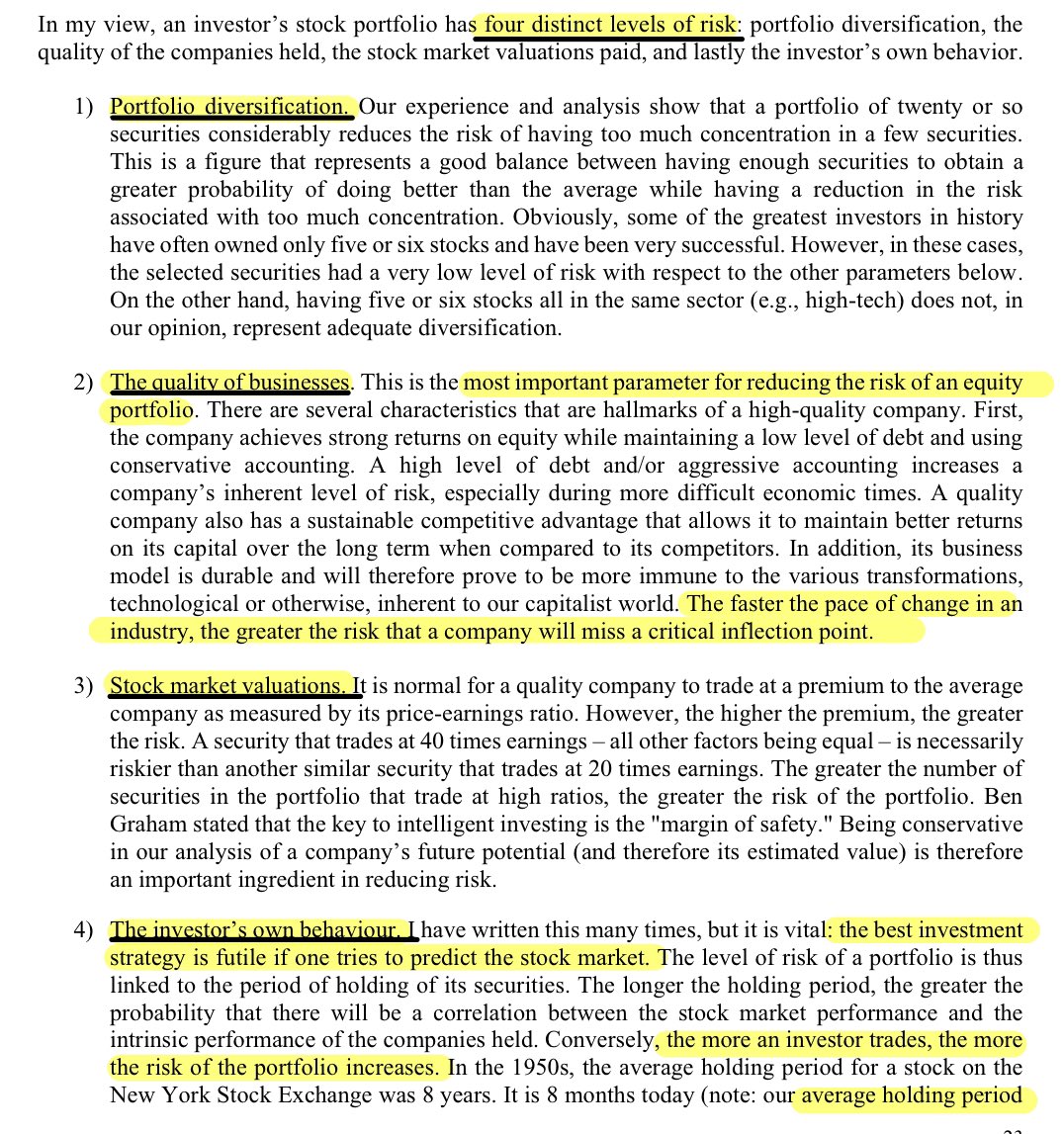
François Rochon talks about 4 levels of risk in his latest annual letter:
1/ Diversification
2/ Quality
3/ Valuation
4/ Behaviour
He believes #2 is the most important of all and I’d say #4 is typically overlooked
Poker & Investing
Having spent an inordinate amount of time in both realms, I feel qualified to comment on the lessons I’ve learned in poker that are massively helpful in investing.
Would really appreciate a retweet, especially if you have poker players following you.
Huge thanks to my poker pro friend Jacob Miller for reviewing this. (1/n)
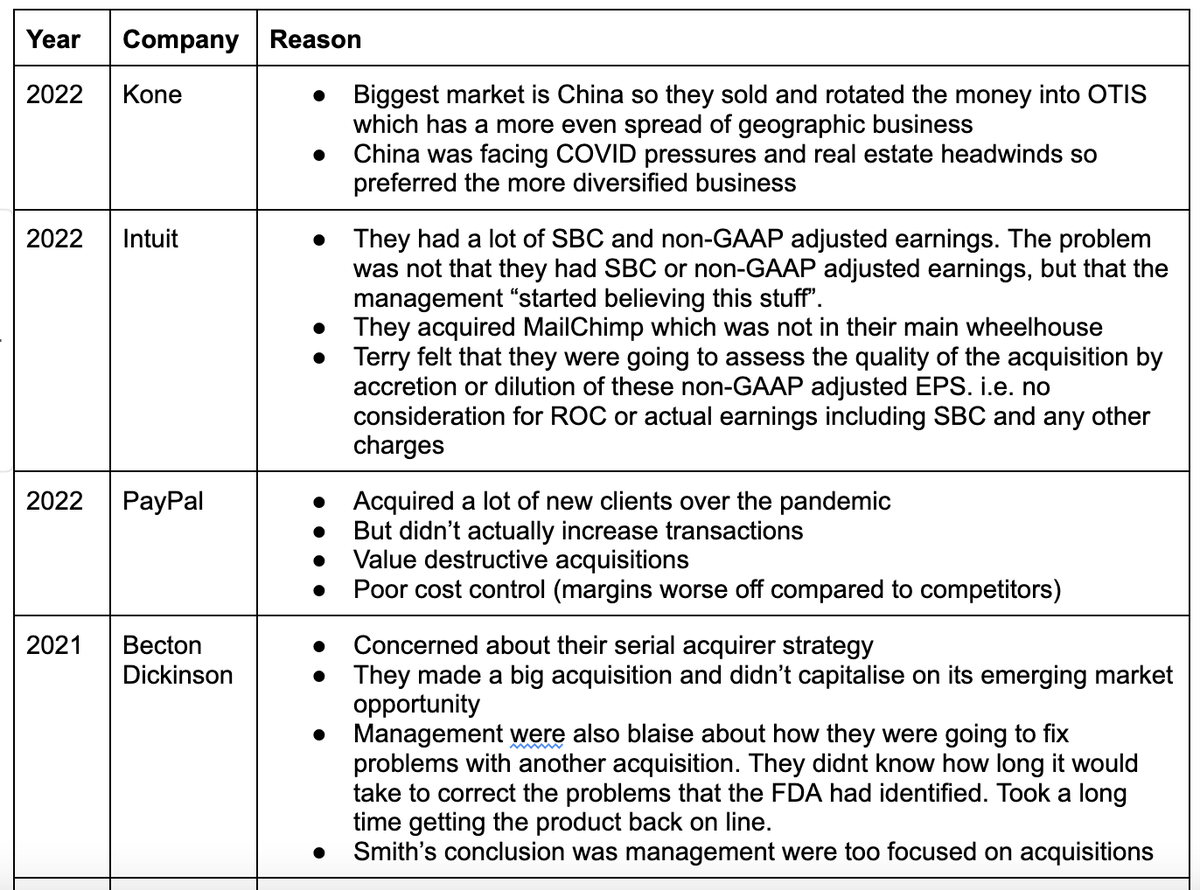
Here’s a comprehensive list of every stock Terry Smith of Fundsmith has sold and the reasons behind each decision, as explained in his annual letters and shareholder meetings. I hope you find it useful!