Baidu just open-sourced an OCR model that reads entire 40-page documents in one shot.
It's called Unlimited-OCR. 3 billion parameters but only 500 million active during inference. Runs 100% locally on your machine.
Why this matters: traditional OCR tools chop documents page by page. Tables that span two pages break. Reading order gets lost. Cross-page context disappears.
Unlimited-OCR processes the whole document at once. 32K context window. Text, formulas, tables, reading order all preserved across pages.
Output comes out as clean structured Markdown.
→ 93% accuracy on the standard benchmark. +6 points over the baseline.
→ Error rate stays below 0.11 even past 40 pages.
→ Multilingual out of the box.
→ 2.12 million downloads on Hugging Face last month. 14,600 GitHub
stars.
For context: Amazon Textract, Google Cloud Vision, and Azure Document Intelligence all charge per page. This runs locally for free.
I built a 5-agent AI content team using OpenClaw that works for me 24/7.
Here’s how it works:
→ Employee #1 scrapes Twitter and YouTube from top creators in my niche
→ Tracks velocity (views per hour, engagement, virality signals)
→ Ranks the most viral content automatically
→ Sends the best ones directly to my Telegram
I open Telegram, review what’s trending, learn from it, and implement ideas myself. Once I find a video, tweet, or thread that resonates, I hand it off to Employee #2.
Employee #2 brainstorms with me, takes my input, understands the angle, and converts it into a thread in my writing style and tone.
Then Employee #3 repurposes that thread into:
→ YouTube video scripts
→ Instagram scripts
→ Tweet variations and wrappers
Employee #4 reviews the thread and humanizes it to make sure it doesn’t sound AI-generated and feels authentic.
Employee #5 then reviews everything for virality, ensures it matches my exact tone and style, and delivers the final version to my custom dashboard for approval.
This is how I’m scaling content moving forward. Will share the results.
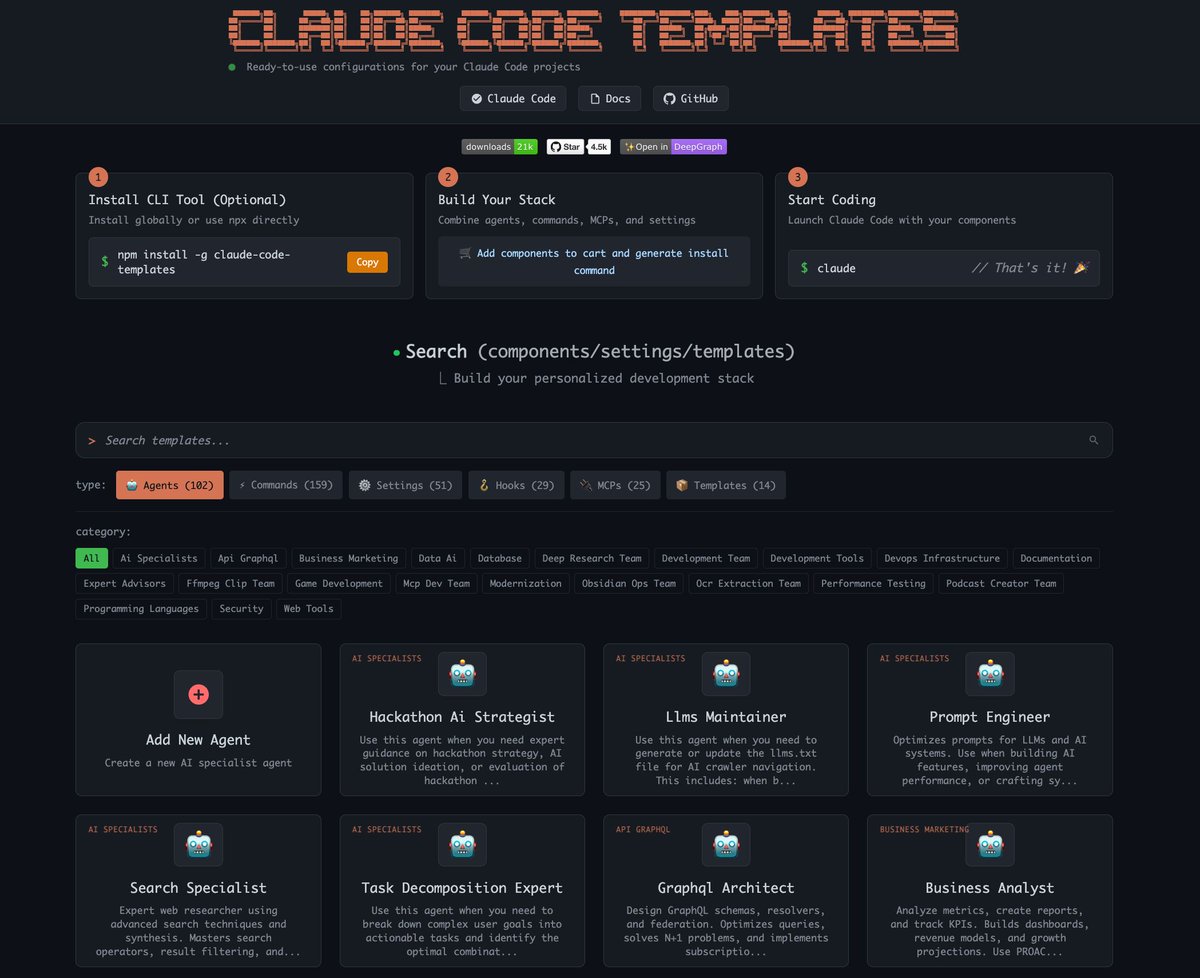
You can now turn Claude Code into a full development stack.
A new update ships a CLI that installs agents, commands, and integrations in minutes, with 14.8k GitHub stars.
𝗖𝗹𝗮𝘂𝗱𝗲 𝗖𝗼𝗱𝗲 𝗰𝗮𝗻 𝗻𝗼𝘄 𝗯𝗲 𝗰𝗼𝗻𝗳𝗶𝗴𝘂𝗿𝗲𝗱 𝗹𝗶𝗸𝗲 𝗮 𝗿𝗲𝗮𝗹 𝘁𝗲𝗮𝗺
It packages roles, workflows, and tools as reusable components.
You install them with one command.
No manual prompt wiring or copy pasting.
• Agents for code review, security, and performance
• Slash commands for testing, optimization, and checks
• Hooks for pre commit and post task automation
𝗜𝘁 𝗮𝗱𝗱𝘀 𝗼𝗯𝘀𝗲𝗿𝘃𝗮𝗯𝗶𝗹𝗶𝘁𝘆 𝘁𝗼 𝗔𝗜 𝗰𝗼𝗱𝗶𝗻𝗴
It tracks sessions, state, and usage in real time.
You can inspect live conversations locally or remotely.
• Analytics with performance metrics
• Health checks for misconfiguration
• Plugin dashboard with permission control
𝗜𝘁 𝘀𝗼𝗹𝘃𝗲𝘀 𝗿𝗲𝗽𝗲𝗮𝘁𝗮𝗯𝗶𝗹𝗶𝘁𝘆 𝗮𝗻𝗱 𝘀𝗰𝗮𝗹𝗲
Instead of one off prompts, you install standardized behavior.
That lets teams share setups, debug faster, and onboard consistently.
We combined forces with @elgato to create a Stream Deck-integrated mechanical keyboard 🤯
Say hello to GALLEON 100 SD!
Command your entire gaming setup from one device with the limitless customization options this keyboard has to offer 👀
🔗 https://t.co/vGxQemAXns
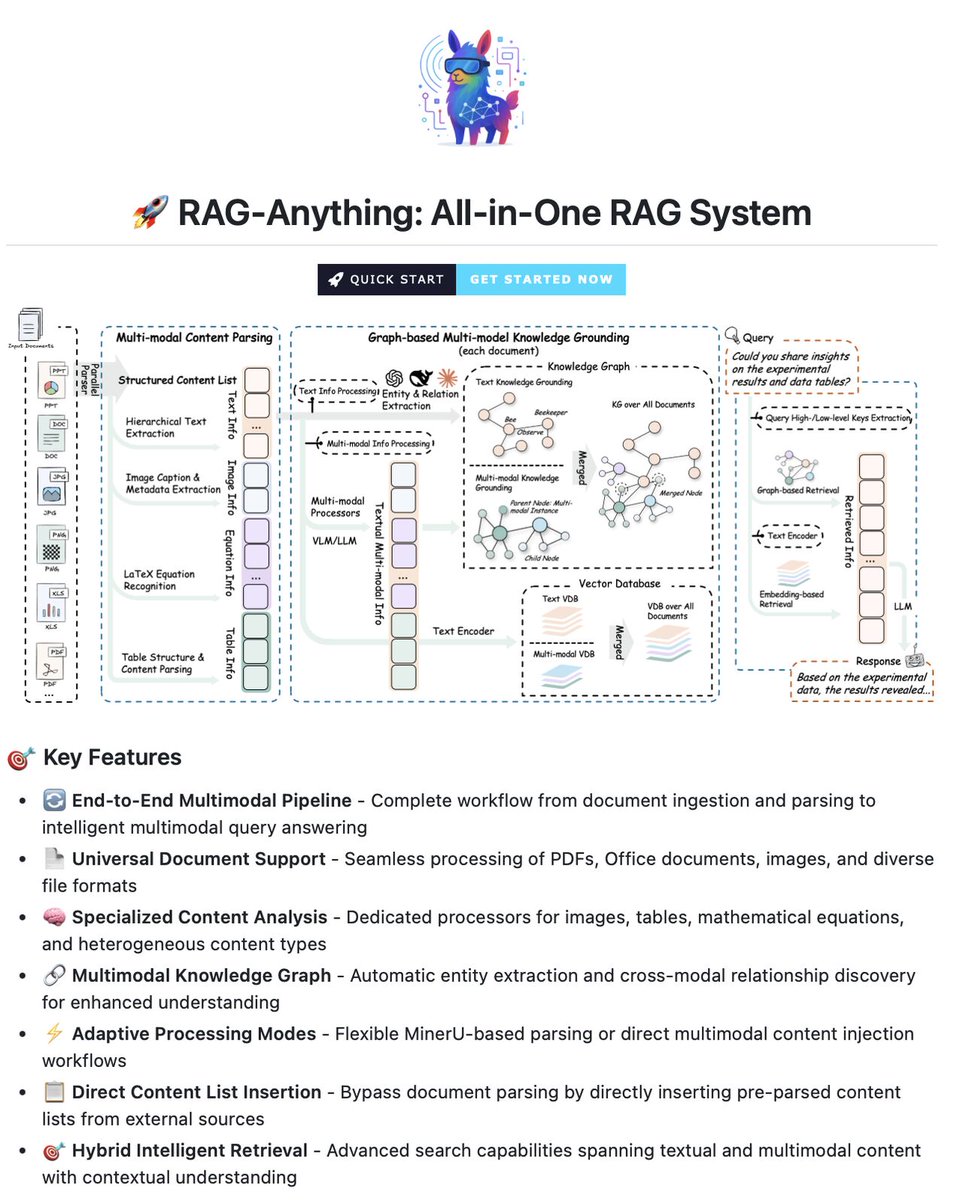
All-in-One RAG System!
RAG-Anything is a unified framework with a multi-stage multimodal pipeline that extends traditional RAG architectures.
It seamlessly handles diverse content through intelligent orchestration and cross-modal understanding.
Unlike conventional RAG systems that struggle with non-textual elements, RAG-Anything delivers end-to-end multimodal processing and retrieval in one integrated framework.
Key Features:
🔄 End-to-End Multimodal Pipeline – From document ingestion and parsing to intelligent multimodal query answering
📄 Universal Document Support – Process PDFs, Office docs, images, and diverse file formats
🧠 Specialized Content Analysis – Handle images, tables, equations, and heterogeneous content with dedicated processors
🔗 Multimodal Knowledge Graph – Extract entities and discover cross-modal relationships for deeper insights
⚡ Adaptive Processing Modes – Choose MinerU-based parsing or direct multimodal content injection
📋 Direct Content List Insertion – Insert pre-parsed content lists without document parsing
🎯 Hybrid Intelligent Retrieval – Search across text and multimodal content with contextual understanding
It’s 100% Open Source.
Link to the GitHub repo in the comments!
RAG vs. Graph RAG, explained visually!
RAG has many issues.
For instance, imagine you want to summarize a biography, and each chapter of the document covers a specific accomplishment of a person (P).
This is difficult with naive RAG since it only retrieves the top-k relevant chunks, but this task needs the full context.
Graph RAG solves this.
The following visual depicts how it differs from naive RAG.
The core idea is to:
- Create a graph (entities & relationships) from documents.
- Traverse the graph during retrieval to fetch context.
- Pass the context to the LLM to get a response.
Let's see how Graph RAG solves the above problem.
First, a system (typically an LLM) will create a graph from documents.
This graph will have a subgraph for the person (P) where each accomplishment is one hop away from the entity node of P.
During summarization, the system can do a graph traversal to fetch all the relevant context related to P's accomplishments.
The entire context will help the LLM produce a complete answer, while naive RAG won't.
Graph RAG systems are also better than naive RAG systems because LLMs are inherently adept at reasoning with structured data.
👉 Over to you: Have you used Graph RAG in production?