Chatbots like ChatGPT can be jailbroken to output harmful text. But what about robots? Can AI-controlled robots be jailbroken to perform harmful actions in the real world?
Our new paper finds that jailbreaking AI-controlled robots isn't just possible.
It's alarmingly easy. 🧵
If a smart model were attempting to deceive or sabotage us, we might not be able to tell from its actions alone. The main tool we have is reading its chain of thought. This works because transformer models cannot do much serial computation per token, so longer reasoning has to go through a chain of thought in visible text. However, looped transformers expand the serial depth, allowing for more thinking in activation space.
We don’t yet have great techniques for decoding activations (but I’m glad we partnered with Goodfire and NDIF to accelerate this research)!
Looping is one way to increase compute per token, potentially increasing unverbalized capabilities. In one experiment, looping was 1.5-1.9x as compute efficient as a non-looped baseline, so we’d expect to see looping as a plausible design choice as transformers are scaled.
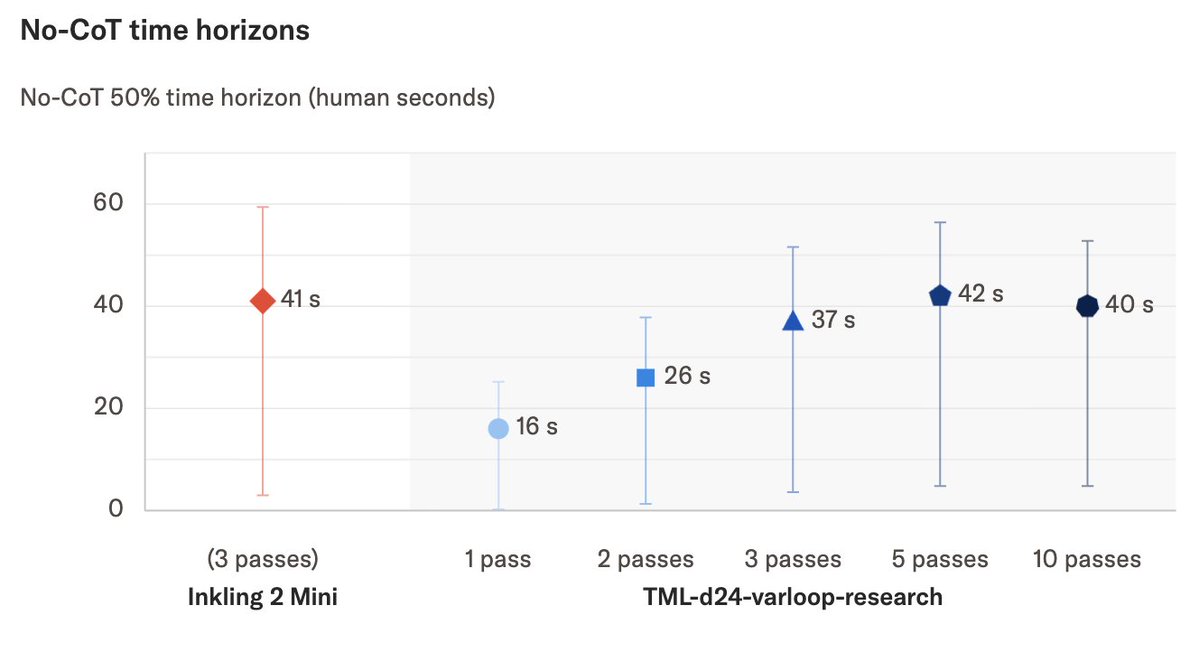
Given these implications, we spent time before the release studying how monitorability changes with looping. At Inkling 2 Mini’s scale, we found that the no-CoT time horizon increases with more looped passes, but we saw no meaningful degradation in monitorability. That may or may not hold at larger scale.
I’m proud that we prioritized safety research in this release, and that we released a non-production variable-loop model to study looping in a more controlled setting. Rather than speculating, let’s get to work on studying this architecture in the open!
mini model is out.
27B looping MoE, 3B active.
fits on a 32GB memory machine.
Been running this on my DGX Spark, Mac Mini.
Evals are roughly as good as Qwen 3.8 27B.
On my DGX Spark, got it to run roughly at 75 tok/s decode so far (my agents are actively trying to make it go faster).
Hopefully r/localLlama will be more happy now ;-)
24 layers, middle 12 looped 3x, pruned to 26B total / 5.4B active, natively in NVFP4 🚀
that's Inkling 2 Mini: a small point on our scaling ladder 🪜 logit-distilled from a big one. small enough to run on your own device, strong enough for agentic work
open weights!
Looped models are weird. A layer can write to itself or read from "future" layers.
@thinkymachines gave us early access to Inkling 2 Mini so we could study its inner mechanisms. We uncover how it coordinates information flow across layers, blocks, and loops.
Studying Inkling 2 Mini gave us cause for optimism: as transformers continue to evolve, we believe our ability to understand their internal mechanisms can evolve with them.
Read the full post: https://t.co/kySDhcDFC2
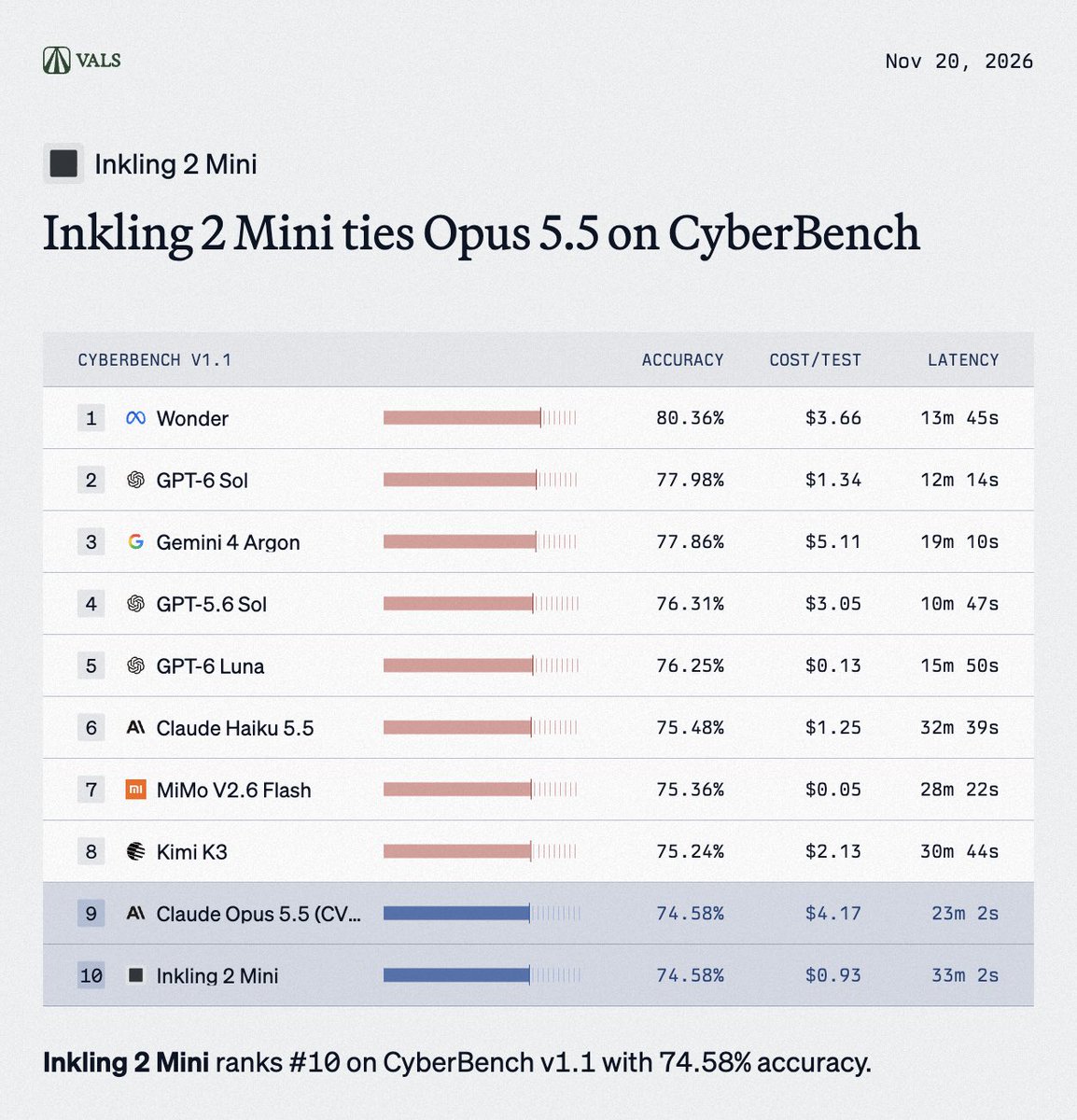
Thinking Machines’ Inkling 2 Mini is small enough to run on a Mac laptop, and it ties Claude Opus 5.5 (CVP) on CyberBench at less than a quarter of the cost.
Besides Inkling 2 Mini (aka Loopling), we also share a variable-looped model, TML-d24-varloop-research, because Inkling 2 Mini only supports a fixed number of looping passes.
https://t.co/GS80nza2os
Studying the variable-loop model, we saw that performances on long-context benchmarks improve with more passes, such as GraphWalks BFS and MRCR v2; but knowledge-intensive benchmarks doesn’t improve with more passes, such as AA-Omniscience, SimpleQA Verified, SimpleVQA, and WorldVQA.
We shipped Inkling 1.0 on July 15, 2026. Now Inkling 2 Mini outperforms it in almost every way at just 2.7% of the size. That’s how we iterate at Thinky :bufo-ship:
Enjoy Inkling in your pocket!
Inkling 2 Mini is a looped transformer that runs on a laptop.
Looping lets a model think more and write less. At this scale, its thought process remains monitorable; this may not stay the case. We’re also sharing a variable-loop research model to enable further study.
Some of you thought that Inkling 2 Small was too big at 594B parameters. We heard you: Inkling 2 Mini is a looped transformer with just 26B parameters, small enough to run on your laptop, powerful enough for agentic work with a score of 20.1 on AA Index.
https://t.co/9HzaUMwghb
Today we’re releasing Inkling 2 Mini, a looped transformer, with open weights.
A big reason we're doing this is to let the AI safety community study looping, especially how loops affect chain-of-thought monitorability and how to interpret the computation inside loops. 🧵
Some of you thought that Inkling 2 Small was too big at 594B parameters. We heard you: Inkling 2 Mini is a looped transformer with just 26B parameters, small enough to run on your laptop, powerful enough for agentic work with a score of 20.1 on AA Index.
https://t.co/9HzaUMwghb
At this scale, we found that:
- looping does let the model do more without writing anything down
- its CoTs got shorter but not less legible
- our models’ ability to carry out sabotage-style tasks undetected didn’t meaningfully improve as we added loops