Head of Patient Safety and Risk Management at @nhsuhcw. Supporting the development of a robust patient safety culture with AI at the heart. All views my own.
Standing with and for all the teams who work in ED around the world today on World EM Day. We are so grateful every single member of works in our ED. Unfortunately, they face increasing threats due to escalating incidents of violence and aggression.
#EmergencyMedicineDay
There’s a reason why all great teams have a great culture. It’s because leaders focus their culture on the living…breathing essence of what the team believes, their heart and soul values,and how they treat each other each day. 💯
#LeadershipMatters#Entrepreneurship#Culture #Teams
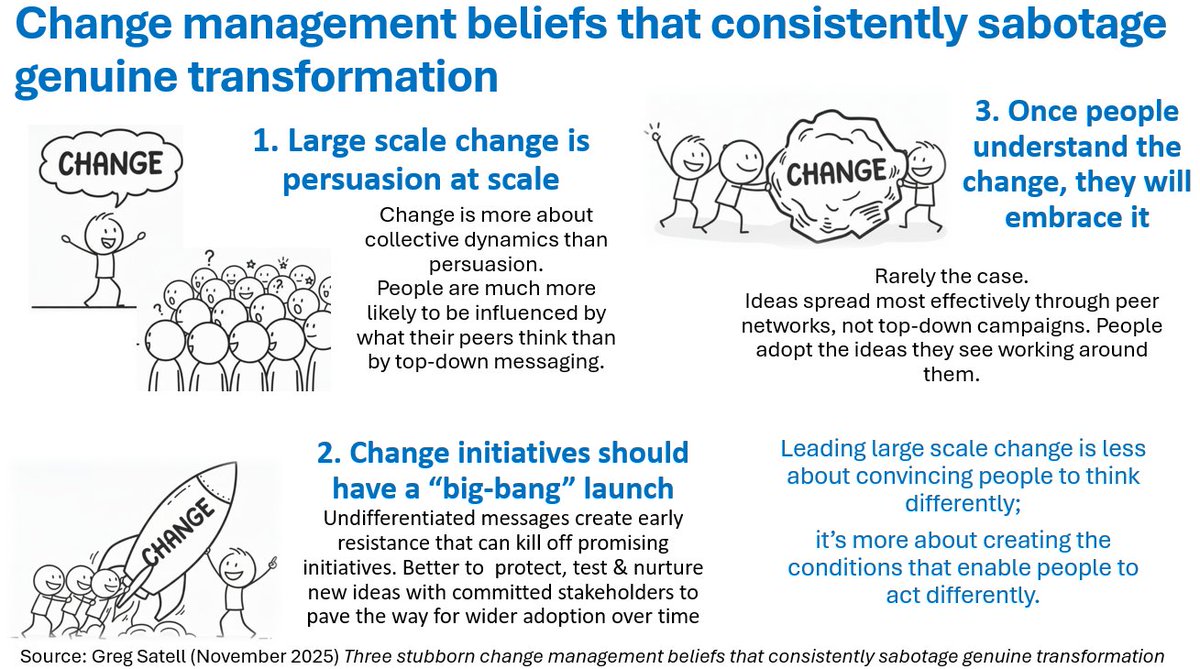
Our beliefs & assumptions about change are often the biggest barrier to leading & enabling effective change.
@DigitalTonto describes “change management beliefs that consistently sabotage genuine transformation”.
The first such belief is that large scale change is persuasion at scale; the idea that we can change opinion across an organisation by communicating a compelling case. However, change is much more about collective dynamics than about persuasion. People are more likely to be influenced by what their peers think than by top-down messaging. If we want change to spread, we need to help activate peer networks.
The second belief is that a large scale change initiative should have a “big bang” launch. The aim is to create widespread awareness that the change is happening & drive the message home. The problem is that undifferentiated messages create early resistance that can kill off promising initiatives. Much better to protect, test & nurture new ideas with committed stakeholders to pave the way for wider adoption over time, rather than trying to convince everyone at once.
The third belief is that once people understand the change, they will embrace it. The issue is that people are typically navigating many competing influences—prior beliefs, habits, social pressures & noise from many directions. That’s why ideas spread most effectively through peer networks, not top-down campaigns. People adopt the ideas they see working around them.
What might work better?
1. Deliberately starting where there’s already energy & enthusiasm & building out from a local majority (eg., three allies in a room of five) instead of trying to convert everyone first
2. Intentionally working through & connecting peer networks so people are influencing “others like us”, rather than relying on one-to-many broadcasts
3. Creating early proof through local majorities that “people like us are already doing this,” tapping into social proof rather than abstract persuasion techniques.
4. Expecting that some people will resist change & take steps to work with it, rather than assuming that better messaging will win “resistors” over
5. Focusing less on increasing information and more on enabling people to see others like them succeeding with the new behaviours, so they can appropriate and adapt the change as their own.
Leading large scale change is less about convincing people to think differently; it’s more about creating the conditions that enable people to act differently.
https://t.co/EWYFYVfxcO
Let’s talk about “emergence” in organisational change initiatives.
Emergence is when new ways of working & new forms of order grow out of the interactions of people, practices & structures, rather than through implementation of a fixed, top-down change plan. Top‑down, programme‑driven approaches assumes change is predictable & that leaders can design the route in advance. Research on emergent change shows our change environments are complex, fluid & cannot be fully understood or controlled in advance.
It’s not surprising that, in many situations, top down approaches on their own are failing to deliver the outcomes we need. Emergent approaches (which blend strategic intent & accountability with high local autonomy on how to move things toward) are clearly the way to go. Yet organisational leaders are reluctant to adopt them. Why?
· The wider accountability & governance systems we operate in expects linear plans, business cases & RAG reports, so leaders worry that explicitly adopting emergent approaches will be seen as vague, indecisive, or not having “management grip” of the change, even in obviously complex environments.
· Under high levels of scrutiny & pressure, leaders may worry that inviting more emergent, adaptive ways of working will look like ‘losing control’ & create chaos, especially in cultures where it still feels unsafe for leaders to name fear, uncertainty, or not having all the answers.
· Most leadership development does not include practices for emergence such as inquiry‑based facilitation, safe‑to‑fail experimentation, joint sense‑making & adaptive framing, so “emergence” is often heard as “no plan”.
We can build emergence into our daily leadership practice by adding new ways of working around experimentation, learning & distributed leadership, without losing focus on accountability & delivery:
1) Take a “tight-loose-tight” approach: tight on strategic intent, loose on multiple local routes & experiments towards it & tight on accountability for results
2) Introduce safe‑to‑fail experiments: many small, parallel interventions around key priorities that enable learning & can fail without harm
3) Make experimentation routine: require major programmes to allocate a proportion of budget & capacity to designed experiments before any big‑bang roll‑out
4) Measure improvement in adaptability & collaboration - not just results: add measures for experimentation, collaboration & responsiveness (e.g., number of safe‑to‑fail tests, time from idea to first trial, cross‑team initiatives started) alongside traditional KPIs
5) Build the likelihood of emergence into the business case process: add “learning system design” to the template - how data, stories & signals will be gathered, discussed & used to pivot or stop; align incentives, risk & culture so people are rewarded for stopping or redirecting initiatives when evidence changes, not just for delivering the original plan
6) Institutionalise collective sense‑making: forums across the system where data, stories & experiment results are interpreted together, & next moves are agreed adaptively.
7) Replace blame or failure language with forward‑looking learning language (“what did we discover?”), especially in reviews & governance meetings
8) Develop leadership capabilities for emergence: build skills in inquiry, facilitation, “holding space”, & working with uncertainty, not just project & programme management & “technical” improvement methods.
A favourite “classic” article on leading for emergence by Gervase Bushe & Robert J Marshak: https://t.co/oJRDnjatUZ.
Graphic by Joss Colchester of @Sys_innovation: https://t.co/5YKqM5HdrL
As leaders of change & learning, we should seek out & welcome feedback continuously as it gives us an opportunity to improve. At the same time, we should try not to “over-focus” on negative comments or criticism, rather than positive comments.
There have been many occasions where I’ve led a learning session & got overwhelmingly positive feedback yet I have zoomed in & stewed over the one or two negative comments, ignoring the majority of encouraging feedback. This is a normal human response. It’s called “negativity bias.” It means that negative feedback, criticism, or potential threats trigger a stronger emotional reaction in our brains than positive feedback does.
For change leaders, negative comments (even in a situation of overwhelming positive feedback) may slow down us or make us reverse course on important initiatives—not because of data, but because of how heavily that concern weighs on our minds. Negativity bias can undermine our confidence, make us more risk-averse, stifle innovation & affect engagement, even when there is strong overall support for the change. It can fundamentally undermine the optimism, confidence & forward momentum that successful organisational or system change needs. Negativity bias is something that even the most experienced change leaders have to consciously manage.
Five ways to mitigate the risk of negativity bias:
1) Name & acknowledge the bias: Even recognising when negativity bias is influencing our thinking can reduce its power over our decision-making.
2) Lean into feedback: don’t treat the possibility of negativity as a reason not to get feedback. Build evaluation into every encounter; always hold a “retrospective”/after action review of every project or significant event.
3) Use negative comments as data points for learning but place them in a broader context. Use systematic approaches such as a pros & cons list or scenario analysis to evaluate both the risks & rewards of a given decision.
4) Build a learning culture where mistakes are seen as chances to learn, not reasons to blame. Knowing it's safe to experiment & fail makes us more willing to innovate & take creative risks, alongside the majority of positive responses.
5) Appreciate that “resilience” is a team activity: understanding that negative comments can have a profound personal impact. Always discuss feedback with others who have our back & can help us maintain perspective & keep going with the change.
See, eg: https://t.co/FUNIuUOTiJ by Bryce Hoffman & https://t.co/5mb0eU6ZRp by Philip Woods.
Graphic adapted from one by @OzolinsJanis which inspired me to write this post.
@ElizaH64344 Just listened to it, not a big horror fan but found it really interesting and looking forward to the next one. Always end on bad jokes, that’s a great way to end your podcast
“Leverage points” is an important principle in implementing change. By identifying the leverage points within a system where small changes can have a large impact, change leaders can target those points & make changes that can have a cascading effect throughout the entire system.
The classic approach to leverage points is the work of Donella Meadows (1997) who identifies 12 potential leverage points (“places to intervene”) in a system. Very often, we intervene by redesigning the structures or changing the practices, when the greatest leverage for change comes from thinking differently - our assumptions & mindsets.
What frequently happens is that change leaders love the idea of leverage points but find Meadows’s descriptors hard to work with in practice. This article by @ryanjamurphy is helpful because it suggests ways to put Meadows’s powerful concept into a more usable framework. So I have created a new graphic for leverage points, based on one of the models the author suggests.
See the Murphy article: https://t.co/ozXtFqx3DW
The “leverage” principles in this graphic taken from @johnvkania et al: https://t.co/k3qj7EUrLS
Donella Meadows on leverage points: https://t.co/SATGUmUI9m
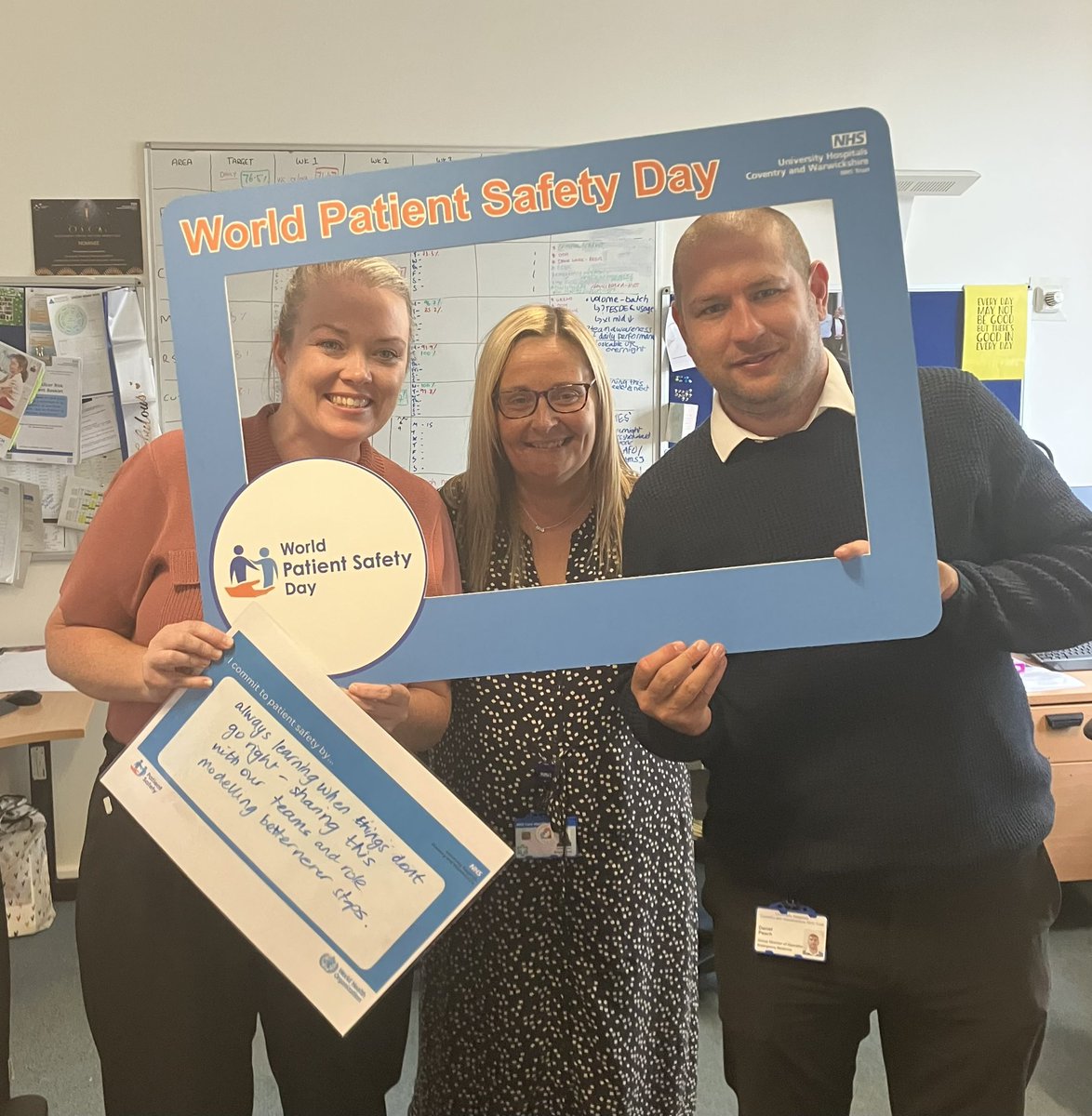
#WorldPatientSafetyDay
HIWM hosted a national visit showcasing regional progress in implementing the Managing Deterioration – PIER and Martha’s Rule Programme.
Hear from Dr Aidan Fowler, National Director for Patient Safety below and read more here: https://t.co/0lqMzhUg2D
@WhoMerchandise To whom it may concern,
There are so many opportunities to continue this line, with those that are lesser known and where there is opportunity to teach stories that are unknown to younger readers.I request that this decision be reviewed and reversed.
Thank you for your time